


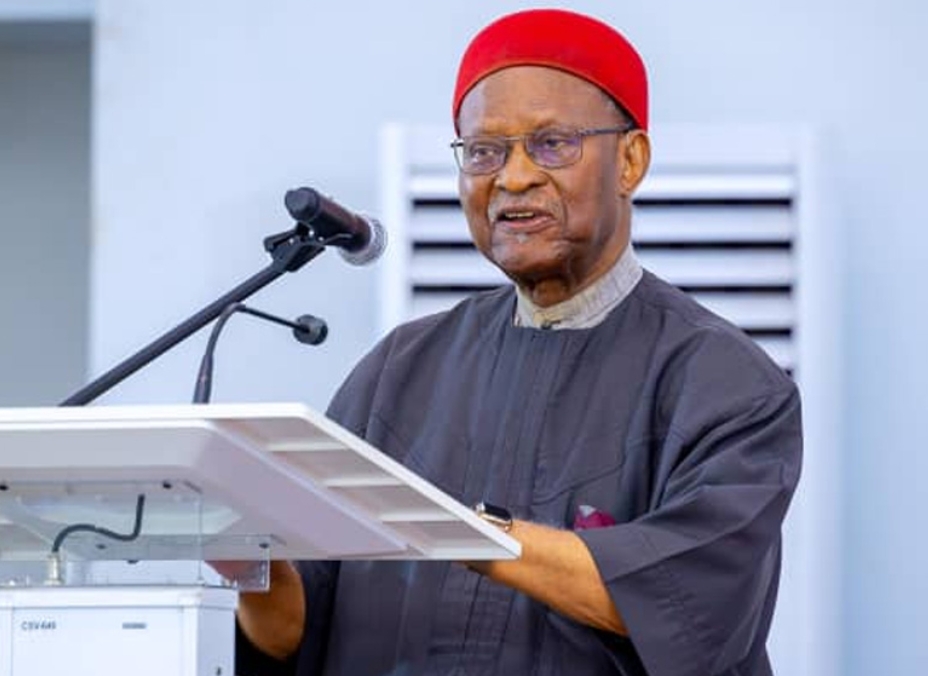

- Anyaoku said the 36-state structure lacks capacity to drive national growth compared to Nigeria’s post-independence development pace.
- He argued that real leadership quality depends on the governance system defined by the nation’s constitution, not personality alone.
The former secretary-general of the Commonwealth, Emeka Anyaoku, has dismissed the 1999 constitution as lacking democratic legitimacy.
Anyaoku made this known at a national summit held in Abuja on Thursday, convened by The Patriots and the Nigerian Political Summit Group.
He said Nigeria’s current constitutional framework does not represent the will of the people and must be replaced through a credible referendum.
According to him, the existing charter was crafted by a military administration and fails to reflect the plural nature of Nigerian society.
“As a background to this summit, it is important to state the following indisputable facts, recognised by all citizens—except, of course, those who choose to remain in denial,” he said.
“Nigeria is a pluralistic country. Like all successful pluralistic countries around the world, for its political stability and maximal development, its constitution must address its pluralism by being formulated by elected representatives of its diverse peoples.
“Our present 1999 constitution (as amended) is not one. It was not democratically formulated. Instead, it was imposed on the country through a decree by the military administration.
“And the governance system derived from it is not only non-inclusive but also results in the over-expenditure of the country’s resources on administration rather than on capital development. Hence, the need for a new Nigerian people’s democratic constitution.”
The elder statesman argued that the current charter contributes to economic inefficiency, insecurity, and political discontent across the country.
He maintained that a constitution imposed without public participation could not foster unity or promote effective governance in a diverse society.
Anyaoku linked several of Nigeria’s challenges—including poverty, weak infrastructure, and youth despair—to the deficiencies of the constitution.
He insisted that restructuring into a genuinely federal system was key to unlocking national development and restoring citizen confidence.
“Overall, the present 36 federating units are obviously incapable of generating and sustaining the pace of national development achieved in the early years of the country’s independence,” he said.
“To those who say that the fate of a country depends primarily on its leadership, I say that the constitution, from which the system of governance is derived, largely determines the character of the people who get elected or appointed to govern the country through the three arms of government.”
Anyaoku noted that the summit would offer a roadmap for drafting a fresh constitution and recommend core features for inclusion.
He said the new legal framework should address key national concerns, including leadership rotation, system of government, and the legislative structure.
The former diplomat insisted that legitimacy must come from the people through a direct vote, not from an unelected regime.
“In considering the process of actualising the new constitution, I hope that there would be due emphasis on ensuring that it is formulated by representatives specifically elected for that purpose by the Nigerian people,” he said.
“And after it has formulated the new constitution, it should be submitted to the people of Nigeria in a national referendum.
“And it is the endorsement of the new constitution in a national referendum that will confer legitimacy on it, unlike the 1999 constitution, which lacks legitimacy because it was not drafted by representatives of the people, nor was it endorsed by the Nigerian people.”
Discussion about this post