


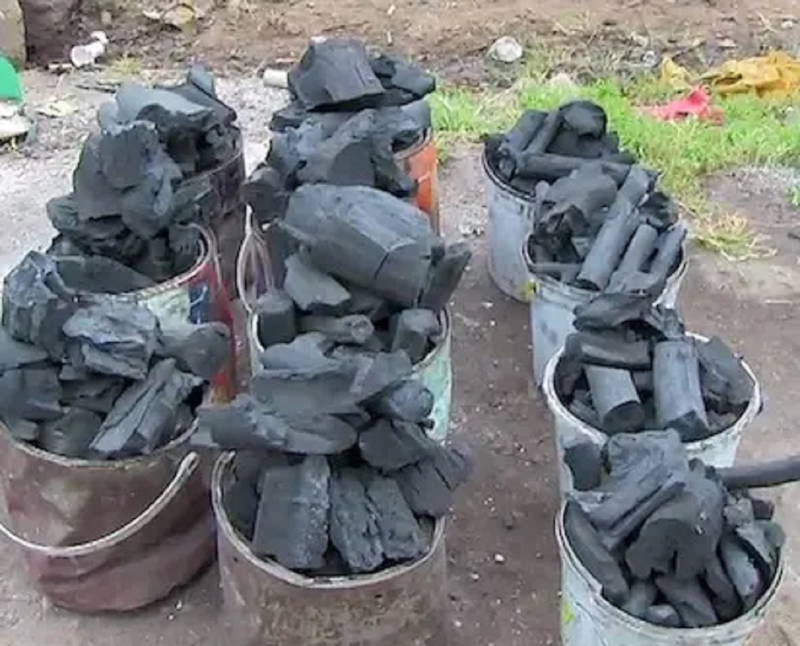

Nigeria’s forest economy holds significant potential, yet charcoal remains absent from the nation’s official economic framework.
The federal government has repeatedly emphasised the need to diversify revenue sources beyond oil, but charcoal continues to exist in the shadows of policy.
Charcoal production is widespread across rural communities, serving as both a source of income and a vital energy supply for millions of households.
Despite its scale, the industry operates informally, with little monitoring, weak documentation, and no formal recognition as a tradable commodity.
This gap means that producers and traders work outside structured markets, leaving the government unable to collect meaningful revenue from exports.
In 2023, Nigeria exported just 443 tonnes of charcoal, valued at around $119,000, according to trade data.
By comparison, Namibia, with a population of barely three million, exported over 270,000 tonnes worth $80.5 million in the same period.
This contrast highlights the lack of regulation and policy support that has left Nigeria trailing behind smaller economies.
Charcoal is in high demand globally, particularly in the European Union, Asia, and the Middle East, where it is used for heating, cooking, and industrial processes.
Industry projections estimate the global charcoal market could reach $11.4 billion by 2030, yet Nigeria risks losing out due to weak structures.
The country’s export restrictions, introduced through conditional licensing, have slowed growth and created uncertainty for potential investors.
Customs regulations require charcoal shipments to carry multiple layers of approval, creating bottlenecks at ports and discouraging formal trade.
Many traders resort to informal channels to move the product, resulting in unrecorded exports and revenue losses for both the government and local producers.
The absence of clear pricing frameworks means producers often sell at undervalued rates, with middlemen capturing most of the profit.
Over 70 percent of charcoal producers in Nigeria are women and young people, concentrated in the north-central and south-west regions.
For these communities, charcoal is not only fuel but also a livelihood that supports households and provides employment in rural economies.
Yet the informal nature of the trade exposes them to exploitation, poor working conditions, and limited access to wider markets.
The environmental cost is also high, as uncontrolled production accelerates deforestation and contributes to the loss of biodiversity.
Nigeria has already lost more than 90 percent of its original forest cover, according to forestry records, raising concerns about long-term sustainability.
A regulated charcoal sector could incorporate reforestation programmes, sustainability protocols, and modern production methods that reduce forest damage.
Countries such as Namibia have demonstrated that with the right policies, charcoal can be a legitimate, profitable, and environmentally managed export.
Formal recognition of charcoal as a commodity would allow Nigeria to introduce price benchmarks, taxation systems, and export frameworks.
Such measures could generate foreign exchange, boost government revenue, and open access to carbon credit markets.
It would also attract investment in cleaner technologies, including improved kilns that produce higher yields with lower emissions.
The sector’s integration into Nigeria’s broader forest economy could create a pathway to achieving non-oil revenue targets set by policymakers.
Failure to act risks leaving the industry in the shadows, where unregulated trade continues to harm both communities and the environment.
A national strategy for charcoal could link production to afforestation projects, ensuring that harvested trees are replaced to maintain ecological balance.
This would support climate commitments while still providing rural communities with stable income opportunities.
Charcoal represents more than just fuel; it is an untapped resource that could strengthen Nigeria’s economy if managed responsibly.
The decision to formalise or neglect it will determine whether the country captures its full value or allows it to remain invisible.
For now, the industry continues to operate at the margins, with enormous potential locked away by policy silence and regulatory gaps.
The challenge for Nigeria is not whether charcoal exists in abundance, but whether it can be transformed into a sustainable and visible part of the economy.
Discussion about this post