


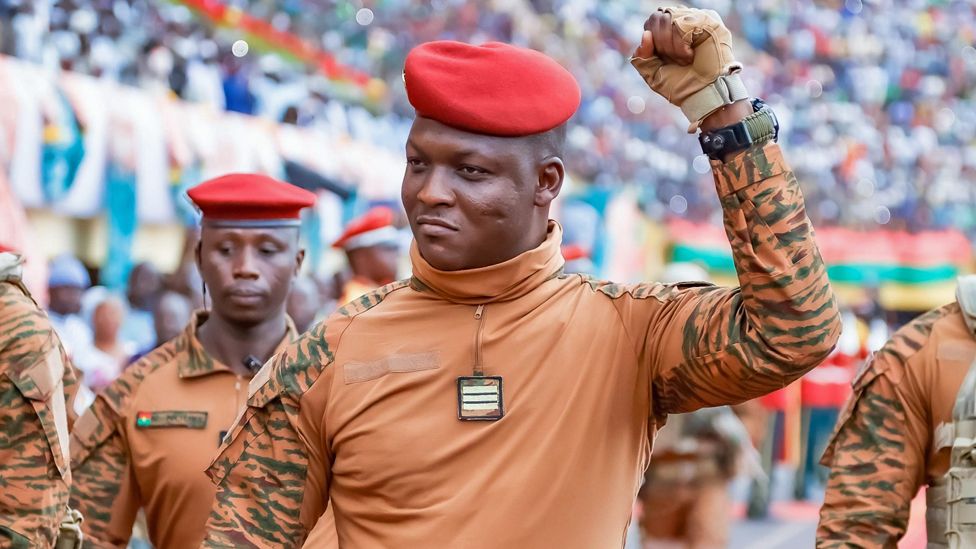

In the waning hours of a humid West African evening, Ouagadougou hums with cautious energy. Motorbikes weave between dimly lit avenues, soldiers’ boots echo against cracked pavement, and whispers of a young leader ripple through the city like the wind before a storm. Lieutenant Colonel Ibrahim Traoré is no ordinary figure. At thirty-four, he carries the weight of history, insurgency, and public expectation on shoulders far too young for such burdens. Yet he walks with the confidence of someone who has seized a moment the world believed was slipping away.
A few hundred kilometers south, Nigeria pulses differently. Here, democracy hums like a stuttering river, promising vitality but moving in fits and starts. Elections unfold on schedule, yet the machinery of governance grinds slowly, slowed by bureaucracy, political rivalry, and the weight of history. Decisions that could save lives, secure territories, or rebuild infrastructure drift, suspended in procedural limbo. Citizens watch, frustrated, as promises stack up like unread letters in a dusty inbox.
This is a story of contrast, of two nations navigating similar storms—insurgency, corruption, and societal pressure—but steering with radically different compasses. One moves swiftly, sometimes dangerously, with the precision of military discipline; the other wades carefully, bound by procedure and the shackles of democratic process.
The journey ahead is not about declaring one superior to the other—it is an exploration of leadership, governance, and the human cost of action versus inaction.
The Young General: Traoré’s Rise in Burkina Faso
Burkina Faso has long been a nation of turbulent political rhythms. From Thomas Sankara’s visionary yet truncated rule to Blaise Compaoré’s decades-long presidency, the country has swung between hope and constraint, revolution and consolidation. Into this fragile equilibrium steps Ibrahim Traoré, a man who embodies both urgency and controversy.
In January 2022, Traoré orchestrated a coup that ousted the transitional government, citing incompetence in confronting the jihadist insurgency gripping northern Burkina Faso. His justification was straightforward: action was overdue, and indecision had cost lives. At just thirty-four, he became Africa’s youngest sitting head of state. His youth, far from being a liability, became a symbol of generational change, a message that stagnation would no longer define Burkina Faso.
Under his leadership, Burkina Faso has adopted an aggressive security strategy. Operations against jihadist groups intensified, curfews were imposed, and local militias were integrated into national defense strategies. While these measures drew criticism from human rights observers for curtailing certain civil liberties, they have also generated a perception of order amid chaos. Citizens who once feared military dominance now cautiously applaud the semblance of stability that has begun to emerge.
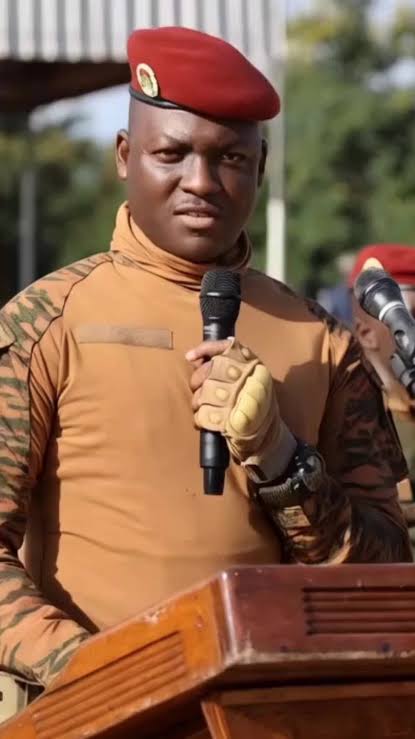
Yet Traoré’s rule is not simply a story of military decisiveness. It is an intricate narrative of public sentiment, regional politics, and historical expectation. Burkina Faso’s citizens are intimately aware of their nation’s history of coups and contested authority. Each move he makes is measured against the specter of past failures and the shadow of Sankara’s unfulfilled promises. In this crucible, Traoré balances on a knife’s edge, striving to deliver results without repeating the mistakes that have long haunted Sahelian governance.
Nigeria’s Political Paralysis: Democracy Stalled
Contrast this with Nigeria, Africa’s most populous nation. Democracy here is a double-edged sword. While it provides mechanisms for representation and accountability, it is simultaneously burdened by systemic corruption, ethnic and religious fragmentation, and procedural inertia. Policy decisions that could address Boko Haram in the northeast, banditry in the northwest, or flooding in the south are often delayed, trapped in cycles of debate, legal challenges, and political grandstanding.
The Nigerian electorate witnesses a political theater where promises abound, yet action rarely aligns with rhetoric. Legislators and executives, though constitutionally empowered, frequently find themselves in deadlocks that prevent meaningful intervention. Citizens feel the consequences in tangible ways: decaying infrastructure, vulnerable communities, and persistent insecurity. Unlike Burkina Faso, where military precision drives immediate, if controversial, outcomes, Nigeria’s democracy struggles under the weight of its own procedures.
This is not to diminish Nigeria’s achievements. The country boasts a vibrant civil society, entrepreneurial energy, and technological innovation unmatched in much of Africa. Yet these strengths are often hampered by political bottlenecks, producing a dissonance between potential and execution. The river of governance, rich in promise, is slowed by sediment: bureaucracy, entrenched interests, and historical grievances.
Contrasting Currents: Action versus Inertia
The divergence between Burkina Faso and Nigeria illustrates a broader truth: leadership style profoundly shapes national trajectory. Traoré’s approach is rapids-like—swift, forceful, and unrelenting. His decisions, often unilateral, create tangible movement, delivering both hope and anxiety in equal measure. Nigeria’s governance resembles a vast delta, broad and full of potential, yet sluggish. Decisions meander through committees, courts, and partisan negotiation, delaying resolution even in urgent crises.
Citizens’ perceptions reflect these realities. In Burkina Faso, despite the authoritarian undertones, many express cautious optimism that decisive action can restore order. In Nigeria, the democratic promise feels distant, leaving citizens oscillating between frustration and resignation. The contrast is stark: one nation moves like a storm across the Sahel, the other drifts like a slow-moving tide along the Gulf of Guinea.
Historical Echoes and Regional Implications
To understand these dynamics, one must consider history. Burkina Faso has been scarred by a series of violent transitions, from Sankara’s assassination in 1987 to repeated coups in the decades since. Military intervention has often been framed as both a symptom and a solution: a reflection of popular frustration, and a response to governance failure. Traoré’s rise fits this pattern, yet diverges in its youth and boldness, signaling both generational and strategic shifts in leadership culture.
Nigeria’s post-colonial history shares similarities—decades of military rule punctuated by periods of civilian governance—but the stakes differ due to population size, diversity, and economic complexity. Democratic processes are intended to safeguard representation, yet the sheer scale of Nigeria makes timely, effective governance difficult. Insecurity, corruption, and bureaucratic inertia compound, producing a form of paralysis that undermines public confidence.
The contrast offers both warning and insight. Burkina Faso’s rapid, militarized governance may achieve short-term gains but risks overreach, potential human rights violations, and eventual backlash. Nigeria’s democratic system, while protective in theory, risks irrelevance if it cannot adapt to urgent challenges. Both illustrate the delicate balance African nations face between stability, liberty, and efficacy.
Citizens in the Crossfire: Human Stories of Governance
Behind statistics and policy analyses are human lives. In Ouagadougou, small business owners speak quietly of safer streets under Traoré’s rule. Farmers in the north describe mixed experiences: some report more security patrols, others fear arbitrary detentions. The young general’s decisions reverberate in markets, schools, and neighborhoods—creating both relief and tension.
In Nigeria, families in flood-prone areas watch rainy seasons with dread, knowing emergency responses may be delayed. Insecurity in the northwest leaves villages vulnerable, while cities contend with crumbling infrastructure. Citizens navigate a complex interplay of hope, cynicism, and patience—living daily with the consequences of systemic paralysis. The human stakes of leadership are immediate and visceral, a reminder that governance is not abstract but deeply personal.
Policy and Security: Immediate versus Prolonged Action
Traoré’s regime illustrates the speed at which policy can be enacted under a concentrated authority. Security operations are ordered and executed with minimal delay. Yet, these gains are fragile, dependent on continued public tolerance and military cohesion. A misstep could ignite unrest, illustrating the precariousness of concentrated power.
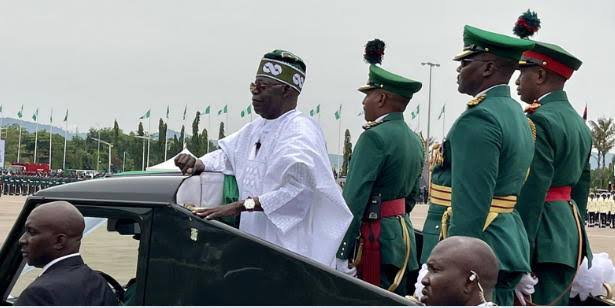
Nigeria, conversely, embodies the strengths and weaknesses of distributed governance. Laws and procedures aim to prevent abuse and encourage representation, yet the same mechanisms can impede urgent action. Security operations, infrastructure projects, and economic interventions often require months of negotiation before execution, leaving citizens exposed to risks that demand immediacy.
The contrast is instructive: decisiveness without accountability risks authoritarian drift; deliberation without momentum risks irrelevance. Both nations grapple with this tension, albeit through divergent strategies.
Regional and Global Perception
Internationally, Traoré’s Burkina Faso is viewed with a mix of admiration and caution. Western observers criticize the coup’s disruption of democratic transition, while regional bodies cautiously welcome renewed stability. His leadership style—youthful, bold, militarized—signals a potential new model for responding to insurgency in the Sahel, yet questions of legitimacy and human rights remain.
Nigeria, by contrast, is often held up as Africa’s democratic benchmark. Yet its paralysis undermines soft power and regional influence. Foreign investors and neighboring states observe with concern the slow pace of reform, corruption, and insecurity. While democracy remains a global ideal, effectiveness increasingly matters in an interconnected world.
Closing Reflection: Rivers Diverging, Lessons for the Future
Burkina Faso and Nigeria, separated by geography but connected by history and challenges, offer a study in contrasts. Traoré’s young generalship embodies the promise and peril of decisive, concentrated power. Nigeria’s sprawling democracy illustrates the promise and pitfalls of representation bound by procedure.
The two nations remind us that governance is a human endeavor—shaped by ambition, history, and societal pressure. Decisions ripple through lives, streets, and markets; leadership style dictates whether those ripples become waves or stagnation. There are no simple prescriptions, only lessons: the need for balance, adaptability, and vigilance in the face of complexity.
As dusk falls over Ouagadougou and Abuja alike, citizens live at the intersection of hope and anxiety, action and inaction. Africa’s story is not only written by leaders but by the responses they provoke. In the contrast between Traoré’s rapid currents and Nigeria’s measured tides lies a profound reflection on governance itself: the eternal tension between the speed of action and the weight of democracy.
Discussion about this post