


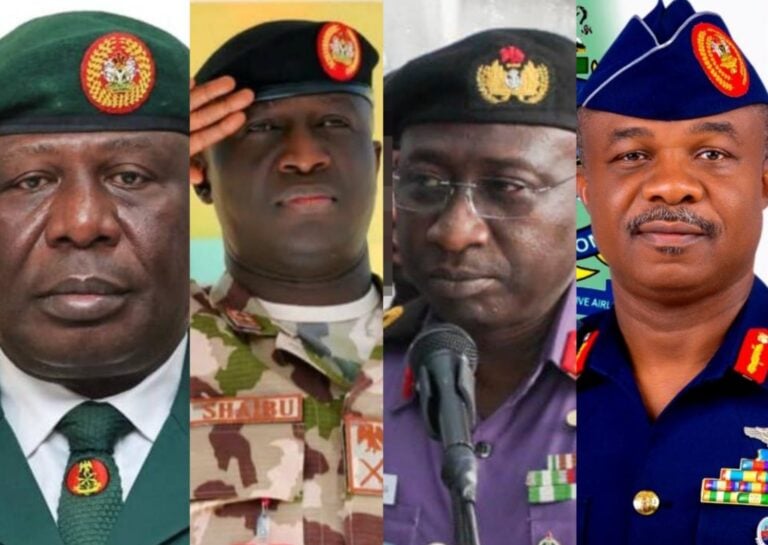

On Friday, President Bola Tinubu announced a shake-up in the military hierarchy. The move led to changes that resulted in the termination of the appointments of service chiefs, marking President Bola Tinubu’s first deliberate and comprehensive reshuffling of his security team.
Before yesterday’s shake-up in the military echelon, the only change to the armed forces came after the death of Taoreed Lagbaja, former chief of army staff, last year.
The latest rejigging came barely a week after an online media outlet published a report of a botched coup. According to the report, at least sixteen military officers have been arrested in connection with the coup plot. The report also claimed that the alleged coup led to the cancellation of the annual Independence Day parade on October 1.
The presidency has since denied claims that the shake-up is connected to the alleged coup attempt.
Reacting to the speculation, the Senior Special Assistant to the President on Media and Publicity, Tope Ajayi, disclosed that the move followed two years of sustained operations under the previous chiefs, adding that the decision to relieve the security chiefs of their duty has nothing to do with the purported coup.
He noted that the move showed the President’s desire “to inject new direction, vision, vigour and energy” into the military.
“This is not a reaction to any rumour of coups. He is exercising his powers. The service chiefs have done two years,” Punch quoted him as saying.
“We are fighting security issues — Boko Haram in the North-East, banditry in the North-West, IPOB and ESN in the South-East, kidnapping in the South-West, and other crises in the North-Central,” he added.
On his part, the Special Adviser to the President on Information and Strategy, Bayo Onanuga, stated that Tinubu exercised the power vested in him by the constitution which allows him to make leadership changes in the military.
“Service chiefs can be hired and fired by the President. He is the Commander-in-Chief. He has the power to hire and fire,” Onanuga said.
The latest shake-up, according to a statement by Sunday Dare, special adviser to the president on public communication, is aimed at “strengthening the national security architecture”
It added, “The new Chief of Army Staff is Major-General W. Shaibu; Air Vice Marshall S.K. Aneke is Chief of Air Staff; while Rear Admiral I. Abbas is the new Chief of Naval Staff. Chief of Defence Intelligence, Major-General E.A.P. Undiendeye, retains his position.”
Olufemi Oluyede, the lieutenant general who previously served as the chief of army staff (COAS) replaced Christopher Musa was relieved of his role as the chief of defence staff (CDS),
Waidi Shaibu, a major general, will take over from Oluyede. Sunday Aneke, an air vice marshal, took over as air chief, while Idi Abbas, a rear admiral, became the new naval chief.
Below are short biographies of the newly deployed service chiefs:
CDS: OLUFEMI OLUYEDE — A FRESH CHALLENGE FOR A HARDCORE MILITARY MAN
Oluyede was born in Ikere-Ekiti, Ekiti State, on June 21, 1968. He attended primary and secondary school there.
His military career started in 1987 when he joined the army as a member of the 39th regular course. He was commissioned as a second lieutenant in 1992. He rose through the ranks and became a major general in September 2020.
He has been involved in several military operations inside and outside Nigeria. He was part of the Economic Community of West African States Monitoring Group (ECOMOG) mission in Liberia, Operation Harmony IV in Bakassi, and Operation Hadin Kai in the north-east theatre of operations.
Oluyede was also the commander of the 27th Task Force Brigade. He succeeded the late Lagbaja, who died after battling an undisclosed illness, as COAS in November 2024. Oluyede was promoted to a lieutenant-general by Tinubu shortly after his resumption as COAS in 2024.
ARMY: WAIDI SHAIBU — A GALLANT SOLDIER AND SCHOLAR
Shaibu is an indigene of Kogi State. He was born on December 18, 1971, in Olamaboro LGA of the Middle Belt State. He joined the Nigerian Defence Academy as a member of the 41 regular course in 1989 and was commissioned on September 17, 1994, as a second lieutenant.
He has impeccable and excellent academic accomplishments. He has a bachelor’s degree in mechanical engineering, a master’s in public administration from the University of Calabar, a master’s in strategic studies from the University of Ibadan, and another master’s in security and strategic studies from the National Defence University, Washington DC, United States.
He takes over from Oluyede as the new COAS. Before his latest appointment, he had served as the theatre commander of Operation Hadin Kai in the north-east. Shaibu ensured the upgrade of vital military hardware that guaranteed troops’ smooth kinetic operations.
Under his watch, troops launched the deep clearance of the Sambisa forest, believed to be the impenetrable hideout of insurgents wreaking havoc in the Borno area. Troops also reportedly neutralised 567 terrorists and recovered 492 assorted weapons, over 10,714 rounds of ammunition, and numerous high-value items, including general-purpose machine guns, rifles, and various explosives.
IDI ABBAS, NAVY: THE ANTI-OIL THEFT CZAR
Abbas is from Kano State. He was born on September 20, 1969. He was commissioned as a midshipman on September 18, 1992, as a member of the 40 regular course. He attained the rank of rear admiral on September 10, 2020.
He was a former flag officer commanding (FOC) of the central naval command in Bayelsa, where he spearheaded anti-crude oil theft military campaigns and maritime patrols around the Niger Delta.
Abbas also served as chief of naval safety and standards in 2023. He recently served at the Nigerian Army Heritage and Future Centre. Abbas steps in as the new chief of naval staff, replacing Emmanuel Ogalla
SUNDAY ANEKE, AIR FORCE: A PHYSICIST TURNED AIRMAN
Aneke was born in Makurdi, Benue State on February 20, 1972, in Makurdi, Benue state. Sylvester, his father and a former air warrant officer, hailed from Udi LGA of Enugu. His military career began on September 10, 1988, and he was commissioned as a pilot officer into the Nigerian Air Force (NAF) on September 10, 1993.
He holds a BSc in physics, PGD in management, a master’s in international affairs and diplomacy, a master’s in political economy and development studies, and a master’s in strategic studies from the US Air War College, Montgomery, Alabama.
Aneke has military training in aeromechanical engineering, as well as ab-initio flying training and basic flying training. With his extensive training, he has logged over 4,359 flying hours while flying aircraft models such as Air Beetle 18, Dornier 228, Falcon 900, Gulfstream V, Gulfstream 550, and Hawker 4000. He holds an Advanced Transport Pilot Licence (ATPL).
Aneke was the deputy commandant of the Nigerian Defence Academy before his latest appointment. He had previously served with the United Nations Mission in Congo (MONUC).
Discussion about this post