




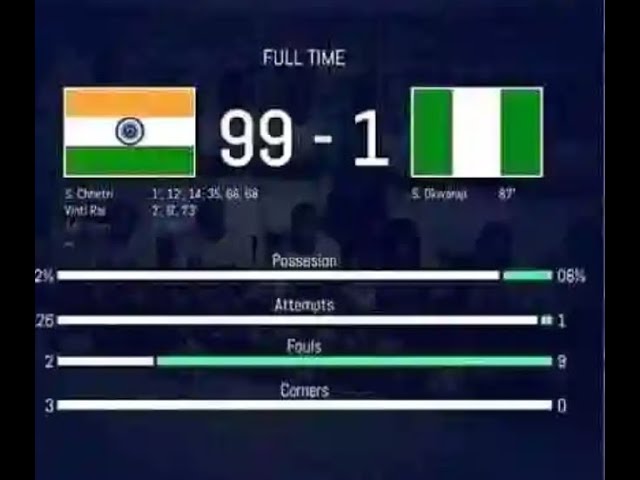
There are stories in sport that linger not because they happened, but because they could have. They linger in the corners of memory, whispered in markets, replayed in the minds of young fans, and stretched like elastic across decades. One such story haunts Nigerian football culture—a match between India and Nigeria, where the scoreboard allegedly read 99 to 1. A number so implausible it forces laughter, disbelief, and sometimes, embarrassment.
No stadium, no official record, no photograph; just a story that has traveled across generations, morphing with each retelling. A myth, yes—but a myth that feels like it might carry truths beneath its layers. Some say it speaks to Nigeria’s own anxieties about global football standing, others see it as a narrative of human vulnerability, where one underprepared side is overwhelmed by forces beyond comprehension.
This story, like all enduring myths, exists on the edge of fact and fiction, demanding a deep dive into what football means for nations, pride, and identity.
The Birth of a Myth
The early 1980s in Nigeria were years of football optimism shadowed by insecurity. Nigerian clubs were beginning to make small dents in continental competitions, but the national team struggled to make consistent marks on the global stage. Meanwhile, India’s football scene, often overlooked internationally, had moments of regional promise, particularly in South Asia.
Somewhere between memory and imagination, a narrative arose. It was told in hushed tones by vendors in Lagos markets, recounted at social gatherings in Enugu, and whispered in boarding schools where young boys learned the rhythm of the game. The tale described a match that never existed—a match where India, inexplicably, outclassed Nigeria to a degree so extreme that the scoreboard supposedly read 99–1.
Each telling added new elements. The Nigerian players were said to have been confounded, their skills nullified by a combination of misfortune, clever play, and, occasionally, supernatural interference. Some narrators spoke of a ball that seemed almost alive, evading Nigerian feet and guiding itself into the Indian net. Others hinted at a psychological collapse, as if the very notion of facing India had broken the team before the first whistle.
By this point, the story was less about football than it was about perception—how Nigerians viewed themselves in global sport, and how mythology could fill gaps where memory and evidence failed.
Myth Meets Memory
Even those who were teenagers during the supposed match often recall fragments as if they were actual events. “It was a disaster,” one old-timer in Ibadan might say, speaking with a solemnity that suggests a lived truth. “We lost, and not by a little—we lost so badly, no one wanted to talk about it afterward.”
Yet, when pressed for details—dates, stadium names, players—the narrative collapses. No archives hold the record. No football historian can point to a FIFA or CAF fixture listing. And yet, the story persists, sustained by repetition, humor, and the thrill of the absurd.
This is the first lesson of the 99–1 story: myth can be more powerful than reality when it speaks to collective identity. Nigeria, a nation obsessed with football, found in this imaginary scoreline a mirror of fears, hopes, and a subtle critique of its own organizational weaknesses.
The Alleged Match in Detail
According to the most colorful retellings, the match was more spectacle than competition. India allegedly approached the field with a rhythm and precision that defied expectation, moving the ball with mechanical exactitude. Nigerian defenders, bewildered, watched passes that seemed impossible to intercept and shots that arrived with the inevitability of a tide.
One key aspect of the narrative involves a single Nigerian goal. The name of the scorer shifts depending on who tells the story, but that solitary goal is symbolic. It represents the lone flicker of resistance in a narrative otherwise dominated by impossibility. Some recount that the scorer collapsed on the field afterward, overwhelmed by the humiliation and exhaustion, lending the myth a human tragedy component.
The story, however, quickly spirals into exaggeration. Entire halves are described as being wiped off the scoreboard within minutes. Spectators, if they existed at all, are said to have abandoned hope, retreating into the stands or leaving entirely. By the time the whistle would have blown, India had allegedly scored 99 goals, a figure meant to signal absolute domination rather than precise arithmetic.

Modern Reinterpretations and Digital Echoes
Decades after the story first drifted through the crowded streets and schoolyards of Nigeria, the 99–1 myth discovered new life online. Social media platforms became the canvas on which fans painted their imagination: memes exaggerated the scoreline into a running gag, threads dissected the plausibility of every goal, and hashtags carried it across continents. In this digital ecosystem, the story ceased to belong to any single generation; it became a shared spectacle, evolving with each retelling and reflection. The scoreboard no longer mattered—the myth had become a living, breathing phenomenon.
For the younger generation, the story functions as a symbolic lesson rather than a historical fact. It teaches humility, strategy, and mental preparation in a world where appearances often deceive. “Even if it didn’t happen,” one Lagos blogger reflected, “the story reminds us to respect every opponent, to never take the field lightly.” In this sense, the 99–1 scoreline transforms from numerical absurdity into moral allegory, an imaginative echo that shapes how fans understand competition, effort, and human limits.
The myth’s digital reincarnation has also turned it into a playful lens for cultural commentary. Animations, short videos, and fan illustrations often depict the Nigerian team in comical yet heroic struggles against an unstoppable force, emphasizing both humor and perseverance. Even the impossible becomes meaningful: each imagined goal, each over-the-top defensive error, serves as a metaphor for challenges in life and sport alike. The story’s absurdity amplifies its emotional resonance, drawing laughter, awe, and reflection in equal measure.
Interestingly, the myth’s spread online blurs boundaries between reality, imagination, and national identity. International audiences encounter it as curiosity or comic relief, while Nigerian fans treat it as part of a shared cultural memory. In this way, the 99–1 tale evolves into a global narrative about perception, expectation, and the enduring human fascination with improbable outcomes. Its digital afterlife proves that a myth does not require reality to persist—it thrives on imagination, emotion, and participation.
Voices from the Field
The 99–1 story gains its deepest significance when viewed through the voices of those closest to Nigerian football. Former players and coaches, though quick to dismiss its literal occurrence, acknowledge its cultural and emotional power. It functions as a living parable, a story that transcends fact to teach lessons about discipline, respect, and the unpredictable nature of competition. The myth, in their eyes, is less a scoreboard anomaly and more a narrative compass.
Segun Odegbami, a luminary in Nigerian football, has consistently treated the story with humor and reflection. “You hear it and you laugh,” he noted in a 2024 interview. “There was no match like that, but the story sticks because it makes people feel something—fear, pride, or awe. It becomes a part of the folklore that defines our sport.” His perspective highlights the crucial human element: myths endure not because they are true, but because they resonate emotionally.

Coaches often invoke the tale when mentoring young players, emphasizing its metaphorical weight. “I tell my squad about the 99–1,” one trainer explained, “not to scare them, but to instill awareness and focus. Underestimating an opponent can feel like a hundred goals raining down.” Here, the myth functions as a psychological tool, reinforcing mental toughness and humility in ways a literal history lesson could never achieve.
The story also bridges generational gaps. Young athletes imagine themselves on the pitch, confronting an overwhelming adversary, while older fans recall the story as part of their childhood folklore. In these overlapping perspectives, the myth becomes a cultural thread, stitching together imagination, learning, and national identity. Its life exists in the hearts of those who play, watch, and remember—not in match records.
Cultural Resonance and Psychological Weight
The 99–1 myth endures because it captures the interplay between national identity, pride, and the collective psyche. Football in Nigeria is more than a sport; it is a reflection of society, an emotional barometer, and a stage for human drama. The story magnifies fears of inadequacy, the anxiety of global perception, and the thrill of possibility. It externalizes collective tensions in a manner that is at once entertaining and instructive.
Artists, writers, and performers have appropriated the narrative into cartoons, stage plays, and short stories, exploring both its comedic exaggeration and its emotional depth. In every retelling, human responses—confusion, resilience, panic, and fleeting triumph—take center stage. These creative interpretations allow the myth to function as more than a joke; it becomes a canvas for exploring human emotion, cultural norms, and the psyche of a nation.
Psychologically, the tale provides a safe space to explore extremes. The impossibility of 99 goals against one frames the fears of humiliation, failure, and inadequacy in an imaginative context. By exaggerating reality, the story allows reflection on both personal and national resilience, teaching lessons about endurance, humility, and the unpredictable nature of competition.
Yet the myth is not despairing. The solitary Nigerian goal—a moment of resistance amid overwhelming odds—symbolizes defiance and hope. This tiny beacon transforms a narrative of complete defeat into a meditation on human courage. Through this lens, the myth resonates not merely as an improbable scoreline but as a symbolic testament to persistence, pride, and the emotional life of sport.
The Myth as a Mirror
The 99–1 story functions as a cultural and psychological mirror, reflecting the hopes, fears, and identity of Nigerian football across generations. It dramatizes extremes—failure and triumph, humiliation and resilience—allowing society to examine itself through the prism of imagination. The myth magnifies the tension between expectation and reality, creating a symbolic arena in which national pride, collective anxiety, and human vulnerability converge.
At its heart, the narrative celebrates resilience. Though the scoreboard is absurd, the single Nigerian goal glows like a small flame in a storm of defeat, symbolizing defiance, effort, and hope. Even in an imagined catastrophe, human agency asserts itself, offering a metaphorical lesson about persistence in the face of overwhelming odds.
The tale’s endurance lies in its multi-layered resonance: it is simultaneously humor, caution, cultural reflection, and psychological exploration. It allows generations to confront national anxieties creatively, offering both instruction and entertainment. The story’s power is proportional not to its reality but to the emotional truths it evokes, making it a mirror in which Nigerians see themselves, their sport, and their imagination reflected.
Finally, the myth acts as a bridge across time and geography. From neighborhood whispers to global social media threads, it connects generations of players and fans, teaching lessons about preparation, humility, and hope. Its symbolic life surpasses its factual void, proving that a story’s power resides not in verification, but in the hearts and minds it continues to move.
Myth in the Digital Age
With the rise of digital media, the 99–1 story has been archived, reinterpreted, and reshaped in ways unimaginable in its oral infancy. Blogs, social media platforms, and online forums allow collective imagination to remix the myth, adding subtle variations, humor, and emotional weight. Diaspora communities engage with it, creating cross-cultural narratives that layer memory, nostalgia, and identity upon the original story.
Digital reinterpretations also emphasize its universality. International football fans encounter it as an extreme anecdote, stretching credulity yet inviting curiosity. For Nigerians, it is a connective tissue, linking generations and communities through shared laughter, reflection, and pride. The myth becomes a living repository of cultural memory, a story that grows with every interaction and reshaping.
Moreover, the digital age amplifies the myth’s metaphorical value. Animated interpretations, video replays, and fan analyses transform an oral anecdote into a multimedia narrative, turning the scoreline into a symbol of resilience, human error, and the unpredictable theater of sport. Each retelling, each remix, deepens its emotional impact and cements its place in collective consciousness.
Ultimately, the 99–1 myth survives because it resonates on multiple levels: as humor, as cultural reflection, as psychological exploration, and as imaginative storytelling. It is a narrative that has outgrown its origins, becoming a digital-age legend whose reality is less important than its emotional, cultural, and symbolic life. The story reminds us that myth and memory often carry deeper truths than statistics ever could.
Conclusion: Football Myth or Reality?
India’s alleged 99–1 victory over Nigeria may never have graced a scoreboard, yet its presence in the imagination of generations keeps it alive. Whether myth or reality, the story endures because it captures something beyond numbers—a confrontation with pride, expectation, and the impossible.

In the end, the match exists as much in memory, rumor, and cultural reflection as it does in any historical record. Its truth is not measured in goals scored but in the lessons it evokes, the debates it sparks, and the emotional imprint it leaves on fans who have carried it for decades.
So, was it real? Perhaps not. Yet the 99–1 lives in the collective heartbeat of Nigerian football, a symbol of imagination triumphing over evidence, and a story that blurs the line between myth and reality.
Discussion about this post