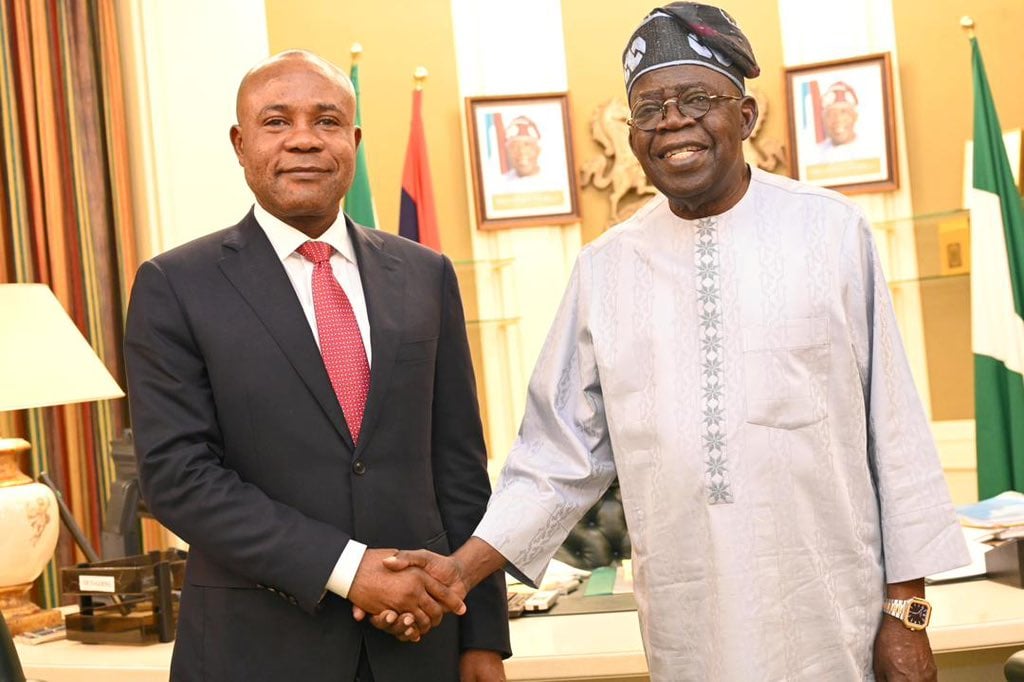
As 2027 approaches, Nigeria’s political scene is again witnessing a wave of movement and realignment. Governors who were once loyal to the Peoples Democratic Party (PDP) are now switching to the ruling All Progressives Congress (APC).
Across the South-South and South-East regions, this quiet shift is changing the country’s political balance and reshaping how power is shared between the ruling and opposition parties.
Defections among politicians are not something new in Nigeria’s politics, but this current pattern carries a different wave because of its timing. Since President Bola Ahmed Tinubu took office in May 2023, several governors and lawmakers from the PDP have joined the APC.
In many states, the defections have reduced the strength of the major opposition party, the Peoples Democratic Party (PDP). This shift is already creating debates about party loyalty and whether Nigeria is slowly moving towards a one-party system.
As more governors switch sides, one question stands out: Are these moves driven by genuine plans for development or by political survival?
Is this the fall of Nigeria’s major opposition party?
The recent wave of defections among PDP governors did not happen suddenly. It grew from long-standing problems within the party that have worsened over time.
The signs of trouble began earlier than many realised. Dave Umahi of Ebonyi defected to the All Progressives Congress (APC) in November 2020, citing marginalisation of the South-East, followed by Ben Ayade of Cross River in May 2021, who said he wanted to align with the federal government, alongside Bello Matawalle of Zamfara.
After losing the 2023 presidential election, the party struggled with weak leadership, internal divisions, and a lack of direction that forced many of its top members to reconsider their loyalty.
The crisis deepened with the rise of the G5 Governors, Nyesom Wike, Seyi Makinde, Samuel Ortom, Okezie Ikpeazu, and Ifeanyi Ugwuanyi. They rebelled after Atiku Abubakar became the PDP’s presidential candidate in 2022, accusing the leadership of ignoring power rotation and refusing to back his campaign, which divided the party and weakened its chances in the 2023 elections.
After the polls, the problems grew worse. Wike accepted an appointment as Minister of the Federal Capital Territory under President Bola Tinubu’s APC government in 2023, confirming suspicions of quiet collaboration and narratives that the APC is a fertile ground for politicians.
By 2025, the defections grew worse.
At least four PDP governors have defected to the ruling APC since Tinubu’s Emergence. Governor Sheriff Oborevwori of Delta State left the PDP for the APC. Delta, a stronghold of the PDP and a state known for its oil wealth and political influence, had been a PDP stronghold since 1999.
Oborevwori’s defection, joined by his predecessor and former governor Ifeanyi Okowa, marked a major political shift. Okowa, who served as the PDP’s vice-presidential candidate in the 2023 elections, explained that aligning Delta with the federal government would open doors for greater development opportunities.
On June 8, 2025, Governor Umo Eno of Akwa Ibom State followed suit. His defection came after months of political tension and speculation.
In his declaration speech, Eno explained that the state’s interest was better served through closer collaboration with the APC-led federal government.
He emphasised that his decision was not about abandoning the PDP but about ensuring that Akwa Ibom continued to benefit from national projects and federal partnerships.
On October 14, 2025, Governor Peter Mbah of Enugu State officially left the Peoples Democratic Party (PDP) to join the All Progressives Congress (APC).
Mbah announced during a stakeholders’ meeting at the Government House in Enugu, explaining that his defection was aimed at fostering closer cooperation with the Federal Government to enhance development across the state.
His defection ended more than two decades of PDP control in Enugu and marked a significant political victory for the APC in the South-East region.
Governor Douye Diri of Bayelsa State formally resigned from the Peoples Democratic Party (PDP) on October 15, 2025, after what he described as extensive consultations.
Diri’s exit came barely 24 hours after Enugu State Governor Peter Mbah defected to the ruling All Progressives Congress (APC), sending fresh waves through the political space.
His decision reinforced the belief that more PDP governors may follow suit in seeking alignment with the federal government ahead of the 2027 elections.
The defections have left the PDP with just 8 governors.
One Party Narrative
Nigeria’s political scene is slowly shifting toward a one-party structure as more governors, Lawmakers, and top members of the opposition PDP move to the ruling APC. This steady wave of defections has strengthened the APC and left the PDP struggling to hold on to its influence across the states.
The ruling party now controls most parts of the country, giving it more political weight. For many governors and political leaders, joining the APC has become a way to secure access to federal support and stay relevant ahead of the 2027 elections.
Loyalty to party ideals now seems less important than being close to those in power. This growing pattern shows how politics in Nigeria is driven more by survival and benefits than by ideology or principles.
The defections have also weakened its ability to challenge government policies or mobilise strong opposition at both the grassroots, state and national levels.
The PDP, once proud of being Africa’s largest party, now faces a major identity crisis. As governors and their loyal supporters depart, the party’s strength in many states continues to wane.
However, Sokoh Abraham, a political expert, explained that despite PDP governors decamping to the ruling party, it cannot create a one-party system.
He emphasised that to have a one-party system, the constitution of the country has to recognise it.
“ Every other party has to be banned from existing. There also needs to be a form of coercion, where people are forced into joining a one-party,” he said.
“ Without the existence of these factors and others, there is no way we can honestly say we are practising a one-party system. As a result, if by law we are not in a one-party system, but in practice and efficiency of APC as a result of these defections. We are effectively in a one-party state.”
He maintained that the opposition has been greatly weakened, emphasising that in Nigeria, State governors play a very prominent role in political parties.
“They automatically become the leader of any party they belong to. They also provide the majority of the funding, parties need to operate. By decamping to APC, the opposition parties are starved of these advantages,” he said.
Impact on Nigeria’s Political Climate
With the opposition becoming weaker, the country risks sliding into a political system where power stays with one major party for too long. This limits open debate, weakens checks and balances, and makes it harder for citizens to hold leaders accountable.
At the state level, this imbalance already shows. Opposition voices are fading in state assemblies, and dissenting lawmakers often face pressure to join the ruling side. This has created a culture where few are willing to challenge authority, and political competition is gradually giving way to conformity.
Abraham explained that PDP’s internal conflicts began when there was a general understanding that the PDP’s 2023 presidential ticket should go to a southern candidate, following President Buhari’s eight-year tenure in the North. However, it was ignored.
“ In a meeting in Asaba, led by then-Governor Ifeanyi Okowa, PDP governors publicly agreed that power should return to the South. This agreement encouraged southern politicians such as Peter Obi and Nyesom Wike to seek the party’s ticket.
“ But when delegates later voted for a northern candidate, Atiku Abubakar, the decision broke the unity of the party. Wike, who felt betrayed, became one of the loudest critics of the PDP leadership and went on to support the APC in the 2023 general elections. The fallout from that decision marked a turning point in the PDP’s decline,” he said.
Abraham explained that the PDP never truly recovered from those divisions, and the PDP is struggling with internal lawsuits, leadership battles, and defections.
“The major figures like Atiku Abubakar and others distancing themselves from the party have left the PDP too divided to mount a serious challenge against the APC in 2027,” Abraham said.