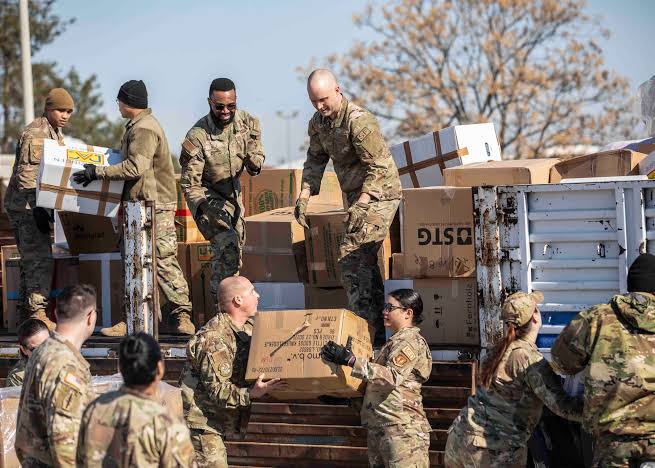
President of the United States of America Donald Trump recently disclosed that there will be possible military action, including air strikes or deploying troops, if Nigeria fails to crack down on the killing of Christians.
This disclosure has provoked outrage. Many Nigerians contended that if US soldiers invaded the country without the consent of Bola Tinubu, President of the Federal Republic of Nigeria, it would be an invasion, interruption, or mockery of sovereignty.
Some Nigerians argued that Donald Trump should rather extend military aid in the form of equipment, technology, and personnel, which would help Nigerian troops to defeat terrorists.
A check by WITHIN NIGERIA revealed that the United States of America had invested over $7 billion as foreign aid in Nigeria from 2015 till 2025.
This foreign aid covers health—such as HIV/AIDS, malaria, tuberculosis, and maternity—and education, scholarships, training, security, and others.
However, there are six (6) African countries where the United States of America (USA) had intervened with foreign aid during crises, which helped affected countries to regain balance.
Activities credited to the USA on the African continent have been in terms of humanitarian missions, peacekeeping support, counterterrorism operations, medical aid, and emergency response.
Here are six (6) African countries that have greatly profited from the United States:
SOMALIA (1992-1994)
Somalia was troubled with widespread famine, hunger, and absolute poverty occasioned by a devastating civil war.
The United States of America (USA) deployed troops to Somalia under Operation Restore Hope in 1992 to facilitate aid delivery, which later transitioned into a broader UN mission.
The civil war escalated, which forced U.S. troops into combat engagements, including the infamous Battle of Mogadishu in 1993.
The mission ended in 1994, becoming one of the most significant U.S. military operations in Africa.
LIBERIA (2014-2015)
The U.S. deployed troops and logistical support to Liberia to help contain the Ebola outbreak. The mission included constructing treatment facilities, transporting supplies, and training healthcare workers.
The U.S. provided support for overwhelmed health systems and prevented regional spread of Ebola.
SENEGAL (2014-2015)
The U.S. deployed troops, which provided logistical and medical support to help coordinate regional response efforts during the Ebola crisis.
The efforts of the U.S. helped prevent the outbreak from overwhelming weak public health systems and strengthened medical infrastructure.
KENYA (1998)
The U.S. forces mobilized to provide medical care, rescue services, and logistical support for victims of bombings.
The assistance came after a coordinated terrorist bombing struck the U.S. Embassy in Nairobi, which killed hundreds and injured thousands. The operation was largely humanitarian, focused on recovery and investigation.
TANZANIA (1998)
The U.S. deployed its forces to treat victims, assist in disaster recovery, and investigate the terror attack.
According to a credible report, the U.S. Embassy in Dar es Salaam was hit by a bombing, which resulted in the killing and injury of many.