
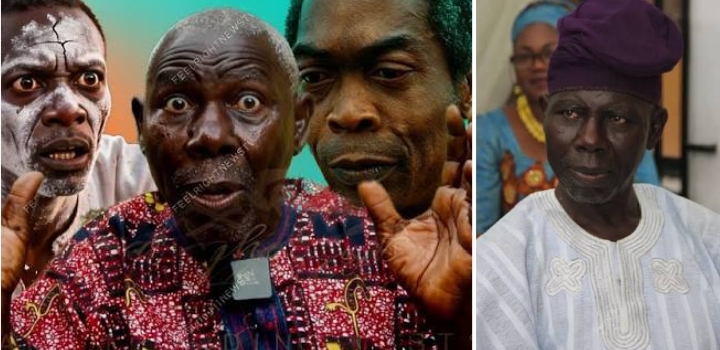
In a recent interview that has since circulated widely online, veteran Nigerian actor Pa Tunbosun Odunsi reflected on episodes from his long career and personal life, including a public encounter with Afrobeat pioneer Fela Anikulapo Kuti and experiences he described as encounters with reincarnated individuals. The interview, shared by a digital media platform, presented these recollections as personal testimony rather than documented historical record.
Pa Tunbosun spoke calmly and without dramatization, recounting events he said occurred decades ago during his active years as a stage performer. His account did not attempt to settle historical debates or make definitive claims. Instead, it offered insight into how he remembers certain moments and how they have stayed with him over time.
The interview did not begin with controversy. The references to Fela and to ghosts emerged gradually as the conversation moved through different phases of his career and worldview. The structure of the interview allowed these stories to appear as reflections rather than revelations.
What has drawn public attention since is not only what was said, but how fragments of the interview have been reframed and titled for online circulation.
What Pa Tunbosun Said Happened at the University of Ife
According to Pa Tunbosun, one of his most memorable professional encounters involving Fela Kuti occurred during a performance engagement at the University of Ife, now known as Obafemi Awolowo University. He explained that two different event organisers had independently booked both his theatre troupe and Fela with his band for the same programme.
Pa Tunbosun said he and his team were already performing on stage when Fela arrived at the venue. At that point, Fela reportedly noticed that another act was occupying the stage space meant for the event and expressed his displeasure openly.
In the interview, Pa Tunbosun recalled that Fela interrupted the performance and addressed him directly, referring to him teasingly as a black boy. He described this as a verbal provocation rather than an act of physical aggression.
Pa Tunbosun said he responded immediately, exchanging words with Fela in front of the audience. He emphasized that the exchange remained verbal and that neither party attempted to escalate the situation beyond banter.
How the Exchange Played Out in Public
Pa Tunbosun explained that the exchange between himself and Fela quickly drew the attention of the audience. Rather than reacting with discomfort, the crowd reportedly responded with excitement as the interaction unfolded.
He described the moment as turning unexpectedly into part of the entertainment. What began as a scheduling conflict, he said, became an unscripted interaction that held the audience’s attention.
In the interview, Pa Tunbosun did not characterize the encounter as a physical confrontation or a fight in the literal sense. He framed it instead as a clash of personalities and artistic presence on a shared stage.
He also noted that such overlaps were not uncommon at the time, particularly during periods when event organisation lacked coordination and multiple performers could be booked without proper communication.
How Pa Tunbosun Framed Fela’s Role in the Encounter
In recounting the incident, Pa Tunbosun did not portray Fela as hostile or malicious. He spoke of him as assertive and unyielding, traits that were already widely associated with Fela’s public persona.
He suggested that Fela’s reaction reflected his strong sense of ownership over performance spaces rather than personal animosity. The issue, as Pa Tunbosun described it, was less about rivalry and more about authority on stage.
Pa Tunbosun also indicated that the encounter ended without lasting conflict. The programme continued, and the moment became one of those incidents remembered more for its drama than for any consequences that followed.
In his telling, the incident was one episode among many in a long career rather than a defining event.
The Shift in the Interview to Personal Belief
After discussing his career and public performances, Pa Tunbosun turned to a more personal subject during the interview. He began speaking about experiences he interpreted as encounters with ghosts.
He clarified that he did not mean ghosts in the conventional sense of apparitions or haunted locations. Instead, he described what he believed were individuals who had died and returned to life elsewhere, living under different identities.
Pa Tunbosun presented these accounts as personal observations rather than claims he expected others to verify. He spoke in general terms about having encountered such individuals at different points in his life.
He emphasized that these experiences shaped his understanding of life and identity but did not suggest that they were universally accepted explanations.
The Surulere Account as Told in the Interview
One specific story Pa Tunbosun recounted involved a man who lived in Surulere, Lagos. According to him, the man appeared ordinary and integrated into his environment until people claiming to be his family arrived.
Pa Tunbosun said these individuals asserted that the man had died elsewhere and was living again under a different identity. He did not provide details about how they reached this conclusion or how widely the belief was shared.
What stood out in his account was what followed. He said that after the family confronted the man, the man disappeared and was never seen again.
Pa Tunbosun did not claim to know where the man went or what ultimately happened to him. He presented the disappearance as unresolved and unexplained.
How Pa Tunbosun Interpreted the Experience
In the interview, Pa Tunbosun explained that the Surulere incident reinforced his belief that some people return to the world only temporarily and vanish once their past catches up with them.
He did not connect this belief to any formal religious doctrine or spiritual practice. Instead, he spoke of it as an understanding formed through experience and observation.
He also did not suggest that such occurrences were common or easily identifiable. His tone suggested caution rather than certainty.
The account was framed as one of several experiences that contributed to his worldview rather than a singular proof of reincarnation.

From Interview Content to Viral Title
After the interview was published online, clips and summaries began circulating under the title “My Fight With Fela Kuti and the Living Ghost in Surulere Lagos.” The title emphasized confrontation and mystery.
However, as reflected in the interview itself, Pa Tunbosun did not describe a physical fight with Fela, nor did he present the Surulere account as a confirmed supernatural event.
The phrasing of the title reflects the conventions of online media, where intrigue and suspense often drive engagement more than nuance.
This difference between the interview content and its presentation has contributed to confusion and debate.
What Is Known and What Remains Unverified
It is verifiable that Pa Tunbosun Odunsi granted the interview and made the statements attributed to him. His career as a veteran actor in Yoruba theatre and Nigerian film is also well documented.
There is no independent record confirming a physical altercation between him and Fela Kuti at the University of Ife, nor is there documented evidence supporting the Surulere reincarnation account.
These elements remain personal testimony rather than historical fact.
Fela Kuti’s life and career, by contrast, have been extensively documented through biographies, recordings, and archival materials.
Reading the Interview for What It Is
Taken as a whole, the interview functions as a personal recollection rather than an attempt to rewrite history. It reflects how one individual remembers encounters from a period that predates extensive documentation.
The value of the interview lies less in verification than in perspective. It offers insight into how artists navigated shared spaces, conflicting egos, and belief systems in mid to late twentieth century Nigeria.
Pa Tunbosun did not ask listeners to accept his accounts as fact. He shared them as memory.
Understanding the interview in that context allows it to be read without exaggeration, dismissal, or undue sensationalism.