
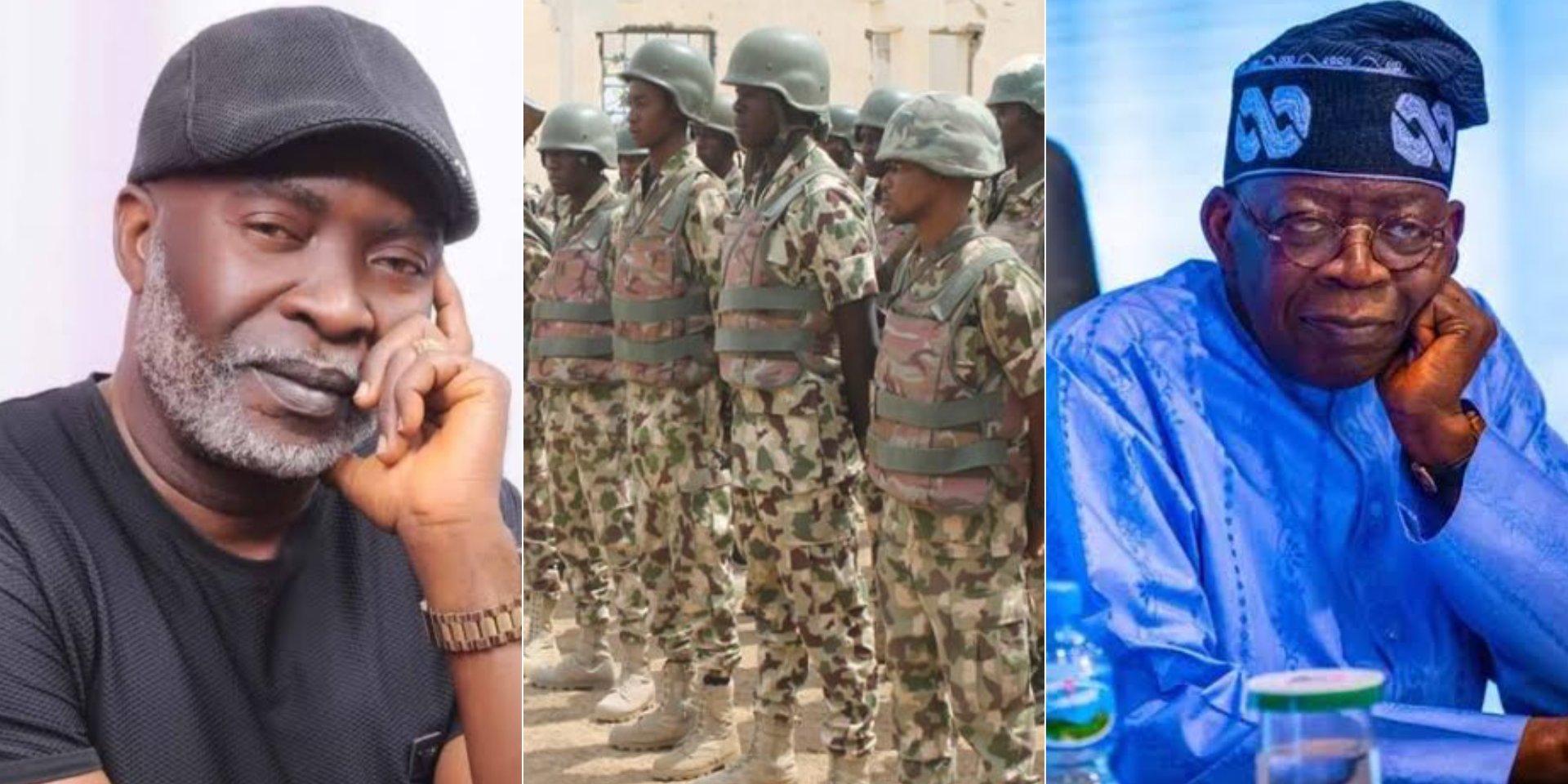
Power rarely announces itself with noise, most times it moves quietly through rooms where nobody is supposed to be watching, passing through conversations that sound ordinary until they are replayed later with dread. When Nigeria’s security agencies finally confirmed that a coup plot against President Bola Ahmed Tinubu had been foiled, the revelation landed not as a single event but as a slow unmasking, with soldiers detained, files opened, and briefings rewritten long before the public was allowed to know. Months after the dust appeared to have settled, a civilian name surfaced from within the classified layers of the investigation, not a politician and not a serving officer but a Nollywood actor, Stanley Amandi.
The shock was not merely that a creative figure had been arrested, but that his name appeared not at the edges of the case but embedded deep inside it. By the time authorities acknowledged his detention, the investigation had already traveled a long road marked by silence, recalibration, and uncomfortable discoveries about how influence now operates in modern power struggles. To understand why Stanley Amandi was arrested, one must first understand what investigators found before they ever touched him.
The First Signals That Something Was Wrong
The earliest warning signs did not resemble a coup in the traditional sense, there were no tanks on highways, no broadcast interruptions, and no public threats. What investigators noticed instead was a pattern of internal unease within certain military units, communications that did not align with routine operational chatter, and a growing disconnect between official discipline reports and what intelligence officers were hearing informally.
At first, the situation was treated as an internal military issue, with senior officers flagging behavioral anomalies, unauthorized meetings, and subtle resistance to command authority. These were initially categorized as indiscipline, a familiar term that allows security institutions to investigate quietly without alarming the public. As the internal review deepened, however, it became clear that the issue was not limited to breaches of protocol.
Investigators began mapping relationships rather than incidents, tracing who spoke to whom, who introduced whom, and who facilitated access across institutional boundaries. What emerged was not a single rogue unit but a loose alignment of actors, some uniformed and others civilian, linked less by ideology and more by shared dissatisfaction and strategic ambition. This shift from discipline review to national security investigation marked the first major turn in the case.
Crucially, civilian names began appearing earlier than expected, not as commanders or financiers but as connectors, people who could shape perception, test narratives, and prepare the ground psychologically long before any physical action became necessary.
When the Investigation Moved Beyond the Barracks
Once intelligence officers accepted that the issue extended beyond military confines, the investigation was restructured, moving away from a narrow focus on command hierarchies toward an examination of civilian networks that intersected with military life. This included retired officers, political intermediaries, and individuals with cultural reach who could normalize radical ideas without triggering alarms.
This phase of the investigation was delicate, as civilian involvement in military plotting is historically sensitive in Nigeria given the country’s long experience with coups and countercoups. Investigators were cautious not to overreach, but the data forced their hand as communications analysis showed recurring civilian presence in discussions that should have remained purely internal.
At this stage, Stanley Amandi’s name was not yet a headline risk, appearing instead in background notes and introduced through indirect references rather than direct accusations. His profile nonetheless stood out because he was not merely an actor but a former leader within the Actors Guild of Nigeria at the state level, someone accustomed to organization, messaging, and influence.
Investigators noted that his access pattern did not fit that of a casual acquaintance, as he was neither a distant sympathizer nor an accidental contact. His interactions suggested intentional positioning, the kind that serves a function rather than curiosity, a distinction that would later become critical.
The Messaging Dimension Investigators Could Not Ignore
One of the most significant discoveries made before Stanley Amandi’s arrest was that the suspected plot placed unusual emphasis on narrative control. Traditional coup planning focuses on force, timing, and command seizure, but this case placed early weight on messaging, legitimacy framing, and public sentiment management.
Investigators found discussions that revolved around how actions would be perceived rather than merely executed, with concern shown for public reaction, regional interpretation, and international optics. This alone signaled a modern evolution in coup thinking, one that recognized that power without acceptance is fragile.
Stanley Amandi’s alleged relevance emerged strongly here, as his professional background meant he understood storytelling, audience psychology, and emotional resonance. Investigators did not see him as a tactician but as a narrative asset, someone capable of shaping how events might be explained or justified if they unfolded.
This focus on propaganda did not imply that messages had already been disseminated publicly, as investigators emphasized that the concern lay in preparation rather than execution. Draft ideas, tone strategies, and scenario planning were reportedly discussed long before any attempt to move physically, placing the case firmly in what intelligence analysts describe as a dangerous pre action zone.
Why Investigators Took Stanley Amandi Seriously
Stanley Amandi was not arrested because he was famous, and investigators were clear internally that celebrity alone does not constitute threat. What elevated his status in the file was convergence, as his profile aligned with the needs of the plot at a specific stage and his access aligned with individuals already under surveillance.
Investigators noted that Amandi operated comfortably in both formal and informal spaces, able to meet officers socially without raising suspicion while engaging political discourse without appearing partisan. This dual credibility is rare and valuable in sensitive operations.
Additionally, his previous leadership role within AGN suggested administrative competence, as he was familiar with mobilization, internal discipline, and message coherence. Investigators flagged this as a potential risk factor, not because it proved guilt but because it explained why he might be recruited rather than incidental.
The decision to escalate his status from person of interest to active subject followed a pattern review rather than a single trigger, with no dramatic moment or public confrontation, just an accumulation of signals that reached a threshold.
The Arrest That Happened Before the Public Knew
By September 2025, investigators believed they had sufficient grounds to detain Stanley Amandi, and the timing was deliberate. At that point, military detentions had already begun quietly, and the investigation had entered a containment phase where the priority was preventing escalation rather than generating publicity.
Amandi’s arrest was therefore handled with minimal visibility, with no press release, no court appearance, and no immediate confirmation. His sudden disappearance from public activity, including social media, went largely unnoticed outside close industry circles.
This silence was not accidental, as authorities feared that publicizing civilian involvement too early could destabilize ongoing interrogations and alert other potential collaborators. It could also politicize the case before evidence consolidation was complete.
Internally, Amandi was treated as a civilian detainee linked to a national security investigation rather than as a public figure, a distinction that shaped how information about him was handled and delayed broader disclosure.
Why the Public Disclosure Came Months Later
When Defence Headquarters eventually confirmed the foiled coup plot in early 2026, the narrative presented was controlled and measured, focusing on institutional resilience rather than individual culpability. Civilian names were initially omitted.
The later emergence of Stanley Amandi’s involvement reflected a shift in investigative posture, as by that time the military phase of the case had concluded and files had been transferred to civilian prosecutorial channels. This transition reduced the operational risk of public discussion.
It also reflected legal necessity, since once a case enters civilian court territory, prolonged secrecy becomes harder to justify. Media inquiries intensified, industry whispers grew louder, and acknowledging Amandi’s detention became preferable to continued silence.
The delay, however, fueled suspicion and speculation, something investigators had hoped to avoid, yet from a security standpoint the priority had always been containment first and explanation later.
The Legal Architecture Built Around the Case
One of the most misunderstood aspects of the Stanley Amandi case is jurisdiction, as many assumed that his arrest implied a military trial. In reality, investigators were careful to maintain a clear legal boundary.
As a civilian, Amandi was never intended for court martial, with his case structured from the outset for civilian prosecution even while initial detention involved military custody due to the nature of the investigation. This handover process was meticulously documented to avoid future legal challenges.
Investigators also separated evidence streams, with military defendants facing charges related to insubordination, conspiracy, and breach of service law, while civilians including Amandi were assessed under criminal statutes relating to treasonable felony, conspiracy, and related offenses.
This bifurcation explains why Amandi’s case has moved at a different pace, as civilian prosecutions demand higher evidentiary thresholds and stricter procedural compliance.
Nollywood’s Quiet Reckoning
Within Nollywood, the reaction to Stanley Amandi’s arrest was subdued, with no loud defenses and no public condemnations. The Actors Guild of Nigeria acknowledged awareness and emphasized due process, but stopped short of advocacy.
This restraint reflected uncertainty rather than indifference, as many industry figures struggled to reconcile Amandi’s professional identity with the gravity of the allegations while others feared that public commentary could expose them to scrutiny or misinterpretation.
Behind the scenes, conversations shifted, and questions about political proximity, influence peddling, and the responsibility of cultural figures became unavoidable. Amandi’s case forced an industry wide reflection on how close is too close when power and creativity intersect.
What Investigators Believe the Case Represents
Beyond individual culpability, investigators view the Stanley Amandi case as emblematic of a broader shift in how threats emerge. Modern coup plotting, they argue, is no longer confined to force alone but increasingly relies on perception, legitimacy construction, and narrative preparation.
In this framework, civilians with cultural reach are not accessories but assets, shaping the environment in which actions might later unfold. This realization has reshaped how security agencies assess risk.
The Tinubu coup case therefore became not just a thwarted plot but a learning moment, revealing vulnerabilities that do not sit at borders or barracks gates but within society’s influence networks.
The Unfinished Nature of the Story
As of now, Stanley Amandi remains an accused person and not a convicted one, with the legal process ongoing and charges not yet fully ventilated in open court. Outcomes remain uncertain.
What is clear is that his arrest did not occur in isolation or error, as it was the result of layered findings, cautious escalation, and a redefinition of what constitutes threat in contemporary Nigeria.
The story is unfinished, but its implications are already visible. Power is no longer challenged only with weapons, sometimes it is tested with words, images, and belief systems prepared long before action, which is why investigators paid attention long before the public did.