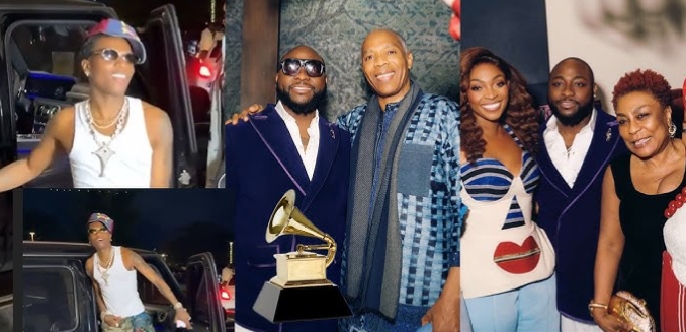
The lights of Los Angeles shimmered across the Grammy Honors Party, but inside, something else glimmered with equal intensity, the weight of legacy. Fela Anikulapo-Kuti, the man whose rhythms once shook Lagos streets and global stages alike, was being immortalized with a Lifetime Achievement Award.
The recognition came not as a sudden burst, but as a crescendo decades in the making, the kind of accolade that refracts history through a prism of music, culture, and influence. Among the assembled guests was Davido, one of Nigeria’s brightest contemporary stars, whose presence beside Fela’s family hinted at more than casual attendance. Cameras flashed, phones recorded, and social media began to stir. The event was ostensibly about Fela, yet the undercurrents of celebrity, legacy, and comparison rippled far beyond the ballroom.
This was a night where applause intertwined with expectation. Where the celebration of a father of Afrobeat collided with the realities of modern fame.
The question began to take shape: Could one artist’s homage inadvertently cast a shadow, or shine on another? Across timelines and feeds, Davido, Wizkid, the Kuti family, and millions of fans became actors in an unfolding story about influence, respect, and the fragile architecture of reputation
In this article, we will examine the sequence of events, the motivations behind each actor, the public reaction, and the potential implications for Wizkid’s image.
Fela Kuti’s Grammy Honour: A Legacy Cemented
Fela Kuti’s contribution to music is impossible to overstate. Afrobeat, a genre he pioneered, fused jazz, funk, highlife, and traditional African rhythms into a political and cultural force. His lyrics challenged authority, celebrated African identity, and exposed corruption in ways that resonated far beyond Nigeria. When the Recording Academy announced that Fela would receive a Lifetime Achievement Award, it was an acknowledgment not only of musical genius, but of a cultural revolution that continues to reverberate globally.
The Grammy Honors Party in Los Angeles on Saturday January 31st 2026, was meticulously curated to reflect the depth of Fela’s influence. Guests included music historians, contemporary African artists, and members of the Kuti family, who have long been custodians of his legacy. Femi Kuti and Yeni Kuti, among others, represented both the continuity of Fela’s mission and the living embodiment of Afrobeat’s enduring power. The atmosphere was celebratory, yet charged with reverence. Every photograph, every handshake, seemed to capture a dialogue between past and present.
Davido’s presence at the event added another layer of significance. He is widely recognized as one of Africa’s foremost contemporary artists, a global ambassador for Afrobeats, and a Grammy nominee in his own right. His attendance was interpreted by some as a bridging of generations—a contemporary star paying homage to a foundational figure. Yet in the age of social media, presence alone can be scrutinized as symbolic, and every nod, every photo, can become a statement in ways not intended.
It is critical to distinguish between celebrating Fela and appropriating the honor. Davido was not collecting the award; he was joining the family and the industry in recognition of Fela’s life work. This nuance, however, is often flattened online, where perception can eclipse reality. The images of Davido alongside the Kuti family became a focal point for discussions about influence, respect, and the comparative weight of musical legacies.
Davido at the Grammys: Context and Significance
Davido’s own journey to Los Angeles is a testament to the globalization of African music. With hits that dominate charts from Lagos to Los Angeles, and collaborations spanning continents, he represents a contemporary wave of artists who are redefining the international perception of African music. His nomination for Best African Music Performance for the song With You featuring Omah Lay positioned him as both a peer and a successor to the trailblazers like Fela.
Attendance at Fela’s tribute therefore operates on multiple levels. Publicly, it is a mark of respect, a celebration of musical heritage, and a statement of solidarity with the Kuti family. Professionally, it signals engagement with the global music community, and reinforces his standing as an artist who operates at the intersection of African roots and international influence. For fans and critics alike, this dual significance invites interpretation, and in a social media era, even benign gestures are transformed into symbols of rivalry or hierarchy.
The optics of being photographed alongside Femi Kuti and other Kuti family members inevitably generate discourse. In Nigeria, where Afrobeat is both cultural and political, these images are more than snapshots—they are statements about identity, continuity, and respect for the past. Davido’s role at the event is therefore emblematic of a broader negotiation between legacy and contemporary relevance. It is a visual affirmation that today’s stars recognize yesterday’s icons, while simultaneously asserting their place in a global narrative.
While Davido’s Grammy nomination underscores his current influence, the symbolic weight of appearing at Fela’s tribute cannot be dismissed. For some observers, it may be read as aligning with the Kuti brand of authenticity and social consciousness. For others, particularly fans invested in rivalries, it may be perceived as a subtle claim to prestige or a stake in the narrative of Nigerian music greatness.
The Social Media Undercurrents: Wizkid, Seun Kuti, and Public Debate
Almost immediately, the digital landscape responded. Comparisons between Fela Kuti’s impact and contemporary artists were reignited, and this time, the focus included Wizkid. Seun Kuti, Fela’s son, took to social media to challenge narratives suggesting that any modern artist, including Wizkid, could be considered greater than his father. He emphasized that Fela’s influence transcends commercial success, political visibility, or streaming numbers.
This sparked debates online, ranging from reasoned analysis to emotional fan-driven commentary. Fans of Wizkid and Davido weighed in, sometimes pitting the two against each other, and in some cases, inadvertently inserting themselves into Fela’s legacy. Wizkid himself engaged indirectly, with responses interpreted by some as defensive or provocative. While the exchanges were not confrontational in the traditional sense, they highlighted the intensity with which legacy and influence are contested in the digital age.
Music commentators, including Daddy Freeze and Femi Kuti, intervened to de-escalate tensions, urging fans and artists alike to separate respect for Fela from contemporary rivalries. They emphasized that while comparison is inevitable, it should not diminish the historical significance of Fela’s contributions. These interventions reflected a broader concern within Nigerian cultural discourse about preserving respect for foundational figures while acknowledging the rise of new stars.
In this environment, the presence of Davido at the Grammy tribute acquired additional interpretive layers. Beyond celebrating Fela, it became a reference point for discussions about hierarchy, influence, and symbolic alignment. For observers attentive to optics, it raised questions: Was this merely homage, or did it subtly reinforce a narrative of contemporary supremacy in African music?
Fela’s Legacy in Contemporary Music
Understanding the impact of Davido’s appearance requires grasping the depth of Fela’s legacy. Fela transformed music into a vehicle for political commentary and social consciousness. His work is inseparable from his activism, and his influence is measured not only by musical innovation, but by the enduring resonance of his message across generations.
Modern artists like Davido and Wizkid operate in a different context. The global music ecosystem, driven by streaming, social media, and international collaborations, offers opportunities for reach and recognition that were unimaginable in Fela’s era. Comparisons, therefore, are inherently complex. Success today is quantified in streams, awards, and chart positions, while Fela’s legacy is measured in cultural transformation and enduring influence.
This distinction is central to understanding the social media debates. When Seun Kuti pushes back against comparisons to Wizkid, he is emphasizing qualitative rather than quantitative measures of impact. Yet in an age dominated by metrics, the public often interprets influence numerically, which fuels misunderstanding and occasional online friction. Davido’s attendance, while entirely respectful, becomes entangled in this broader conversation about what constitutes lasting influence.
The interplay between historical reverence and modern achievement underscores the tensions within the Nigerian music scene. It also highlights how symbolic moments, such as attending a tribute, can carry interpretive weight far beyond their immediate context.
Celebrity Presence and Symbolic Capital
Celebrities operate in a system of symbolic capital, where visibility, association, and narrative shape public perception. Davido attending Fela’s tribute is a classic example of this phenomenon. While the action is straightforward—celebrating a legend—the implications ripple outward in multiple directions.
Firstly, it affirms Davido’s credibility within African music heritage, signaling that he values historical foundations. Secondly, it positions him within a narrative of continuity, connecting his international recognition with the cultural revolution Fela instigated. Thirdly, it creates contrast, whether intentional or not, with peers whose presence may be absent or less pronounced, such as Wizkid.
In social media discourse, symbolic capital is amplified. Images, videos, and commentary circulate rapidly, often stripped of nuance. As a result, moments that are internally coherent, honoring a legacy, become externally interpreted as competitive gestures. This is not unique to Nigerian music; globally, the optics of celebrity interactions shape reputations and influence audience perceptions.
Davido’s strategic participation demonstrates an awareness of both homage and positioning. While he did not claim Fela’s award, his proximity to the Kuti family during a globally recognized event implicitly elevates his narrative as a custodian of African musical heritage. This, intentionally or not, can shift public perception of his status relative to contemporaries.
Davido, Wizkid, and the Echoes of Rivalry
The optics of Davido standing beside the Kuti family were magnified by a decade-long, often intermittent rivalry with Wizkid, a tension that has threaded through social media, headlines, and fan debates for years. The beef, while never fully crystallized in confrontation, has simmered in the background of the Nigerian music scene, erupting through subtle jabs, song lyrics, and social-media commentary. Every public gesture by either artist is scrutinized, dissected, and reframed, and Davido’s presence at an event honoring Fela Kuti added a new layer of interpretive weight.
Historically, the Davido–Wizkid rivalry began with early comparisons of influence and fan allegiance, a dynamic amplified by online commentary and fan obsession. Over the years, minor provocations, cryptic tweets, veiled lyrics, and carefully staged photos, were often blown into symbolic battles over supremacy in Nigerian music. While both artists occasionally shared stages and acknowledged each other’s successes, the underlying narrative of competition persisted, sustained by millions of fans who translate admiration into rivalry.
In July 2025, the social-media exchanges reignited when Wizkid posted “Biggest” with an eagle emoji, interpreted by many as a claim of dominance, followed by Davido responding with highlights of his own achievements. Moments like these crystallize the tension, framing any shared space, whether award ceremonies, collaborations, or tribute, as a potential arena of symbolic contestation. In this context, attending Fela Kuti’s Grammy honor was no longer a neutral act; it became a gesture layered with cultural, professional, and interpretive significance.
For observers, the event illustrated how legacy, presence, and perception intersect in Nigerian music. Davido’s alignment with Fela’s family reinforced his positioning as a contemporary custodian of Afrobeat heritage, subtly differentiating him from Wizkid, whose absence might be read as disengagement. The rivalry is not about diminishing Wizkid’s influence, which remains substantial, but about how gestures and visibility shape narratives in a social-media-saturated ecosystem. Davido’s presence at the tribute is therefore as much about honoring Fela as it is about navigating perception, influence, and ongoing debates over who defines the modern era of Nigerian music.
Davido’s Response to the Fela vs Wizkid Debate
In a public comment captured on video and widely shared online, Davido weighed in on the online clash between Wizkid and Seun Kuti, advocating for restraint among fans and emphasizing unity in how artists relate to legacy discussions.
His tone underscored that debates about cultural contributions should not devolve into bitterness or diminish the achievements of any artist.
While he did not offer a direct critique of Wizkid or call out any individual’s stance, his comments reflected a desire to redirect attention from personal attacks toward collective respect for Afrobeat’s heritage and the growth of Afrobeats as a global force.
Davido’s intervention, though restrained, was significant. In a celebrity ecosystem where every comment can be amplified as a strategic move, his choice to promote respect and avoid escalating tensions shaped how some fans interpreted the feud. Instead of inflaming divisions, his response underscored continuity—honoring Fela’s legacy, valuing contemporary success, and urging fans away from personal disputes.
This stance subtly reinforced his image as an artist mindful of both history and community discourse, in contrast to the sharper exchanges between others involved in the debate.
Public Perception: Davido vs. Wizkid
The debate over how Davido’s presence affects Wizkid’s image is complex. Fans of both artists have historically compared achievements, often magnifying minor events into major points of contention. Social media engagement, metrics, and celebrity narratives all feed into the perception of supremacy in Nigerian music.
Davido’s visibility at a tribute celebrating Fela naturally draws attention. Observers may interpret his alignment with Fela’s family as an endorsement of continuity, social relevance, or authenticity. Conversely, Wizkid’s absence from such an event can be perceived, unfairly or otherwise, as disengagement, or at least a missed symbolic opportunity. This perception is compounded by existing rivalries and fan narratives that are quick to highlight contrasts.
It is important to stress that perception does not equal reality. Wizkid’s influence, both in Nigeria and globally, remains substantial. His artistic innovation, commercial success, and international collaborations secure his position as a leading figure in African music. However, the optics of key cultural moments, like Fela’s Grammy tribute, influence audience interpretation, particularly among casual fans and social media users.
The framing of these moments matters. In a media landscape driven by visuals, headlines, and online commentary, presence at a high-profile event can reinforce legitimacy, authenticity, and cultural resonance. In this sense, Davido’s attendance indirectly engages with Wizkid’s image, not by contesting it, but by establishing an alternative narrative of proximity to heritage and historical significance.
Takeaway
Davido’s presence at Fela Kuti’s Grammy tribute is simultaneously homage, professional positioning, and narrative reinforcement. It honors the legacy of a musical revolutionary while signaling Davido’s place within the continuum of African music. In doing so, it inevitably interacts with perceptions of Wizkid’s image, particularly among fans and commentators sensitive to optics and symbolic alignment.
Yet it is critical to differentiate perception from reality. Wizkid’s global influence remains undeniable, and his absence from a specific event does not diminish his achievements. What Davido’s appearance highlights is the subtle interplay between legacy, visibility, and cultural positioning. In an era where social media accelerates interpretation and amplifies minor gestures, such appearances acquire narrative weight far beyond their immediate intent.
The unfolding conversations surrounding Fela’s Grammy recognition, Davido’s participation, and Wizkid’s image are emblematic of a broader negotiation in Nigerian music: balancing respect for history with celebration of contemporary success, managing symbolic capital, and navigating fan-driven narratives. The story is not one of rivalry alone, but of how legacy, influence, and image intersect in the 21st-century African music landscape.
Fela Kuti’s rhythms continue to reverberate, and as they do, contemporary artists move within that echo, shaping their own stories while honoring the past. Davido’s presence is a note in that ongoing composition, one that interacts with Wizkid’s image not as opposition but as part of a wider symphony of African musical heritage, perception, and global recognition.