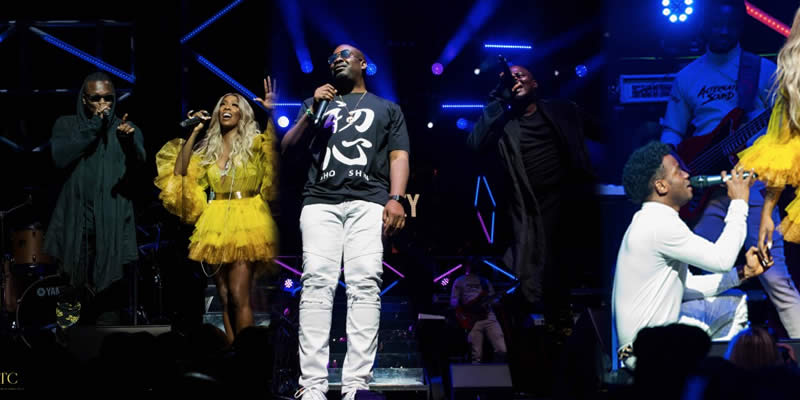


The air inside the hall at Entertainment Week Africa (EWA) in Lagos was thick with applause, heat and disbelief when Tiwa Savage and Yemi Alade who are two of Afrobeats’ most powerful women and longtime perceived rivals, leaned into each other for a tearful, lingering hug.
Cameras flashed, fans screamed, and for a moment the noise of years-long speculation dissolved into something softer. On stage, Yemi spoke words that made Tiwa’s eyes well: “Continue being you. You’re literally walking in strength.” And just like that, a seven-year public rift found its unexpected ending.
Why Their Reunion Matters for Afrobeats

The unexpected reunion of Tiwa Savage and Yemi Alade does more than settle a long-standing feud. It resets the narrative around women in Afrobeats. For nearly a decade, both artists were framed as competitors in an industry that often limits how many female stars can shine at once. Their embrace at EWA 2025 disrupts that old script, signalling a cultural shift toward collaboration, unity and a broader recognition of female power in Africa’s most influential music genre.
TIWA SAVAGE: The Queen Who Refused to Dim

Born Tiwatope Omolara Savage in Lagos Island and raised between Isale Eko and London, Tiwa Savage’s journey to global Afrobeats royalty was anything but accidental. At 16, she was already performing backup for George Michael. She went on to study Accounting at the University of Kent, then trained professionally at Berklee College of Music. This was an unusual pedigree for a Nigerian Afropop star in the early 2000s, but one that shaped her refined blend of R&B, soul and Afrobeats.
Her solo career sailed into mainstream consciousness with projects like Once Upon a Time, Sugarcane, and later, the critically embraced Water & Garri, which also inspired a film she starred in and produced. Over the years, Tiwa has collected MTV awards, chart-topping collaborations, and headline-making moments, including performing at the coronation concert of King Charles III. She has built a brand on raw vocal strength, glossy visuals and intentional storytelling, switching effortlessly between English, Yoruba and pidgin.
Beyond the glamour, Tiwa has positioned herself as an advocate for women. Her “We Are Tired” initiative became a rallying point against sexual violence and a campaign for survivor support. She is, in many ways, a symbol of resilience in the way she navigates career highs, public controversies, heartbreak and reinvention without losing her pulse on global pop culture.
Currently, Tiwa is one of the continent’s most influential female voices, engaging a global audience while still rooted in Lagos’s cultural heartbeat. So her reconciliation with Yemi Alade didn’t just trend, it mattered.
YEMI ALADE: The Rebel Queen of Pan-African Pop

If Tiwa Savage is Afrobeats royalty, Yemi Alade is its pan-African general. Born in 1989 to a Yoruba father from Ondo and an Igbo mother from Abia, Yemi embodies cultural fusion. She studied at the University of Lagos but found her breakout earlier, when she won the Peak Talent Show. This win was a viral springboard that eventually led to “Johnny,” the single that became one of Africa’s most-viewed music videos and her passport to global stardom.
Where Tiwa’s sound tilts toward silky Afropop-R&B, Yemi’s sonic palette is a riot of colour — highlife, dancehall, Afropop, and traditional percussion layered with witty storytelling. She sings in English, pidgin, Kiswahili, French, Portuguese and more, extending her reach far beyond Nigeria’s borders. Her 2016 album Mama Africa solidified her as a cultural ambassador, and over the years she built a brand centered on vibrant visuals, athletic stage performances and pan-African identity.
In 2024/2025, Yemi hit a career milestone with her first Grammy nomination for “Tomorrow” in the Best African Music Performance category. It stamped her global credibility and reignited conversations about her longevity and artistry. She has also consistently used her platform to promote African unity. She has performed at AFCON ceremonies, collaborated across the continent, and curated visuals that foreground African fashion and folklore.
Yemi’s confidence, bold styling and unfiltered personality have attracted fans and controversy in equal measure. But she has remained unapologetically herself, building one of the most loyal and diverse fanbases in modern Afropop.
By the time she stood next to Tiwa Savage at EWA 2025, the symbolism was unmistakable: two different queens, two different journeys, finally collapsing the narrative that the industry often forced on them.
The Feud: Seven Years of Shade, Speculation and Silence

To understand the impact of that hug, one must rewind to 2017–2018, which were the years when the so-called “beef” began. It started subtly, with social media posts that many fans interpreted as shade.
Yemi Alade once shared commentary critiquing female entertainers who edited their backside in photos. Many linked it directly to Tiwa Savage, who had recently posted images highlighting her curves. The internet spiraled, blogs inflated the moment, and Tiwa responded with a now-famous line: “Don’t start a war you can’t finish.” From there, everything was magnified.
Though both women rarely addressed the tension directly, the rivalry became an organism of its own. It was fed by fan wars, comparisons, award moments, stylistic parallels and industry politics. Every release became a competition. Every social media post became evidence. Every silence became a strategy.
The irony? Both women were, by all accounts, focused on their careers. Neither ever released a diss track. Neither mounted a public smear campaign. Yet the narrative persisted, becoming one of Afrobeats’ longest-running storylines.
The EWA Reconciliation: A Moment That Froze an Industry

On November 20, 2025, the “Price of Being Her” panel at Entertainment Week Africa was expected to deliver conversations about challenges facing female creatives. What it delivered instead was a moment that instantly rewrote pop-culture history.
Yemi Alade took the microphone first, speaking passionately about what it meant to exist and thrive as a woman in the music industry. Then she turned toward Tiwa Savage, her voice softening. Yemi Alade said:
“I honestly want you to know, that those moments when you get rugged and do what you truly went to do, you are standing up for many females. Just continue being you. You’re literally walking in strength.”
The room went silent. Tiwa exhaled, obviously emotional by the tribute, lifted her head, and walked toward Yemi. What happened next became a viral clip. Tiwa wrapped her arms around Yemi, Yemi tightened her hold, and the two women held each other like sisters who had finally found common ground. Cameras caught Tiwa wiping a tear, while Yemi’s smile looked like relief.
Fans screamed happily and even the panel moderator stepped back, giving space to the moment.
In a matter of seconds, years of speculation, rivalry narratives and online toxicity evaporated. The hug became more than reconciliation, it became a cultural reset. For the first time in years, people spoke less about competition and more about possibility.
Why This Matters for Afrobeats, Women and the Industry

The reunion of Tiwa Savage and Yemi Alade is being celebrated not merely because it ends a long-running feud, but because it exposes the underlying mechanics of how African female stars are framed, consumed and weaponized.
The industry’s role in feeding rivalry
Unlike their male counterparts who often coexist, collaborate and dominate charts simultaneously, women are frequently reduced to singular tokens in a global narrative. For years, the unsaid rule was that Afrobeats could only afford “one queen at a time.” This scarcity mindset, fueled by media sensationalism, often pitted women against one another before they even met.
Tiwa and Yemi became victims of the trope: two powerful women forced into competition because of their success, visibility and personality differences.
A shift in public sentiment
The EWA moment signals a changing tide. Fans, especially younger ones increasingly reject narratives built on misogyny, rivalry or spectacle at women’s expense. The applause that followed the hug is proof of that.
Global implications
Afrobeats is in a crucial era: Grammy recognition, global charting, festival circuits, streaming dominance and international fusions. With the genre rapidly expanding, the presence of multiple powerful female artists enriches the culture rather than fragments it. Yemi’s Grammy nomination, Tiwa’s international performances, Ayra Starr’s Gen-Z appeal, and Tems’ global songwriting wins amongst others prove that Africa’s female talent pool is deep, not singular.
A united front between Tiwa and Yemi could also reshape branding, touring, festival bookings and global collaborations. A joint performance or even a collaborative record would be a seismic cultural event.
Symbolism for women in music
Beyond music, the moment represents survival, forgiveness and the dismantling of patriarchal narratives that pit women against each other for relevance. In a country where female entertainers are often scrutinized more harshly than men, the Tiwa–Yemi reunion offers a roadmap for solidarity.
Afrobeats, it seems, may finally be ready for multiple queens.
Conclusion

Neither Tiwa Savage nor Yemi Alade has announced a collaboration — yet. But after their emotional embrace at EWA 2025, fans, netizens and global platforms are already anticipating the next chapter. It could be joint performances, a possible record, or at least a public show of continued support.
Whatever happens, one thing is clear: Afrobeats has entered a new era defined not by rivalry, but by reinvention, unity and the power of two women who chose evolution over ego.