
When Biola Bayo sat across from Baba Ijesha for what appeared to be just another tell-all conversation, she likely didn’t expect the storm that would follow. But within hours of the interview surfacing online, outrage began to build quickly across social media.
The podcast session reignited painful memories tied to the actor’s past conviction. What started as a sit-down meant to tell a story soon spiralled into a heated public backlash, forcing an apology and the quiet disappearance of the interview clip.
The Sit-Down That Sparked It

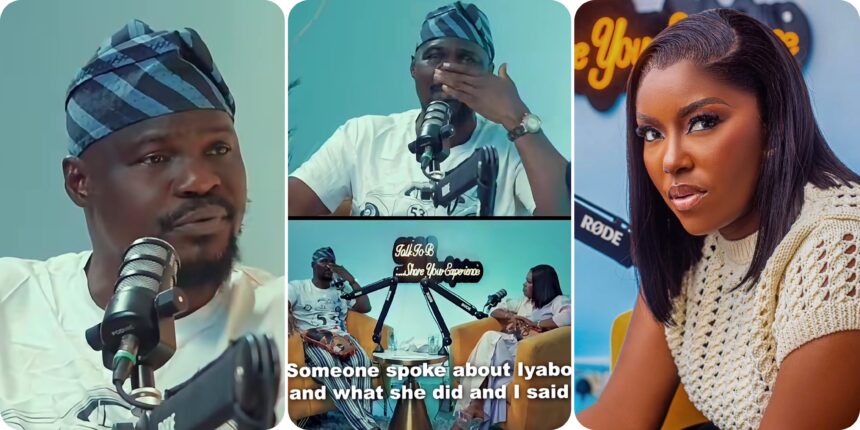
The now-viral interview, released on March 22, 2026, marked Olanrewaju James Omiyinka, popularly known as Baba Ijesha’s first public appearance since his release from prison in November 2025, after serving a five-year sentence for sexual assault. Hosted by Biola Bayo, the interview was positioned as a chance for the actor to speak publicly for the first time since the 2021 case that led to his conviction.
During the conversation, Baba Ijesha maintained his innocence, disputing the events that formed the basis of the case. He denied any romantic or physical involvement with comedienne Damilola Adekoya, popularly known as Princess, and described the incident as a “setup.” According to him, what was widely perceived as evidence of assault was instead part of what he claimed was a staged film scene.
He alleged that he had been invited under the pretext of a production, asked to act out a rape scene, and instructed to improvise without a script. He further claimed that the situation escalated unexpectedly when individuals confronted and attacked him, accusing him of attempted rape before filming was properly underway.
Beyond the incident itself, the interview stretched into broader claims, ranging from alleged betrayal by colleagues, to assertions that some accusers later recanted. He also spoke about his time in prison, describing rehabilitation efforts by correctional officers and portraying himself as reformed, even referring to his current outlook as that of an “ambassador for prisoners.”
The sit-down also reignited tensions with actress Iyabo Ojo, after Baba Ijesha made claims about past trust involving her children. However, the actress publicly refuted, reiterating that the victim in the case was a minor and that the court’s guilty verdict was based on evidence.
Framed as a personal account, the interview quickly drew attention for what was said and the weight of the case it revisited.
Why Nigerians Reacted
The backlash that followed Biola Bayo’s sit-down with Baba Ijesha was swift and unrelenting, driven largely by the weight of the case the interview revisited.
For many Nigerians, the outrage was rooted in a single concern: that a convicted offender had been given a platform to publicly dispute a case involving a minor. Some netizens argued that allowing Baba Ijesha to present his version of events, particularly his claim that the incident was a “setup” linked to a supposed film scene, risked undermining the gravity of the conviction and reopening wounds tied to the 2021 case.
Across social media, the reaction was sharp and deeply emotional. Netizens accused the interview of being insensitive, questioning the ethics of amplifying such a narrative and warning that it could discourage survivors from speaking out. Others described the decision to host the actor as an attempt to “rewrite history” or soften public memory of the incident.
The criticism wasn’t limited to the content of the interview alone, but extended to the platform itself. As reactions intensified, the focus shifted squarely to Biola Bayo. Critics questioned her judgment, accusing her of prioritising content and engagement over sensitivity.
Meaning that the issue was not just what Baba Ijesha said, but that he was given the opportunity to say it in a widely distributed format, so soon after serving his sentence. The interview, they argued, blurred the line between storytelling and accountability.
Still, a smaller but vocal group defended the sit-down, insisting that having served his sentence, the actor had the right to share his perspective.
Biola Bayo’s Response & The Takedown

As backlash intensified, Biola Bayo on March 24, broke her silence with a public apology. She acknowledged the weight of outrage that followed her interview with Baba Ijesha. The podcast host cum actress admitted regret over airing the conversation, explaining it was never meant to excuse or justify his actions but to give him space to apologise and clear the air. She quickly added that this expectation was not met.
“I am very sorry,” she said in a widely circulated clip, addressing those offended by the interview and its implications. She explained that after his release, he initially declined her request for an interview and only later reached out, asking to speak on her platform. Accepting what she described as an honour, she approached the sit-down strictly as an interviewer, expecting remorse that never came. She said:
“I apologize. What happened was, when Baba just came back from prison, he told me he was back, and I asked him if he wanted to do an interview to apologise, to clear the air so he could continue his life.
He said no, he wasn’t ready. I didn’t ask him again until he called me last week to say he was now ready for an interview and wanted to come to me first. I said, ‘Oh, thank you for the honour. No problem, sir.”
Biola Adebayo stressed that her platform was not created to exonerate him and that she does not support his actions, insisting she merely intended to hear his side. She continued:
“I thought I was just an interviewer. My role is to interview him, hear what he has to say. I thought he would apologize, but he did not. It is not in my place to condemn or judge him because I know the masses will do that.”
As criticism mounted, her tone shifted to reflection, acknowledging how the interview could be perceived as amplifying the wrong message. She underscored that she would never enable abuse, noting her personal experience as a survivor and her responsibilities as a mother and a Christian. Biola Bayo shared:
“I would never enable anybody. The interview was not to exonerate Baba Ijesha or to agree with whatever he was saying. I do not support him at all. I just felt that the platform is for everybody, and it’s okay for him to also say his side of the story and apologize. But since he did not, I cannot insist on what he should say.”
“I am a mother. I am a Christian. I am also a rape victim that it took me a while to get over. Yes, it took me time, a lot of prayers, a lot of confession. I would never in this life or the next life enable a pedophile or a rapist.”
In response, she removed the interview from YouTube, restricted it on Instagram, and extended apologies to fans, colleagues, and the public, including Iyabo Ojo. She asked for forgiveness, saying she is learning from the experience and will be more careful going forward, marking a clear shift from defence to accountability even as reactions remain divided.
Conclusion
In the end, what began as an attempt by Biola Bayo to host a conversation with Baba Ijesha became something far more consequential. It turned out to be a flashpoint in an already sensitive national conversation.
The backlash, apology, and eventual removal of the interview did more than close a chapter; they underscored the fragile line between storytelling and responsibility, especially when the subject touches on trauma, justice, and public memory.
Even as the controversy begins to settle, the questions it raised linger. Questions about accountability, platforming, and the role of media in shaping narratives that extend far beyond the screen.