In a particular street, it is forbidden for locals or guests to cut wood or pound yam after dark. According to findings, this taboo is connected to the tale of Esi, a courageous, strong, and powerful warrior who held a large number of slaves. He possessed numerous symbolic abilities. Residents of his neighborhood are advised not to cut wood or pound yam after dark.
This warning was given before he disappeared into the ground with his charms and cock. They must also refrain from fetching water from the Agboja River.
Taboos are social or religious practices that forbid or restrict a particular practice or association with a specific person, place, or thing, according to the Oxford Dictionary.
Different types of taboos exist. Adultery and homosexuality are social taboos in Africa. It is a taboo for Muslims to eat pork. Taboos are broadly dispersed across continents, regions and cities.
Fishes in the “Omi-Afero” River are sacred to the people of Iloko-Ijesa Kingdom, where His Royal Majesty, Oba Akeem Olusayo Ogungbangbe, is the supreme ruler. If you kill and cook them for longer hours, they would remain raw due to their sacredness.
In Iwoye, inhabitants or visitors dare not approach Okun forest and hunt any animal. In Kuta, inhabitants or visitors dare not sell groundnuts or pounded yam. In their own homes, those who labeled these taboos as “lies” or called their forebears who gave the warnings “liars” are reaping the benefits of their own stubbornness, willful disobedience, or disdain for authority.
Still, taboos can have both direction and size. Both general and specific taboos exist. While some taboos affect the entire native population, others are limited to a certain family or community. Every Yoruba town has taboos for particular family compounds or areas.
WITHIN NIGERIA journeyed to Iwoye-Ijesa, the hometown of Esi, a formidable warrior who waged wars and enslaved his opponents. The well-known Ijebu-Ijesa is only a 3-minute drive away to Iwoye-Ijesha. Knowing the location of a blind person’s tomb without being informed is said to be challenging for visitors.

When the reporter arrived at Iwoye-Ijesa, he sought directions from Chief Adewale Adejoro, the Adegunwa of Iwoye-Ijesha, a well-known chief and priest of the Okun deity.
Together, let’s hike to “Ona-Owuro.” Speaking in the vernacular, Chief Adejoro states that it is just a short stroll away from the Palace of Oniwoye of Iwoye, Oba Ogidiolu Adewumi Amos Otokobo II.
The reporter went on to ask what Ona-Owuro was and where he or it was. Chief Adejoro answered that it was the first route that their ancestors used when this town was originally established.
While hiking towards “Ona-Owuro,” the reporter’s mind was occupied by the physical characteristics of those remarkable men and the neighborhood’s appearance when they first cleared a way through the forest.
Upon reaching an old building, Chief Adejoro went inside and emerged with an elderly man he identified as Pa Bolarinwa Ajewole, who is among the oldest residents of the “Ona-Owuro” area and Iwoye-Ijesa overall.
While speaking with our reporter, Pa Ajewole affirmed that it is, in fact, forbidden for locals or guests to chop wood or pound yam in the evening or at night in this street. In describing the origins of Iwoye-Ijesha and the creation of the area known as “Isinmosan,” Pa Ajewole disclosed that “Asaba,” the first settler and founder of the town’s first street, is a hunter who has a companion named “Nimoogun” in Ijebu-Ijesha.
When Nimoogun paid Asaba a visit one fateful day, he saw that Asaba had previously used a cutlass to make a way through a dense forest at Iwoye-Ijesha when hunting. When did you clear the bushes here? Nimoogun inquired. Asaba retorted, “I just cleared the bushes now,” meaning ‘I sin ni mo san’ That was how the name Isinmosan came up. Before crossing to Ojude-Oba, every king we install is required to travel this route, which we refer to as “Ona Owuro.” Pa Ajewole told WITHIN NIGERIA, explaining the significance of the neighborhood.
Pa Ajewole revealed that there is a taboo that has been passed down from generation to generation when this reporter questioned him about why locals or visitors don’t pound yam or cut wood in the evenings or at night.
According to Pa Ajewole, they don’t chop wood or pound yam in the evening because of a curse imposed by the formidable warrior Esi Apataki, who disappeared into the ground with a cock in the neighborhood.
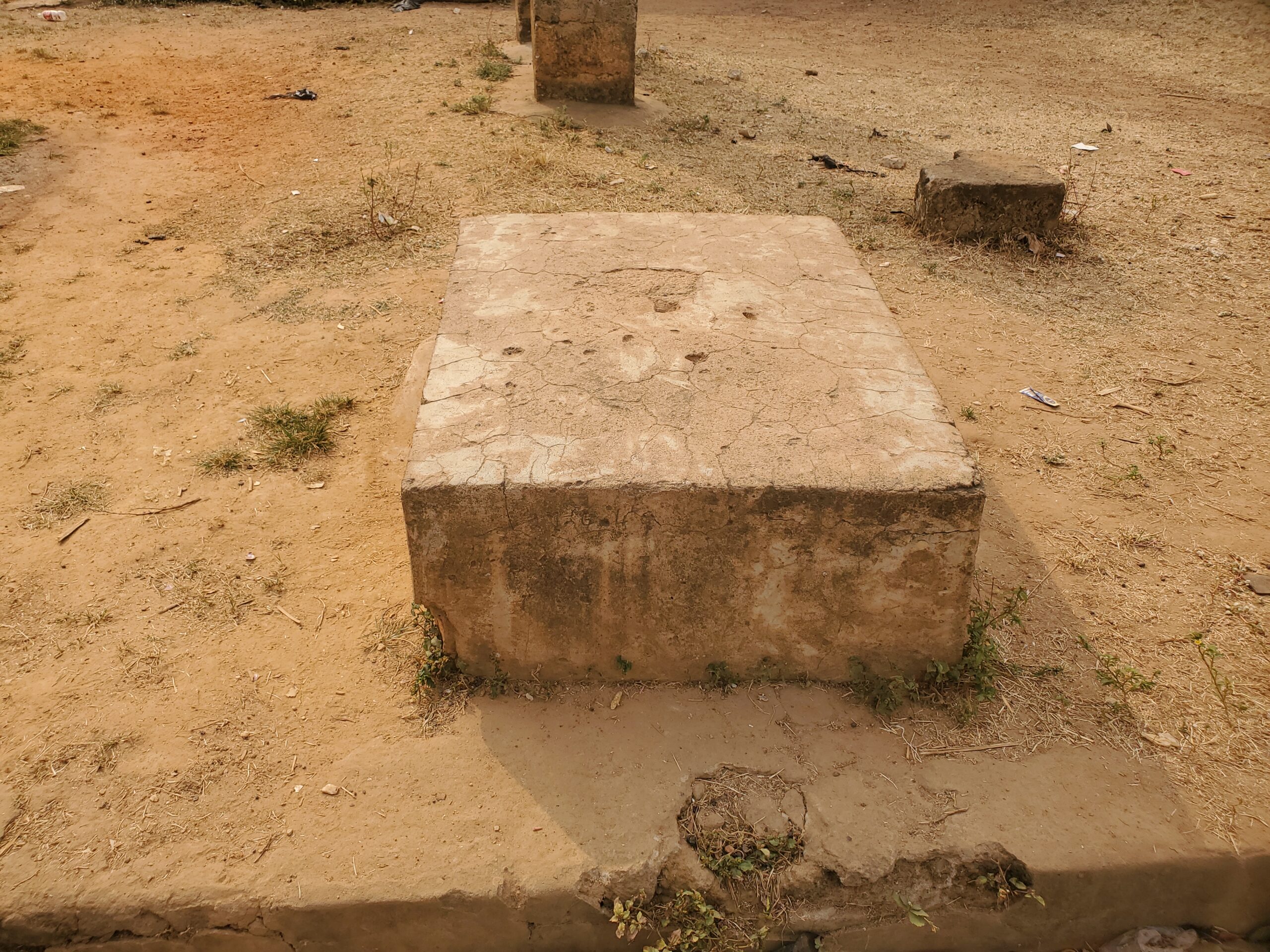
This reporter was led by Pa Ajewole to the location where Esi, a formidable warrior and slave owner, disappeared into the ground. This reporter saw that a tiny block and cement building had been built to hide it when we arrived. Pa Ajewole claims that because it was only partially exposed, some followers erected a block-like structure there in 1948.
Pa Ajewole attracted the reporter’s attention to a date that was inscribed on the block-like construction while he was attempting to remove dirt at the upper portion of the side view. When this reporter pressed Pa Ajewole further about why Esi, the formidable warrior, had cast such a curse prior to his entry into the ground, Pa Ajewole admitted that he was unaware of the circumstances surrounding the aforementioned incident.
I think only few people know the story. They also told us not to chop wood or pound yams after dark. I also met it in such manner. When we were younger, we would visit any home that had broken the taboo, and add ashes to the food that had been prepared. The fireplace would be the source of these ashes (Oju Aro). Pa Ajewole went on to say that if ashes were not added to the food, the individual would die and cause further deaths in the family.
Any visitor or guest entering this neighborhood, according to Pa Ajewole, will be duly informed that it is forbidden for them to cut wood or pound yam in the evening.
When this reporter questioned Pa Ajewole further about whether this taboo still existed, he revealed that while some residents of the neighborhood still abide by the taboo to avoid curses, there are few who do not. However, prayers have been made heavily to stop the said curse after the neighborhood has grown. Despite this, the taboo persists because some residents would never try to break it.
As one of the neighborhood’s elders, Pa Ajewole, disclosed that he still firmly abides by the taboo, forbidding guests or relatives from pounding yams or cutting wood at his home after dark. It is a neighborhood full of visitors. The majority of locals have visited cities. Pa Ajewole said, “I think it also contributed to the little violation of taboo we’ve already experienced.”
When this reporter inquired about whether people still pray or venerate the special being who turned deity at the location, Chief Adejoro, the Adegunwa of Iwoye-Ijesha, revealed that this was no longer the case.
“They used to venerate Esi, the strong warrior who would serve everyone with pounded yam, palm oil, cock, and kolanuts, but we no longer do that. It is one of the town’s most significant historical sites, however. The Esi is the third most powerful deity in Iwoye-Ijesha, behind Osunta and the Okun deity. Chief Adejoro said further that “never would a king be crowned in this town without coming here to receive the blessings of Esi – the powerful warrior that enslaved his enemies.”
This reporter was also informed by Chief Adejoro and Pa Ajewole that they were unaware of the curse’s origins. This reporter hiked to the home of Pa Olutayo Osewa, a well-known local son and the author of the book Iwoye Ijesa in Time Perspective. The respected author and educator gave the reporter hearty welcome when he arrived at his home. During the course of the interview, Pa Osewa disclosed that although he is unaware of the origin of the Esi’s curse, he is aware that natives and visitors are not permitted to pound yam or cut wood on the town of Isinmosan’s main street at night.
When Pa Osewa was questioned further, he revealed that Esi, the formidable warrior, was a very small man with supernatural abilities. He was so forceful that you can not pass his side with two things because he will undoubtedly take one, Pa Osewa continued.
While glorifying the formidable warrior turned deity, Pa Osewa characterized him as a man who would collect small stick to chew but would not. In addition, he said he would gather cutlass but would not go farming. Esi was a man who became a god after rushing to earth from heaven.
“Omo lesi agbarubo mo hun. Omo lesi a gbada ma roko. Esi o ri jo gun nile esimosan ni ile oniwoye. Osakutu torunwaye”
Following his departure from Pa Osewa’s home, this reporter made another journey to the Oluode of Iwoye-Ijesha in an attempt to discover the reason behind the Esi’s curse, which denied residents and visitors of the first neighborhood the ability to cut wood or pound yam in the evening or at night.
The old man merely told the reporter the stories we had previously recorded from Pa Ajewole, Pa Osewa, and Chief Adejoro when this reporter arrived at the Oluode of Iwoye-Ijesha’s home. He admitted to not knowing the background to the taboo to WITHIN NIGERIA. He did, however, pledge to look into it and come back to us.
There has to be a tale for every taboo. We don’t post half-baked pieces at WITHIN NIGERIA due to our internal policies and practices. This reporter departed Iwoye-Ijesha but returned to the agrarian town two days later. He set out to search Isinmosan, the town’s first neighborhood, seeking senior citizens.
This reporter spoke with a few elderly people, and one of them said he knows someone who would likely know the backstory on the taboo. We immediately set out on a new adventure, and we were able to learn the truth behind the taboo—namely, the reasons why people from Isinmosan, the first street in Iwoye, Ijesha, are not allowed to chop wood or pound yam in the evening or at night.
Here is the story:
Esi was a fierce warrior who subdued his opponents and won numerous wars. He was powerful, well-known, wealthy, and in charge. He had numerous wives and slaves as well. Despite his immense prowess, Esi never bore a male offspring. Every one of his spouses had female offspring. In the past, a male child has always been particularly important, especially in rich and prominent families.
He started to feel anxious and depressed. He was in great need of an heir to carry on his greatness, riches, and abilities. As luck would have it, one of Esi’s female slaves became pregnant and gave birth to a boy. He felt relieved to have removed a significant blemish from his life. Esi had gone on a journey on the fateful day his pregnant slave gave birth to a son. When his wives found out that the slave had given birth to a boy, they mistreated her.
They did not allow her to care for the new baby nor bury the placenta. They asked her to cut wood into pieces. They also sent her to the Agboja River to fetch water. They directed a woman who just delivered a baby to prepare pounded yam. The female slave was prevented from cleaning up her infant boy’s blood. The placenta and the newborn son had been devoured by a dog before the female slave returned from her trip to the Agboja River to fetch water.
Esi became enraged and gave vent to his fury. He cursed his wives and warned that anyone who cut wood or pound yam in the evening or at night in the first street or neighborhood would suffer from these curses. He then gathered his charms together with his cock and disappeared into the ground.
After learning the truth behind the taboo, this reporter was incredibly relieved. He said good-bye to the local elders and left the ancient town behind. He wondered what Esi might look like as he left the neighborhood, glancing at the area where he had supposedly vanished. Yoruba towns do really have a wealth of customs, taboos, traditions, and history.