In football, physical decline is usually treated as an unavoidable curve. Speed reduces, recovery slows, and the body becomes less forgiving. For most defenders across Europe, this curve becomes visible between the ages of 30 and 33. By 35, many are already transitioning into reduced roles, lower leagues, or retirement. Yet Italian defenders continue to complicate this pattern. In Italy, defenders routinely remain competitive at elite levels well into their late thirties, and in some cases, beyond forty.
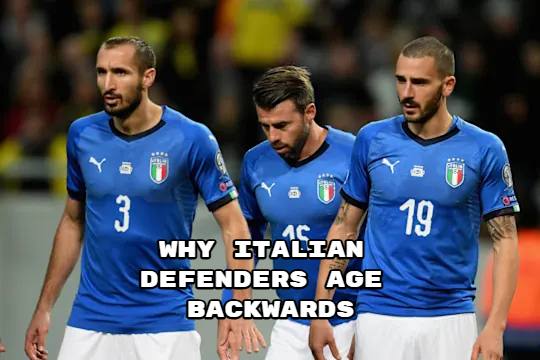
Paolo Maldini retired at 41 after a full season as a starter for AC Milan. Giorgio Chiellini was still a central defensive reference point for Juventus and Italy at 37. Andrea Barzagli remained tactically relevant into his late thirties. Leonardo Bonucci was still starting Champions League matches in his mid-thirties. Alessandro Costacurta retired at 41. Fabio Cannavaro won the Ballon d’Or at 33 as a centre-back. These are not isolated cases across a century of football. They are concentrated within one football culture.
The phrase “Italian defenders age backwards” does not mean their bodies reverse time. It refers to the visible reality that their influence, authority, and tactical control often increase as physical attributes decline. Their careers appear to gain stability rather than erosion. Their game becomes calmer rather than weaker. Their decision-making replaces athletic reliance more smoothly than in many other leagues.
This phenomenon cannot be explained by genetics, coincidence, or selective memory alone. It reflects a system that prepares defenders for longevity long before decline begins. Italian football teaches defending as a discipline of intelligence, space management, and responsibility rather than a contest of speed and strength. The result is a defensive culture where age functions less as a limiter and more as an amplifier of accumulated understanding.
In this article, we will examine that reality through historical tradition, tactical culture, training methods, case studies, youth education, psychological factors, and modern data. It also addresses criticisms of the idea and compares Italy with other major leagues. The aim is not to mythologise Italian defending, but to explain why its defenders continue to age differently.
The Reasons Why Italian Defenders Age Backwards
Italian football has historically organized itself around defending. The culture prizes defensive intelligence and positional discipline in ways that other footballing nations do not. This is not about nationalism or romantic mythology. It reflects measurable differences in how defenders are trained, deployed, valued, and developed throughout their careers. The result is that Italian defenders enter their thirties with skill sets that remain relevant even as their physical attributes decline. They have spent their entire careers developing the exact capacities that matter most when speed and stamina begin to fade.
The thesis here is not that Italian defenders are biologically superior or that Serie A is inherently better. The thesis is that a particular set of conditions has historically enabled Italian defenders to extend their careers in ways that are uncommon elsewhere, and that understanding these conditions reveals something important about how football values different types of expertise at different stages of a player’s life.
Historical Lineage
Italian football’s defensive identity did not appear spontaneously. It developed across decades of competitive necessity, tactical evolution, and institutional memory. While modern discussion often reduces Italian defending to “Catenaccio,” the reality is broader and more nuanced. Catenaccio itself, developed from Karl Rappan’s Swiss “verrou” system and refined in Italy during the 1950s and 1960s, prioritised structure, covering defenders, and positional responsibility. It introduced the idea that defending was a system, not an individual reaction.
Franco Baresi at AC Milan in the 1980s redefined the sweeper role into a proactive organiser. His reading of offside lines, communication with fullbacks, and positional discipline influenced generations of Italian defenders. Gaetano Scirea at Juventus embodied elegance combined with defensive responsibility. Alessandro Nesta combined anticipation with technical quality. Paolo Maldini added positional discipline across multiple defensive roles. These players did not succeed by relying on speed alone. They succeeded through anticipation, structure, and tactical literacy.
Italian coaching institutions absorbed these models. Youth coaches studied positioning patterns, defensive angles, body orientation, and line management as core elements of development. Unlike some football cultures that emphasised individual duels, Italian training emphasised spatial responsibility. Defenders were taught to protect zones, not chase opponents. They were trained to delay attacks, not to over-commit. This educational foundation created defenders whose primary tool was interpretation rather than reaction.
As a result, Italian defenders learned to age within their system. When speed declined, their spatial control remained. When strength reduced, their timing compensated. Their game was not dependent on peak physicality. It was dependent on knowledge, repetition, and coordination.
This historical continuity explains why Italian defenders often appear older earlier but remain effective longer. Their game matures gradually rather than peaks suddenly. Italian football did not accidentally produce long-lasting defenders. It cultivated them deliberately through consistent philosophical inheritance.
Why Italian Defenders Excel Beyond Physical Peak
Italian football prioritises tactical responsibility over athletic expression. This principle shapes how defenders operate across their careers. Defenders are evaluated less by sprint recovery and more by positional economy. A defender who takes three correct steps instead of ten is considered superior. This logic directly supports longevity.
In Serie A, defensive lines are trained to move as coordinated units. Centre-backs do not operate in isolation. Fullbacks, midfield shields, and defensive midfielders are structurally connected. This reduces exposure to pure physical contests. It increases reliance on communication and synchronisation. Older defenders benefit from this environment because their understanding of spacing allows them to compensate for reduced speed.
Italian tactical culture also encourages delayed engagement. Defenders are trained to guide attackers into less dangerous zones rather than confront them immediately. This conserves energy and limits physical strain. Over long careers, this approach reduces injury accumulation and fatigue erosion.
In contrast, leagues that emphasise high pressing and constant transitional defending often accelerate physical decline. Italian football historically limited these demands for defenders. Even as modern pressing has increased, Serie A still maintains a stronger emphasis on mid-block and structured defensive phases.
The Italian defender therefore learns to survive through positioning first and confrontation second. As years accumulate, this hierarchy protects career longevity. The defender’s relevance shifts from reactive athleticism to anticipatory authority. Younger defenders may outrun opponents. Older Italian defenders out-think them.
This tactical environment also rewards communication. Veteran defenders act as spatial organisers. Their value lies in directing teammates, maintaining line integrity, and controlling match rhythm from the back. These skills do not decline with age. In many cases, they improve.
Italian football does not merely tolerate older defenders. It structurally requires their intelligence.
Training, Management, and Physical Preparation in Italy
Italian clubs historically emphasised career preservation alongside performance. Training sessions for defenders focused less on maximal sprint output and more on movement efficiency, recovery management, and muscular balance. Defenders were not conditioned to play permanently at physical extremes. They were conditioned to repeat sustainable movements with precision.
Rehabilitation culture in Italy also contributed. Injuries were treated conservatively. Return-to-play decisions often favoured long-term health over short-term urgency. This protected defenders from chronic accumulation. A defender who misses three extra weeks avoids three additional years of instability later.
Italian strength training programs traditionally emphasised joint stability, core control, and controlled explosiveness rather than pure power. This reduced late-career vulnerability. While modern sports science has globalised many methods, Italian clubs adopted these principles earlier through practical necessity.
Another element is role adaptation. Italian defenders are allowed to change roles as they age. Fullbacks become centre-backs. Aggressive markers become positional sweepers. This tactical flexibility is institutionally accepted. It allows defenders to reshape their career arc instead of exiting it.
Italian clubs also value experience structurally. Squad composition routinely includes older defenders as tactical anchors. This reduces psychological pressure to retire prematurely. Players are not forced out simply because they are older. They are evaluated by functional contribution.
Longevity therefore becomes an outcome of systemic patience rather than exceptional resilience.
Case Studies
Individual careers reveal patterns more clearly than general theory. When defenders are observed across full professional lifespans rather than isolated seasons, the mechanisms of longevity become easier to trace. Italian football provides several careers long enough, consistent enough, and well-documented enough to examine how tactical understanding, role adaptation, and psychological discipline interact over time. The following case studies focus on defenders whose careers did not merely last, but evolved in ways that illustrate why Italian defenders often appear to grow more effective as physical decline begins.
Paolo Maldini
Paolo Maldini played professional football from 1985 to 2009, exclusively for AC Milan. He transitioned from left-back to centre-back during his career. His speed declined visibly after 30. His positional authority increased.
Maldini rarely tackled aggressively in later years. He intercepted instead. He delayed instead of chasing. His timing replaced his pace. His body orientation forced attackers into predictable angles. His career longevity did not depend on preserving physical attributes. It depended on evolving responsibility.
By his late thirties, Maldini functioned primarily as a structural controller. His presence stabilised defensive organisation. His anticipation reduced emergency defending. His leadership reduced collective exposure. He did not extend his career by denying decline. He extended it by accepting and reorganising around it.
Giorgio Chiellini
Chiellini’s career illustrates physical evolution. Early in his career, he relied heavily on strength and aggression. As injuries accumulated, he adapted. He reduced his engagement frequency. He increased his positional economy. He developed superior line management.
Chiellini often spoke about studying opponents, memorising movement habits, and anticipating duels rather than reacting to them. His later career was built on preparation rather than confrontation. Juventus structured their defence around his organisational presence even when his physical capacity reduced.
His career longevity was not about avoiding ageing. It was about reorganising identity.
Andrea Barzagli
Barzagli represented defensive minimalism. He rarely left his position unnecessarily. His game was built on containment, body orientation, and recovery positioning. His physical decline was less visible because his game never relied on speed dominance.
Barzagli’s longevity demonstrates the Italian preference for controlled defending. He did not win through spectacle. He won through stability. That stability aged well.
Each of these players reflects the same principle: Italian defenders do not try to maintain youth. They transition into mastery.
Modern Examples and Data
Beyond legendary names, Serie A consistently maintains high usage of defenders aged 30 and above. Squad data across recent seasons shows Italian clubs retaining veteran defenders as regular starters rather than emergency options.
Players such as Leonardo Bonucci, Francesco Acerbi, Matteo Darmian, and Giovanni Di Lorenzo have maintained high minutes in their thirties. Their roles often include organisational leadership and positional control.
Modern Italian defenders are increasingly expected to contribute in build-up play. This requirement actually favours older defenders who possess technical composure and decision discipline. The game slows around them rather than accelerates past them.
Data on duels, interceptions, and positional recoveries often shows older Italian defenders maintaining efficiency despite reduced sprint volume. This indicates structural adaptation rather than decline.
The trend demonstrates continuity rather than nostalgia. Italian defense has modernised without abandoning its longevity model.
Education and Youth Development
Italian youth defenders are introduced early to positional education. Training emphasises reading body angles, recognising passing lanes, and maintaining line shape. Tactical drills replace isolated athletic contests.
Young defenders learn to defend as part of a system before they learn to defend as individuals. This creates mental habits that mature with age rather than fade.
Italian academies also encourage video analysis from early stages. Defenders study professional examples of positional discipline. They learn that defending is a mental profession as much as a physical one.
This educational environment creates defenders who expect to think their way through careers. Physical attributes become tools, not foundations. As those tools decline, the foundation remains intact.
Psychological and Cultural Factors Supporting Longevity
Italian football culture respects defensive authority. Veteran defenders are treated as institutional memory carriers. Their voice carries tactical legitimacy. Their presence stabilises younger teammates.
This cultural respect protects older defenders from marginalisation. It allows them to remain integrated rather than isolated. Psychological security contributes to performance consistency.
Italian defenders also internalise responsibility. They are trained to manage pressure rather than escape it. This mental discipline strengthens with age. Panic decreases. Calculation increases.
The psychological model therefore aligns with the tactical model. Calm replaces urgency. Interpretation replaces reaction. Longevity is not only physical preservation. It is identity preservation.
Critiques and Counterpoints
Some analysts argue that Serie A’s slower tempo artificially inflates defender longevity. According to this view, Italian defenders age well because the league demands less physical intensity. Others argue that modern Italian football is abandoning its defensive heritage due to pressing trends and tactical globalisation. There is also selective memory. Fans remember Maldini and forget dozens of defenders who declined early.
These criticisms carry validity. Italian football does not magically protect every defender. The phenomenon is a trend, not a rule.
However, the consistency of long-lasting elite defenders in Italy exceeds coincidence. While tempo and structure contribute, they do not alone explain the continuity across generations.
The disagreement exists because longevity results from multiple interacting factors. Tactical style, training culture, psychological environment, and career management intersect differently across leagues. Italian football aligns these elements more consistently than most.
Italian Defenders vs. Global Counterparts
Premier League defenders often rely on physical dominance and transitional recovery. Their decline is sharper when speed reduces. Bundesliga defenders face high pressing demands that increase injury risk. La Liga defenders operate in technical environments but often face high transitional exposure.
Italian defenders face fewer constant sprint transitions. Their game emphasises spatial economy. This structural difference explains differing ageing curves.
In global comparison, Italian defenders experience smoother decline trajectories because their peak is less dependent on physical excess.
Will the Tradition Continue?
Modern Italian football is evolving. Pressing is increasing. Build-up demands are growing. Defenders must now combine positional discipline with ball progression.
This evolution may reduce extreme longevity. However, it may also preserve it differently. Tactical intelligence remains central.
Young defenders such as Alessandro Bastoni already demonstrate the blend of modern technique and traditional positioning. The tradition will not disappear. It will adjust.
Conclusion — What Longevity Tells Us About Italian Football
Italian defenders do not age backwards biologically. They age differently structurally. Their football culture prepares them for decline before decline arrives. Their training reduces dependency on youth. Their tactical environment rewards experience. Their psychological culture values authority.
Longevity becomes a product of design rather than accident. Italian defenders do not escape time. They reorganise around it. That is why their careers appear to move forward even as years accumulate.