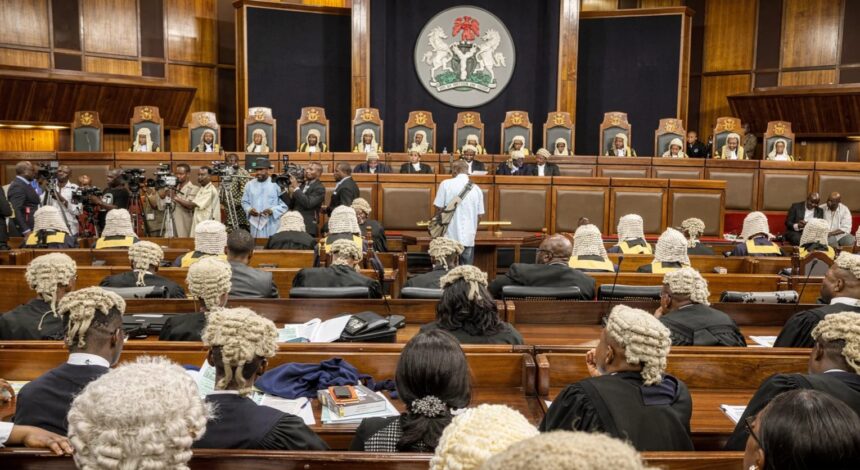
Political party disputes in Nigeria have historically been settled through court intervention, particularly in cases involving leadership struggles and candidate selection processes.
The Electoral Act 2026 now introduces clearer limits on judicial involvement in such internal matters, aiming to preserve party autonomy.
Section 83(5) of the law provides that “no court in Nigeria shall entertain jurisdiction over any suit or matter about the internal affairs of a political party”.
Subsection 6 further directs that courts should avoid issuing interim or interlocutory injunctions in such cases and instead deliver accelerated final judgments while suspending premature rulings.
The law also imposes financial sanctions, with Section 83(6)(b) prescribing a minimum cost of N10 million against plaintiffs and their legal representatives where such suits are filed.
Section 88(4) also bars courts from halting party primaries or general elections pending the determination of any dispute.
ADC LEADERSHIP DISPUTE
The internal crisis within the African Democratic Congress (ADC) has emerged as a practical test of the provisions of the Electoral Act 2026.
The Independent National Electoral Commission (INEC) initially declined recognition of a leadership structure led by David Mark following an appellate court directive to maintain the status quo ante bellum.
The dispute followed a leadership transition in July 2025 when Ralph Nwosu resigned and endorsed an interim arrangement led by Mark after opposition figures adopted the party for the 2027 political cycle.
However, a rival faction led by Nafiu Bala challenged the arrangement, insisting he remained deputy national chairman and should assume leadership based on party rules.
On September 2, 2025, Bala filed Suit No. FHC/ABJ/CS/1819/2025 at the Federal High Court in Abuja seeking to restrain the Mark-led leadership from operating as party executives.
He also sought orders preventing INEC from recognising the leadership and requested recognition as acting national chairman.
Further applications sought to halt party meetings, congresses and conventions pending final determination of the case.
At a hearing on September 4, 2025, Justice Emeka Nwite ordered that all respondents, including INEC, be served to respond to the motion.
In an affidavit submitted on September 12, 2025, INEC urged the court to avoid intervening in what it described as internal political party affairs.
An assistant executive officer, Ayuba, deposed that the case represented an attempt to draw the court into matters reserved for political party governance.
The affidavit stated, “That the Plaintiff’s application is in substance an invitation to this Honourable Court to delve into issues of internal/domestic affairs of 1st Defendant as a political party”.
It further added, “That I know as a fact that a Court of record should not dabble into a political question, which remains the exclusive preserve of political parties, which should be allowed to do their thing.”
Judicial precedent has consistently reinforced limits on court jurisdiction over internal political party affairs.
In earlier decisions, the supreme court held that political parties operate as voluntary associations governed by their constitutions and internal regulations.
In Uba v. Ozigbo (2021), the court ruled that candidate nomination processes remain exclusively within party control.
Similarly, in Anyanwu v. Emmanuel (2025), the apex court stated that leadership disputes within parties are non-justiciable and fall outside judicial authority.
Despite these rulings, litigations over party control continue to be filed in courts across the country.
NBA WARNS
The Nigerian Bar Association (NBA) has cautioned against increasing court involvement in political party disputes.
NBA president Afam Osigwe described such cases as contrary to the Electoral Act 2026 and warned that they undermine legal order.
He also stated that disciplinary action may be taken against legal practitioners who initiate cases contrary to the law’s provisions.