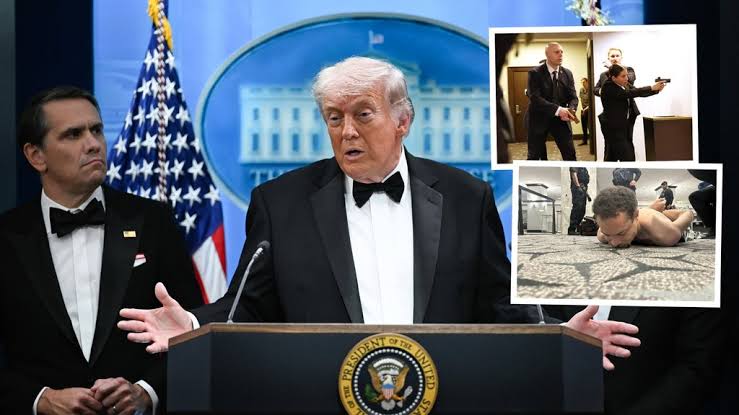
The White House Correspondents’ Dinner held on April 27 2026 at the Washington Hilton in Washington D.C was expected to follow its usual rhythm of speeches satire press celebration and political presence but the atmosphere shifted sharply when an armed security breach unfolded near the entrance zone of the venue. The presence of President Donald Trump along with senior United States officials had already drawn intense security attention before the incident occurred. What followed was a sequence of rapid security reactions that turned a formal dinner into a national security emergency within moments of the first alert. Guests later described confusion silence and sudden movement as security protocols activated across multiple layers of the building perimeter. The gravity of the situation became clear only after confirmation that shots had been fired near a controlled checkpoint outside the main ballroom area.
Authorities have since confirmed that the incident is being treated as a targeted assassination attempt linked to political motivation. The Secret Service responded within seconds of the breach initiating a full evacuation procedure for the President and key officials present at the venue. What could have escalated into a far more devastating outcome was contained due to immediate tactical response and protective coordination between federal agencies. The suspect was apprehended alive at the scene which allowed investigators to preserve critical evidence for ongoing federal review.
Security Breach Sequence Near Washington Hilton Perimeter
The breach began at a designated security screening zone outside the main entry corridor of the Washington Hilton where guests and officials were undergoing standard clearance procedures before entering the ballroom. According to preliminary federal accounts the suspect a 31 year old man from the Torrance area of California approached the checkpoint carrying concealed weapons including a shotgun a handgun and multiple knives. The escalation reportedly occurred when he attempted to forcefully advance beyond screening boundaries triggering immediate engagement by security personnel.
Shots were fired in the vicinity of the checkpoint though authorities have emphasized that no shots were discharged inside the main ballroom. The sound of gunfire caused rapid dispersal of personnel near the entrance area while Secret Service agents moved swiftly to shield the President and senior officials inside the venue. Within moments evacuation routes were activated and secure corridors were used to move high priority individuals away from potential risk zones. The controlled structure of the venue played a significant role in limiting exposure during the critical first minutes of the incident.
Guests who were still arriving or positioned near red carpet sections were directed to shelter points while those already inside the ballroom were instructed to remain low and await further instructions. The entire sequence unfolded within a compressed time frame estimated by officials to be under 3 minutes from initial breach to full lockdown.
Suspect Profile Examination Under Federal Review
Federal investigators have identified the suspect as a 31 year old male originating from the Torrance region of California. Early background checks indicate a pattern of travel from California to Washington D.C shortly before the event which is now being analyzed for planning intent and logistical preparation. Authorities recovered a combination of firearms and edged weapons suggesting a level of premeditation that elevated the severity classification of the case.
The suspect was taken into custody at the scene without fatal force intervention which preserved the opportunity for interrogation and forensic analysis. Investigators are currently reviewing whether he acted independently or was influenced by external ideological networks. His digital footprint including online communications search history and possible manifesto style writings are being examined in detail. Officials have confirmed that handwritten materials believed to contain political statements were recovered during the arrest process.
Law enforcement sources have described the case as one of the most significant attempted breaches involving a high level political event in recent years due to the proximity of the suspect to protected individuals. The combination of weapons carried and timing of the approach has led investigators to classify the event as a deliberate targeted attempt rather than a spontaneous act.
Protective Response Activation By Secret Service Units
The United States Secret Service initiated emergency protection protocols within seconds of detecting the security breach. President Donald Trump along with the First Lady Melania Trump and Vice President JD Vance were immediately moved through secured evacuation corridors. Agents deployed layered shielding formations designed to minimize exposure risk during movement through open access points within the venue structure.
One Secret Service agent sustained a gunshot injury during the confrontation but survived due to protective body armor which absorbed the impact. Medical teams stationed at the event responded immediately ensuring rapid stabilization and transport. Officials have confirmed that no civilians or attending officials suffered fatal injuries during the incident.
The evacuation process included coordination between Secret Service tactical units D.C Metropolitan Police and FBI rapid response teams who arrived shortly after initial containment. The venue was placed under full lockdown while secondary sweeps were conducted to ensure no additional threats were present. Communication systems were also secured to maintain controlled information flow during the emergency phase.
Federal Charges Under Active Consideration
The suspect is currently facing multiple federal charges under preliminary review including attempted assassination related allegations assault on a federal officer and use of a firearm during a violent crime. Depending on final FBI findings additional terrorism related charges may be added to the case. Prosecutors are evaluating intent classification based on recovered writings communication logs and behavioral analysis.
Legal experts involved in early assessment have indicated that the severity of the charges will depend heavily on establishing premeditation and ideological motivation. The presence of multiple weapons and travel behavior are being weighed alongside digital evidence retrieved from electronic devices. The suspect is being held under federal custody pending formal indictment proceedings.
Authorities have not yet released full details regarding court scheduling but have confirmed that the case will be handled at federal level due to the nature of the target and location of the incident.
Investigation Focus Areas Under Active Review
Federal agencies have outlined three primary areas of focus as the investigation continues. The first area involves determining the planning timeline including how long the suspect prepared for the event and whether any external communication networks contributed to planning or ideological reinforcement. Investigators are analyzing movement patterns financial transactions and travel records leading up to April 27 2026.
The second area focuses on security vulnerability assessment. Officials are reviewing how the suspect approached a high security political gathering with access to a controlled perimeter. This includes evaluation of screening procedures checkpoint efficiency and potential procedural gaps that may have allowed proximity before interception. Security protocol adjustments are expected depending on findings.
The third area centers on motive determination. Investigators are examining political grievances mental health history if applicable and any ideological messaging contained in recovered materials. Digital communications are also being reviewed to establish whether the suspect expressed intent to target political figures prior to arrival in Washington D.C.
Inside The Venue During The Incident Window
Approximately 2000 attendees were present inside the Washington Hilton ballroom at the time of the incident including political leaders media representatives entertainment guests and diplomatic invitees. As the situation unfolded many individuals were instructed to remain in place while others were guided to secure exits depending on proximity to threat zones. Some guests reported taking shelter under tables during the initial alert phase as security announcements were made.
The guest list included senior White House officials cabinet level representatives leading journalists from major media networks and international press correspondents. Entertainment performers and media personalities were also present as part of the scheduled program. The density of high profile individuals increased the urgency of the response once the breach was confirmed.
While chaos was limited by swift containment the psychological impact on attendees was significant as many were unaware of the exact nature of the threat during the first minutes of evacuation. Communication remained controlled until full security clearance was achieved.
Broader Security Implications Moving Forward
Security analysts reviewing the incident have emphasized that the event highlights evolving risks associated with high profile political gatherings in open media environments. The fact that the breach occurred near a controlled entry point rather than inside the secured ballroom has raised questions about perimeter reinforcement and layered screening systems.
Federal agencies are expected to conduct comprehensive reviews of protective procedures at similar events going forward. This includes reassessment of checkpoint positioning crowd flow management and rapid response coordination between federal and local law enforcement units. The survival of key officials and containment of the suspect has been described as a result of rapid execution rather than procedural advantage alone.
The investigation remains active with ongoing updates expected as forensic analysis progresses and interrogation results are compiled. Authorities have confirmed that public safety assessments will continue in parallel with legal proceedings to ensure any potential risks linked to broader networks are fully evaluated.