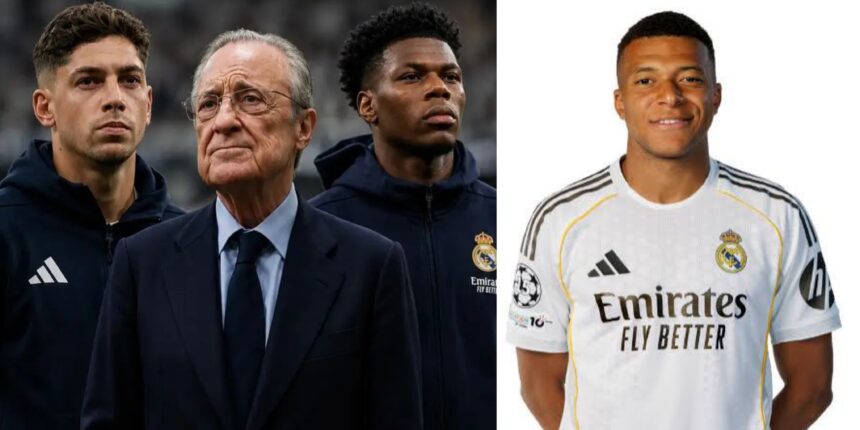
Real Madrid in 2026 finds itself under a spotlight that feels heavier than a normal season pressure cycle, where every training ground moment is no longer contained within Valdebebas walls but instead leaks into global conversation within minutes of occurring. What began as a routine competitive buildup period has gradually transformed into a layered story of tension, perception, frustration, and emotion that now surrounds key figures in the squad. The names most frequently attached to this unfolding situation include Federico Valverde, Aurélien Tchouaméni, and Kylian Mbappé, each carrying their own weight of expectation within a club that demands perfection as a standard rather than an ambition.
Reports circulating around early May 2026 suggest that what is happening inside the dressing room is not a single incident but a chain of emotional reactions shaped by pressure, results, and rising external noise. As details continue to circulate from different outlets and fan spaces, the line between verified events and interpretation becomes increasingly blurred, leaving supporters trying to understand where truth ends and narrative begins.
This is not a story built on one moment alone but rather a sequence of moments that appear to be tightening around a team expected to dominate every competition it enters. The deeper one looks into the situation, the more it reflects a club living through emotional intensity rather than structural collapse, where every action is magnified and every reaction is questioned.
Valdebebas Training Flashpoint 6 May 2026
On 6 May 2026, reports from multiple training observers indicated that an intense session at Real Madrid’s Valdebebas training complex became the initial spark that set off the current wave of tension narratives. The atmosphere during that period was already described as highly competitive, with the squad preparing for decisive fixtures that could define the season trajectory. Within that environment, a single moment involving a hard challenge during a training drill reportedly disrupted the rhythm of the session and shifted the emotional tone among several players present. Federico Valverde and Aurélien Tchouaméni were identified in reports as central figures in that moment, where competitive aggression reportedly crossed into verbal exchange.
What followed, according to circulating accounts dated 6 May and 7 May 2026, was not immediately contained within the pitch boundaries as coaching staff attempted to regain control of the session. The incident is repeatedly described as one of those training ground moments where intensity meant to sharpen performance instead exposes underlying frustration that usually remains hidden during match days.
Valverde and Tchouameni Confrontation Sequence
Following the initial challenge, reports suggest that Valverde and Tchouaméni engaged in a direct confrontation that escalated beyond normal training disagreement. Descriptions from various sources published between 6 May and 8 May 2026 indicate that words were exchanged with increasing intensity, accompanied by physical proximity that required teammates to intervene. While some accounts frame the incident as a brief exchange that was quickly separated, others describe a more extended confrontation that carried into the edge of the training structure where emotions reportedly remained high. The key element repeated across versions is that the disagreement did not remain isolated on the pitch but transitioned into a more serious interaction that required group intervention.
Within the same sequence of reports, there are suggestions that frustration had been building within the squad for weeks, linked to performance expectations and tactical disagreements during a demanding stretch of the season. This broader context is important because it frames the confrontation not as an isolated disagreement but as a symptom of accumulated competitive pressure inside a squad operating under constant expectation.
Dressing Room Escalation Reports
After the pitch based confrontation, attention shifts to what allegedly occurred inside the dressing room area where tension reportedly continued rather than dissipating. Accounts from 7 May 2026 suggest that voices remained raised as players regrouped after training, with staff stepping in to prevent further escalation. One version of events describes the situation as a continuation of emotional exchange that had already started on the pitch, while another version suggests that the dressing room environment became tense due to discussion around the initial incident. Within these narratives, the key concern is not only what happened physically but also the psychological atmosphere that followed, where teammates were said to be divided in reaction to the confrontation.
Reports emphasize that Real Madrid’s internal environment during this period was already sensitive due to performance pressure, making any internal disagreement more impactful than it might have been earlier in the season.
Injury Incident Accounts
One of the most discussed elements emerging from the 6 May 2026 reports is the claim that Federico Valverde sustained an injury during or shortly after the confrontation sequence. According to club aligned explanations circulated in media summaries dated 7 May 2026, the injury was described as accidental, involving a fall that led to a head impact requiring precautionary medical attention. Valverde was reportedly taken for evaluation and later discharged, with medical protocols treating the situation as a precaution rather than a severe structural injury. However, alternative versions of the same event suggest a more chaotic moment involving physical contact that may have contributed to the fall.
These differing interpretations highlight the uncertainty surrounding the exact sequence of events, where the same incident is being described through multiple lenses depending on the source. What remains consistent across all reports is that Valverde required medical assessment following the training ground incident, which immediately elevated the seriousness of the situation within the club structure.
Club Internal Response
By 7 May 2026, Real Madrid’s internal response reportedly shifted into containment mode, with meetings held between technical staff, senior players, and club officials to assess the situation. Sources describe disciplinary discussions being opened regarding the events of the previous day, although no official public statement confirmed specific punishments at that stage. The club’s priority, according to circulating reports, was to prevent escalation of internal tension ahead of critical fixtures in the season calendar. Potential internal measures discussed in media narratives included fines, internal warnings, and temporary training adjustments designed to stabilize squad dynamics.
What stands out in this phase is the emphasis on control rather than punishment, suggesting that the club viewed the situation as manageable internal conflict rather than structural breakdown. However, the fact that emergency style meetings were held indicates that the incident was treated with significant seriousness within the club hierarchy.
Official Valverde Statement Context
In his clarification shared through official club and social channels on 7 May 2026, Valverde explained that the incident stemmed from frustration during a heated training discussion, not an intentional physical altercation between players.
He stated clearly that:
- There was no fight or physical exchange between him and Tchouaméni
- the injury he sustained was accidental
- he hit a table during the argument, which caused a cut on his forehead
- he required hospital treatment only as a precaution
Valverde also emphasized that the emotional intensity of a difficult season contributed to how the situation unfolded, but rejected the idea that it turned into a violent confrontation between teammates.
Mbappe Fan Backlash Narrative
Parallel to the Valverde and Tchouaméni situation, a separate narrative emerged involving Kylian Mbappé, where fan reaction became a dominant storyline across social platforms during early May 2026. Reports circulating online describe a surge of criticism directed at Mbappé, fueled by perceptions of timing, injury management decisions, and overall team performance frustrations. The phrase Mbappé out began trending in various fan spaces, with some claims suggesting large scale petition activity, although exact figures remain disputed across sources.
What is clear from consistent reporting is that Mbappé became a symbolic focal point for wider frustration rather than the cause of internal conflict itself. The emotional intensity of fan reaction reflects the expectations placed on him following his arrival at the club, where immediate success was widely assumed by supporters and media narratives alike.
Sardinia Recovery Controversy Timeline
One of the key triggers behind the fan backlash narrative is linked to reports that Mbappé was seen in Sardinia during a recovery period from injury around late April and early May 2026. According to media coverage dated 5 May and 6 May 2026, this travel coincided with a critical phase of the season where expectations around squad availability were extremely high. Club aligned explanations indicated that the trip was medically approved as part of recovery management, but public perception among sections of fans interpreted the timing differently.
This created a divide between official reasoning and emotional interpretation, which quickly amplified across social platforms. The situation illustrates how modern football narratives are shaped not only by actions but by timing and optics, where even medically sanctioned decisions can become sources of debate when team performance is under scrutiny.
Squad Atmosphere Pressure Cycle
Beyond individual incidents, the broader picture emerging from multiple reports suggests that Real Madrid’s squad atmosphere in early May 2026 is shaped by a continuous pressure cycle. This cycle is driven by performance expectations, tactical demands, media scrutiny, and internal competition for starting positions. Within such an environment, even small disagreements can escalate quickly because emotional tolerance levels are already reduced by constant competitive pressure.
Reports repeatedly emphasize that the squad is not in a state of collapse but rather in a state of heightened sensitivity, where reactions are amplified due to stakes involved in remaining fixtures. The presence of elite players across all positions adds another layer of intensity, as internal competition naturally raises emotional stakes during training sessions.
Media Amplification Social Reaction
As the situation developed between 6 May and 8 May 2026, media coverage and social media interpretation played a significant role in shaping public perception of events. Different outlets presented varying versions of the same incidents, leading to fragmented understanding among fans. Social media platforms further amplified this fragmentation by circulating clips, rumors, and commentary that often lacked full context.
This created a feedback loop where speculation became part of the narrative itself, making it difficult to separate confirmed events from interpreted scenarios. The Mbappé backlash narrative in particular demonstrates how quickly sentiment can shift when performance expectations are not met, regardless of official club communication.
Reality Verification Club Silence Context
Despite the intensity of circulating reports, Real Madrid as a club has maintained limited public communication regarding the specific details of the Valverde and Tchouaméni incident as of 8 May 2026. This silence has contributed to further speculation, as absence of detail often creates space for multiple interpretations. However, within professional football environments, internal handling of disciplinary matters is common practice, especially during ongoing competitive seasons.
The lack of public escalation from the club suggests an intention to manage the situation internally rather than escalate it externally. This approach aligns with historical handling of internal squad tensions where priority is maintaining competitive focus rather than public explanation.
Season Trajectory Implications
Looking at the broader implications, the events reported around early May 2026 highlight how fragile balance can become within elite football environments when pressure, expectation, and performance converge. The Valverde and Tchouaméni confrontation reflects internal competitive intensity, while the Mbappé backlash reflects external emotional pressure from supporters. Together, these narratives create a layered environment where the club must manage both internal stability and external perception simultaneously.
As the season approaches its decisive phase, the ability of the squad to convert tension into performance rather than fragmentation will likely determine how this period is remembered. What remains clear across all reports is that Real Madrid is not dealing with a single issue but with multiple overlapping pressures that require careful management across sporting, psychological, and communication dimensions.