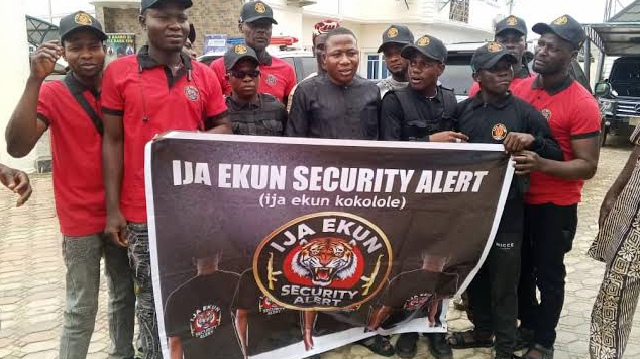
Across the South West region of Nigeria, conversations around security have taken a familiar but increasingly tense direction, shaped by years of kidnapping incidents, forest based criminal activity, rural fear, and repeated calls for stronger community protection. At the center of the latest wave of discussion is a claim tied to a proposed structure known as the Iru Ekun Security Network, which has been associated with the outspoken activist Sunday Adeyemo. The story carries a blend of ambition, urgency, political interpretation, and uncertainty that has kept it circulating across media spaces without a single settled version of the truth. What makes it even more gripping is not just the idea of a large scale volunteer security force, but the suggestion that it may already have backing from the highest level of government, a claim that continues to spark debate.
Yet beneath the noise, a more layered picture emerges, one that raises questions about structure, legality, capacity, coordination, and the future of community based security initiatives in Nigeria. The claims, counterclaims, and official silence all sit side by side, leaving the public to interpret fragments of information that do not always align. Understanding what is real, what is aspirational, and what remains unverified requires a careful walk through the timeline, the intentions, and the political environment surrounding the proposal.
Origins of Security Proposal Narrative
The idea of a South West based security arrangement has circulated for years, largely driven by rising concerns over kidnapping routes that stretch through forests across Oyo, Ogun, Osun, Ekiti, Ondo, Lagos, and parts of Kwara. Rural communities have repeatedly reported incidents involving armed groups operating through forest corridors, creating pressure for localized responses. These conditions formed the backdrop against which Sunday Igboho became one of the most vocal figures calling for self protection structures, particularly during periods of heightened insecurity between 2020 and 2024.
By 2024, discussions around regional security autonomy had already gained traction due to the existence of Amotekun, a state backed security network established across South West states. However, the conversation did not end there. Instead, it evolved into proposals for more expanded or specialized formations that could operate deeper within forest environments where conventional policing often struggles to maintain presence. It is within this environment that the concept of Iru Ekun Security Network began to surface publicly, framed as a more aggressive, forest responsive force.
Reports attributed to statements made in 2025 suggested that the initiative was not merely conceptual but had reached an advanced planning stage. These claims included recruitment intentions, training exercises, and structural organization. However, much of the available information has come through media interpretation rather than official documentation, which is why the narrative remains contested.
Structure Claims Size Ambition
One of the most striking aspects of the proposal is the scale being attached to it. Discussions circulating in 2025 and early 2026 referenced a structure involving approximately 50000 personnel. This figure alone has fueled intense public attention because it suggests a force larger than many formal security deployments at regional level.
According to statements linked to the proposal, the network is intended to function as a coordinated body operating across forest zones, with personnel trained to respond to kidnapping threats, armed incursions, and rural criminal networks. The framing presented by supporters of the idea positions it as a rapid response layer that complements existing security institutions rather than replacing them.
The emphasis on forest based operations is central to its identity. Nigeria’s forest corridors have long been identified by security analysts as difficult terrain for traditional policing due to limited access roads, communication gaps, and the mobility of armed groups. The proposed network is described as a response designed specifically to close that gap through localized knowledge and rapid mobility.
However, despite these descriptions, there is no publicly available government document confirming the formal establishment of such a 50000 personnel structure. This absence of official validation remains a key point of contention in the wider debate.
Training Claims Mobilization Statements
Public statements attributed to Sunday Adeyemo in 2025 and 2026 indicate that preparation efforts had already been completed at the operational level. These statements suggest that volunteers had been identified and that training frameworks were either ongoing or concluded, depending on the source being referenced.
The language used in these claims has often been firm, emphasizing readiness and urgency. Phrases reported in media accounts include assertions that the group is prepared for deployment and that delays in approval are contributing to continued insecurity in affected regions. The tone reflects frustration with the pace of institutional response to rural security challenges, particularly in areas repeatedly affected by kidnapping incidents.
However, no independent verification has confirmed the scale or completion of such training exercises. There are also no official records from recognized security institutions indicating integration, supervision, or endorsement of such a program. This gap between claim and confirmation has fueled skepticism among policy observers.
Political Approval Allegations
The most controversial element of the entire narrative is the suggestion that the initiative has received approval from President Bola Tinubu. This claim has been widely circulated in media discussions but remains officially unverified.
Some reports indicate that supporters of the proposal interpret political conversations around regional security strengthening as indirect endorsement. Others suggest that meetings involving traditional rulers and regional stakeholders may have contributed to the perception that federal backing exists. However, interpretation does not equate to formal approval.
As of the latest available public information, there is no official statement from the presidency confirming registration, authorization, or operational approval of the Iru Ekun Security Network. There is also no record from national security agencies indicating that the initiative has been integrated into Nigeria’s formal security architecture.
The distinction is critical because security operations in Nigeria are governed by strict legal frameworks that require clear authorization from federal institutions before any armed or paramilitary structure can operate legally.
Government Position Silence
Government response to the claims has largely been characterized by silence rather than endorsement. No formal press release has confirmed the existence of a registered national security body under that name. Security institutions such as the police, civil defense structures, and defense headquarters have not issued validation statements regarding the proposed network.
This silence is often interpreted in multiple ways by observers. Some view it as a sign that discussions are ongoing at policy level. Others interpret it as clear indication that no formal approval exists. Without documentation, the debate remains unresolved in public discourse.
Nigeria’s security framework already includes established institutions such as the police force, civil defense corps, and military branches, alongside regional structures like Amotekun. Any new formation operating at large scale would require coordination within this existing legal ecosystem.
Legal Structure Requirements Nigeria
Security operations in Nigeria are governed by constitutional and statutory provisions that define who can bear arms, who can operate as a security entity, and under what conditions community based security groups can function.
For any initiative similar to the proposed Iru Ekun Security Network, several conditions must be met. These include federal registration, defined oversight structures, integration with existing agencies, and clear rules of engagement. Without these, any armed or paramilitary activity risks falling outside legal boundaries.
The existence of Amotekun across South West states provides a precedent for regional security collaboration, but even that structure operates under legislative backing from state assemblies and coordination with federal agencies. This framework highlights why claims of independent large scale security networks require careful scrutiny.
Public Reaction Debate Concerns
Public reaction to the proposal has been divided. Supporters argue that rising insecurity in rural areas requires bold and localized responses. They point to repeated incidents of kidnapping and attacks in forest regions as justification for stronger community driven intervention.
On the other hand, critics raise concerns about the risks of creating parallel armed groups without centralized control. Human rights organizations and policy analysts have warned that such developments could increase tensions, create jurisdictional confusion, and potentially escalate conflict if not properly regulated.
There is also concern about accountability, command structure, and rules of engagement. In environments where armed groups operate without clear oversight, the potential for abuse or misidentification becomes a major policy risk.
Amotekun Comparison Regional Security Context
The Amotekun structure remains the most relevant reference point when discussing regional security in South West Nigeria. Established across multiple states, it was designed as a community based response system working alongside federal agencies.
Unlike the proposed Iru Ekun structure, Amotekun operates within a legally defined framework with state government backing and established operational guidelines. It is also subject to oversight mechanisms that connect it to existing security institutions.
This comparison highlights the gap between a legally grounded structure and a proposed initiative that remains unverified at federal level. It also explains why discussions around approval, registration, and legitimacy are central to the ongoing debate.
Current Reality Assessment
Based on available information as of 2026, the Iru Ekun Security Network remains a proposed initiative rather than a confirmed operational security body. Claims of scale, training, and approval exist in public discourse but lack formal documentation from relevant authorities.
The narrative surrounding it reflects a broader national conversation about insecurity, regional autonomy, and community based responses. It also reflects the growing pressure on government institutions to address rural violence more effectively.
At the center of this discussion remains Sunday Adeyemo, whose statements continue to drive attention to the issue, even as official confirmation remains absent.
Closing Reflection
The story of the proposed 50000 man Iru Ekun Security Network sits at the intersection of urgency and uncertainty. It reflects a population searching for stronger protection mechanisms while navigating a complex legal and political system that governs security operations. Whether the initiative eventually becomes formally recognized or remains a conceptual proposal will depend on future government action, institutional engagement, and legal validation.
For now, the most accurate position is that the idea has entered public consciousness strongly, but its official status remains unconfirmed, leaving space for debate, interpretation, and continued scrutiny as Nigeria’s security conversation evolves.