
The All Progressives Congress (APC) recorded a striking electoral contrast after its 2026 presidential primary figures for President Bola Tinubu significantly surpassed his 2023 general election votes across several states.
Tinubu polled 10,999,160 votes in the party’s presidential primary, exceeding the 8,794,726 votes he secured in the 2023 general election by over two million votes.
The development has triggered renewed debate over the APC’s internal mobilisation strength, membership structure, and the credibility of party registers ahead of the 2027 general elections.
The primary, unlike the general election, was restricted to party members, while the 2023 contest involved a nationwide electorate exceeding 93 million registered voters alongside strong opposition participation.
Political observers say the figures raise questions about the scale of APC’s verifiable membership strength and the efficiency of its internal electoral processes.
Party officials, however, maintain that the outcome reflects improved membership registration and heightened loyalty to President Tinubu within the ruling party structure.
STATE-BY-STATE SHIFT IN SUPPORT PATTERNS
A breakdown of the results shows significant increases in several states when compared with Tinubu’s 2023 general election performance.
Imo State recorded a jump from 66,406 votes in 2023 to 582,960 in the 2026 primary, marking an increase of 516,554 votes.
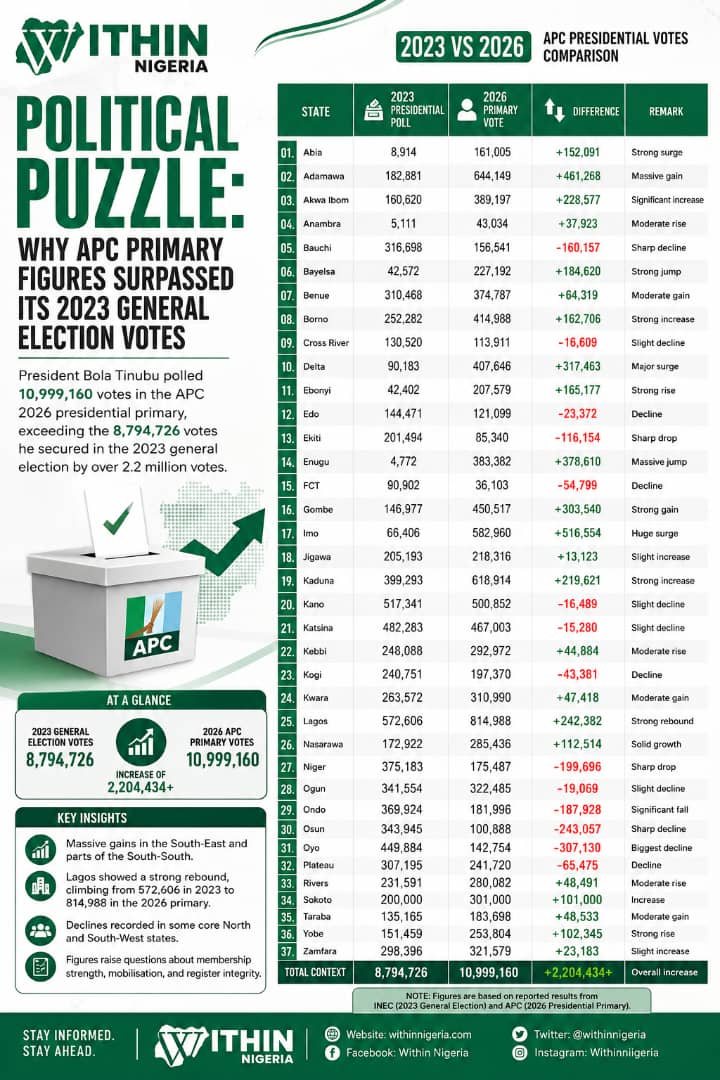
Adamawa State rose from 182,881 votes to 644,149, reflecting a gain of 461,268 votes in the APC internal contest.
Enugu State moved from 4,772 votes in 2023 to 383,382 in the primary, showing a surge of 378,610 votes.
Delta State also increased from 90,183 votes to 407,646, while Gombe rose from 146,977 to 450,517 in the same period.
Lagos State, Tinubu’s political base, climbed from 572,606 votes in 2023 to 814,988 in the primary, reflecting a gain of 242,382 votes.
Akwa Ibom, Kaduna, Bayelsa, Ebonyi and Borno also recorded substantial increases ranging from over 160,000 to 228,000 votes.
However, some northern and south-west states recorded declines compared with the 2023 general election figures.
Kano, Katsina, Ogun, Edo, Kogi and Plateau all showed moderate to significant reductions in APC primary votes compared with the previous general election.
Oyo State recorded the steepest decline, falling from 449,884 votes in 2023 to 142,754 in the 2026 primary, representing a drop of over 300,000 votes.
Osun, Niger, Ondo, Ekiti and Bauchi also posted sharp decreases, with Ekiti alone falling by more than 116,000 votes.
REGIONAL TRENDS AND POLITICAL IMPLICATIONS
The strongest gains were concentrated in the South-East and parts of the South-South, where APC historically underperformed during the 2023 general elections.
States such as Imo, Enugu, Ebonyi, Abia, Delta, Bayelsa and Akwa Ibom recorded some of the most dramatic increases in internal party votes.
In the South-West, Lagos showed a strong rebound, although other states such as Oyo, Osun, Ondo and Ekiti experienced declines.
The North-East presented mixed outcomes, with Adamawa and Gombe recording major gains while others showed modest growth or slight declines.
Party insiders attribute the surge in primary votes to intensified mobilisation efforts, expanded membership drives and the influence of political stakeholders within the APC structure.
In March 2026, the APC national leadership disclosed that about 12 million members had been registered and linked with National Identity Numbers in compliance with electoral regulations.
However, critics argue that internal party primaries often lack the level of scrutiny present in general elections, raising concerns about inflated figures and inconsistent voter verification systems.
They also point to differences in voter turnout patterns between general elections and party primaries as a possible factor, although they note that turnout gaps alone may not fully explain the disparity.
WHAT THE NUMBERS MEAN FOR 2027
Analysts say the figures suggest a party with strong internal cohesion and mobilisation capacity, even as it continues to face challenges in converting that strength into broader electoral appeal.
While the primary results reinforce President Tinubu’s dominance within the APC, they also highlight the gap between party-based support and national election outcomes.
The data is expected to intensify discussions around membership authenticity, electoral preparedness, and the party’s grassroots reach ahead of 2027.
Ultimately, the APC now appears internally consolidated, but the broader test remains how effectively it can translate internal numbers into votes at the national ballot.