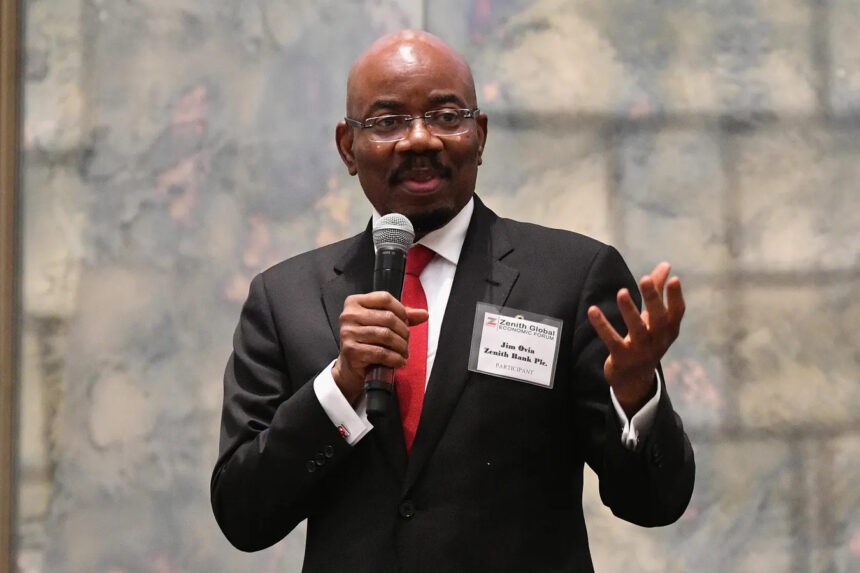
In May 1990, Jim Ovia registered a commercial bank with roughly twenty million naira in startup capital. By the time he stepped down from the chairmanship of that same institution in 2026, it held over thirty billion dollars in assets and had ranked as Nigeria’s largest bank by Tier-1 capital for sixteen consecutive years. The story of how that happened is not a straight line from ambition to success. It is a story shaped by grief, migration, calculated risk, and an unusual obsession with technology at a time when most Nigerian bankers were still processing transactions by hand.
Jim Ovia Success Story: How He Founded Zenith Bank
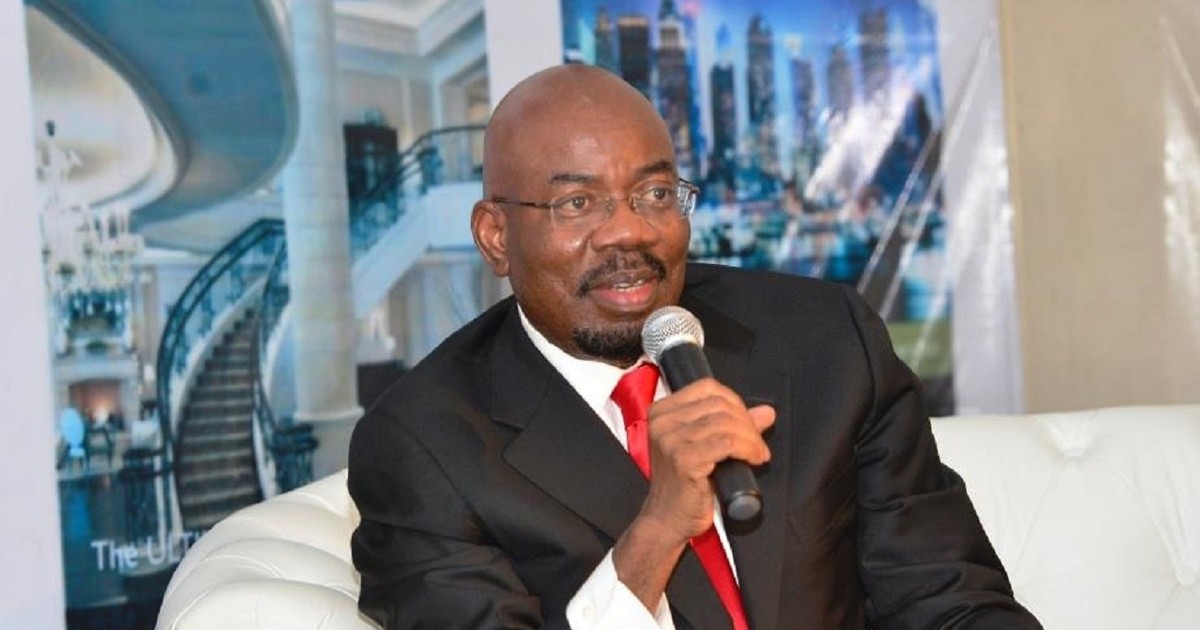
The Jim Ovia success story is, at its core, a study in long-horizon thinking. When he opened Zenith Bank’s first branch inside a converted residential duplex on Ajose Adeogun Street in Victoria Island, Lagos, the conditions were not exactly promising. Nigeria was under military rule, infrastructure was deteriorating, and the banking sector was flooded with new entrants chasing the same licenses. Ovia was betting not just on capital, but on a model of banking that most of his contemporaries had not yet imagined.
A Difficult Start in Agbor
Jim James Ovia was born on 4 November 1951, in Agbor-Obi, in present-day Delta State. His father died when he was four years old, leaving his mother to raise a large family largely on her own through small-scale trading. One of his older brothers, who was working in Lagos, sent money home to cover Jim’s school fees. That same brother eventually brought him to Lagos, where Ovia began his working life as a clerk at Barclays DCO, now Union Bank, in 1973.
Banking, as it turned out, suited him. He stayed in the industry, moving to International Merchant Bank where he rose to the position of Senior Manager. By 1987, he was heading the corporate finance department at the Merchant Bank of Africa. These were not just progressions on a CV. Each role gave him a front-row view of how Nigerian banking worked, and more importantly, how it could work differently.
What distinguished Ovia from many of his contemporaries was what happened when he left Nigeria for college in the United States. Enrolling at Southern University in Louisiana for a degree in Business Administration, he became fascinated with computer technology midway through his studies. He added computer science to his programme despite an uncle’s advice to stay focused on business. That combination, finance and technology, became the philosophical spine of everything he would build afterward.
American Education and the Technology Revelation
After his BSc from Southern University, Ovia completed an MBA at the University of Louisiana. He later attended the Owner/President Management programme at Harvard Business School. But it was his time as a part-time computer operator at Baton Rouge Bank and Trust Company in 1977, while still a student, that left the most durable impression. He saw, in real time, how computers could process banking information faster and more accurately than any team of clerks.
Nigeria’s banking sector in the late 1980s was, by contrast, almost entirely manual. Transactions were recorded on paper, branch operations were disconnected from each other, and the customer experience was slow and unreliable. When Ovia returned to Nigeria and resumed his banking career, he carried a conviction that this gap between how banking was done and how it could be done represented a real opportunity. The question was whether he had the nerve to act on it.
The Founding of Zenith Bank in 1990
Zenith Bank was established in May 1990 and commenced commercial operations in July of that year. The startup capital was N20 million, equivalent to approximately four to five million US dollars at the prevailing exchange rate of roughly four naira to the dollar. Ovia himself has described this figure as modest, but noted that the return on that initial investment over the following two decades was, in his words, record-breaking.
The bank’s first location was a residential property on Ajose Adeogun Street in Victoria Island, Lagos. The building was a duplex shared with a couple who occupied one wing while the bank operated from the other. Ovia’s team converted the garage into a customer service unit and repurposed the interior rooms into teller points. It was, by any reasonable definition, a bank operating out of a house. In time, the neighbors found the foot traffic from customers too disruptive and moved out, giving the bank room to expand into the full property.
The name Zenith was deliberate. Ovia wanted to communicate a ceiling, the highest point, not as a boast but as a direction. His stated ambition was to build a bank that would be the zenith of banking in Nigeria. The language was confident, but the early conditions demanded something more practical: survival.
Building a Bank Without Infrastructure
Nigeria in the early 1990s did not make things easy. Military governance created political uncertainty. Power supply was unreliable. Road conditions in many commercial districts were poor. Ovia has spoken candidly about what he termed a ‘Bring Your Own Infrastructure’ reality, where private businesses could not depend on the state for the basic utilities that banking operations require.
Zenith Bank invested in its own generators and power plants to ensure uninterrupted service. The bank drilled boreholes at some locations to maintain water supply. In areas without adequate road access, the bank built access roads to its branches. These were not symbolic gestures. They were operational necessities that added cost and complexity to running a financial institution at a time when competitors were navigating the same terrain.
What Ovia did differently was to treat technology not as an optional upgrade, but as the foundation of the entire operation. Zenith Bank implemented networked branches and data processing systems earlier than most of its peers. While other banks were still disconnected across locations, Zenith was building the internal architecture that would allow it to scale efficiently once the Nigerian economy opened up. By 1999, it had become one of the first banks in Nigeria to invest in internet banking services.
The Technology Advantage That Separated Zenith
Jim Ovia’s background in computer science was not incidental to Zenith Bank’s growth. It was structural. In an era when banking in Nigeria was synonymous with long queues, manual ledgers, and branch-level isolation, Zenith moved quickly toward electronic systems. The bank implemented full digital connectivity across its branches, allowing real-time data sharing and faster transaction processing.
This gave Zenith an edge in serving a specific kind of customer. Ovia was explicit about his target market. He was not building a bank for everyone. His focus was corporate clients, high-net-worth individuals, and businesses that demanded reliability and precision. Technology was the mechanism through which that promise could be kept consistently. As Vanguard reported in a profile of Ovia, his passion for technology-driven banking was a core factor in the institution’s transformation from a small Victoria Island operation to one of Africa’s largest financial entities.
The pattern continued. In 2004, when Zenith went public through an Initial Public Offering on the Nigerian Stock Exchange, the listing was oversubscribed, reflecting the confidence the market had developed in the institution Ovia had spent fourteen years building. He chose not to pursue the mergers and acquisitions that swept through the industry between 2006 and 2010. Zenith grew organically, on its own terms.
From Victoria Island to the London Stock Exchange
The physical trajectory of Zenith Bank tracks the ambition behind it. From the converted duplex on Ajose Adeogun Street, the bank moved progressively into purpose-built facilities. Its global headquarters is now the Zenith Heights building in Victoria Island, a structure that represents everything the original duplex was not. Meanwhile, the bank expanded geographically, establishing subsidiaries in Ghana, Sierra Leone, the Gambia, the United Kingdom, Dubai, and China.
In April 2007, Zenith Bank became the first Nigerian bank in twenty-five years to receive a license from the UK’s Financial Services Authority, leading to the creation of Zenith Bank UK Limited. This was not a symbolic outpost. It was a functioning subsidiary designed to serve the Nigerian diaspora and facilitate international trade finance. Six years later, in 2013, the bank achieved a Global Depositary Receipt listing on the London Stock Exchange, raising eight hundred and fifty million dollars at six dollars and eighty cents per share.
In 2017, the bank issued a five hundred million dollar Eurobond that was four times oversubscribed. By 2024, Zenith Bank was reporting total assets of approximately N29.96 trillion and gross earnings of N3.97 trillion. It earned the Euromoney Award for Best Bank in Nigeria in 2025, and in the same year posted N1.26 trillion in profit before tax. In the first quarter of 2026 alone, the bank recorded N360 billion in profit, tracking well ahead of the previous year’s full performance.
Twenty Years as CEO, Then the Long Goodbye
Jim Ovia served as Zenith Bank’s pioneer Managing Director and Chief Executive from the day the bank opened in 1990 until July 2010, a tenure of two full decades. When the Central Bank of Nigeria introduced governance reforms that capped managing directors at ten-year terms, his successor at the helm was Godwin Emefiele, who later became Governor of the Central Bank of Nigeria. Emefiele was followed by Peter Amangbo, and then in 2025, Dame Adaora Umeoji was appointed CEO. All of them came from within Zenith’s own ranks.
That internal succession model was deliberate. Ovia’s approach to talent development meant that the bank never needed to import senior leadership from outside. The institutional culture, the emphasis on technology, service quality, and governance, was sustained through people who had been trained inside it. It is one reason the bank’s identity remained stable through multiple leadership transitions.
After stepping down as CEO, Ovia transitioned to the role of Group Chairman in 2010. He held that position until May 2026, when he retired upon completing the mandatory twelve-year non-executive director tenure required under Central Bank of Nigeria corporate governance guidelines. His successor as chairman is Mustafa Bello, a former Nigeria Minister of Commerce and the bank’s longest-serving non-executive director.
A Business Empire Beyond the Bank
Zenith Bank is the most visible part of Jim Ovia’s portfolio, but not the only significant one. In 1995, while still CEO of the bank, he founded Cyberspace Limited, one of Nigeria’s pioneer internet service providers. He later established Visafone Communications Limited, a mobile network that grew to over three million subscribers before being acquired by MTN, Africa’s largest telecoms operator, in 2015 for an undisclosed sum.

He also developed the Civic Centre in Victoria Island, a hospitality and events venue that has become one of Lagos’s most recognizable commercial landmarks, alongside the Aquamarine Boat Club and the Civic Towers, a fifteen-floor office block informally known in Lagos business circles as Nigeria’s Empire State Building.
In education, Ovia has been equally active. He founded James Hope College in Agbor, Delta State, a boarding school where over half of students attend on scholarship. In 2021, James Hope University in Lagos received its operating license from the National Universities Commission. Through his Jim Ovia Foundation, he has sponsored over 1,500 students through university. The MUSTE initiative, Mankind United to Support Total Education, has produced graduates now working as doctors, engineers, lawyers, and accountants.
Recognition at Home and Abroad
The Nigerian government has honored Jim Ovia with three national awards: the Member of the Order of the Federal Republic in 2000, the Commander of the Order of the Niger in 2011, and the Commander of the Federal Republic, Nigeria’s third-highest national honor, in 2022. These were conferred by three different administrations, reflecting a continuity of recognition that transcends political cycles.
International recognition has followed a similar pattern. Forbes Africa named him the Godfather of Banking. The Africa-America Institute conferred the AAI Business Leadership Award in 2017. The University of Nigeria, Nsukka awarded him an honorary doctorate in Business Administration. In April 2025, he was admitted into the Freedom of the City of London at Mansion House, one of the most distinguished civic honors in the United Kingdom and a recognition tied to his influence on the global financial sector.
What the Jim Ovia Story Means for Nigerian Business
The instinct to read Jim Ovia’s success as a story about capital is understandable but incomplete. He started with twenty million naira. Plenty of businesses have started with comparable or greater funding and failed. What Ovia brought to Zenith Bank was a framework, a conviction that Nigerian institutions could operate at international standards, that technology was not a luxury, and that governance was not decoration but the actual mechanism of long-term survival.
His refusal to participate in the wave of bank mergers between 2006 and 2010 was a consequential decision. Many of his peers were consolidating, acquiring, expanding through purchase and assumption. Zenith stayed out and kept building organically. The bank that emerged was cohesive in a way that institutions assembled through rapid acquisitions often are not. Its culture was its own, not a blend of competing inherited ones.
The infrastructure challenges Ovia faced, building access roads, drilling boreholes, running private power plants, are familiar to any Nigerian entrepreneur who has tried to operate a serious business here. What changed over thirty-five years is not the infrastructure problem. It is the proof that it can be absorbed and overcome. Ovia built one of Africa’s largest financial institutions in the same environment that still routinely disrupts smaller businesses. That is the part of the story that has the most practical relevance.
The Zenith That Was Always the Destination
Jim Ovia stepped down as Zenith Bank’s chairman in May 2026, thirty-six years after he opened its first branch in a converted residential building on Victoria Island. The institution he leaves behind has over five hundred branches in Nigeria, subsidiaries across multiple continents, and a profit trajectory that is accelerating even after his departure. He is 74 years old.
The name he chose in 1990 was never accidental. Zenith means the highest point directly above a given position. As a description of institutional ambition, it is unusually honest, an acknowledgment that the destination is always up, and that getting there requires more than capital. It requires a willingness to absorb every structural failure Nigeria throws at you and keep moving. Ovia did exactly that, over thirty-six years, from a converted duplex to the global banking stage.