On the 18th of February 2026, President Bola Tinubu signed into law the Electoral Act 2022 (Repeal and Re-Enactment) Bill 2026, ending a legislative process that had consumed nearly two years, triggered street protests outside the National Assembly, and reopened every unresolved argument from the 2023 general elections. The signing came roughly 24 hours after the harmonised bill cleared both chambers, a pace that contrasted starkly with bills that had waited years for presidential attention.
The reform debate was never abstract. It grew from a specific and documented failure: during the 2023 presidential election, INEC uploaded only 31.8 percent of polling unit results to its Result Viewing Portal within 36 hours of polls closing, while collation centres in Lagos, Rivers, Kogi, and several northern states announced figures that differed materially from what BVAS devices had recorded at the units. The Supreme Court, when petitions reached it, ruled that IReV was merely a public viewing portal and carried no legal force. That judgment did not end the dispute. It relocated it to the National Assembly.
What the Electoral Act 2026 Amendment Means for Electronic Voting Transmission

The Electoral Act 2026 Amendment represents the most consequential statutory intervention in Nigeria’s result transmission framework since independent elections began. At its centre is Section 60(3), which converts electronic transmission from a policy preference into a legal obligation. How that obligation is qualified, and what those qualifications leave open, will shape the credibility of every election Nigeria holds from 2027 onward.
What the 2022 Act Actually Said and Why Courts Rejected Electronic Results
The Electoral Act 2022 was widely treated as a breakthrough, and in several respects it was. It introduced the Bimodal Voter Accreditation System, expanded timelines for petitions, and signalled an intent to use technology for result management. But Section 60(5) of that Act stated only that the presiding officer shall transfer results ‘in a manner as prescribed by the Commission.’ It said nothing about electronic systems, nothing about the internet, and made no mention of the IReV portal.
Section 50(2) reinforced this discretion by placing the entire transmission process within the Commission’s operational guidelines. When disputes from 2023 reached the courts, judges followed the law as written. The Supreme Court held in multiple judgments, including Lawal v. Maitawalle and Ifeanyi v. INEC, that electronic transmission was directory rather than mandatory, meaning non-compliance did not automatically invalidate an election result where manual collation had been properly conducted. The Court of Appeal had similarly ruled that the law did not require immediate electronic transmission as a condition for result validity.
In summary: INEC had deployed technology without the statute demanding it, which meant courts could not compel the commission to rely on the data that technology produced. Citizens watched results on IReV that contradicted what collation centres announced, and the law provided no mechanism to act on that discrepancy.
The Legislative Battle: From Rejection to Emergency Session
The original committee proposal for the new Act contained three elements in a revised Section 60(3): mandatory electronic transmission, explicit statutory recognition of the IReV portal, and a requirement that transmission happen in real time while polling agents and observers were still present at the unit. That sequence mattered. Real-time upload during counting would have closed the window in which results could be altered between a polling unit and a collation centre.
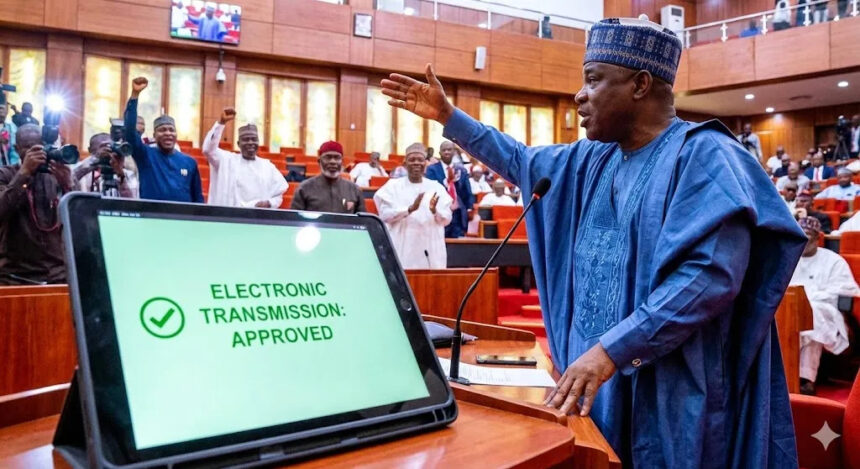
When the bill came before the Senate on the 4th of February 2026, the chamber rejected the committees’ proposal and voted to retain the existing framework from the 2022 Act. The decision triggered nationwide protests. Civil society organisations and opposition figures condemned the vote. Former Vice President Atiku Abubakar, who had joined the African Democratic Congress in late 2025, was among the vocal critics. Faced with public pressure, the Senate reconvened for an emergency session on the 10th of February and reversed its position.
The House of Representatives, which had passed a version mandating real-time transmission in December 2025, subsequently rescinded that position during a harmonisation session on the 17th of February, aligning instead with the Senate’s revised clause. The bill passed both chambers and received presidential assent the following day.
Section 60(3): What the Law Now Actually Requires
The enacted version of Section 60(3) reads, as confirmed by Senate President Godswill Akpabio during the emergency session: ‘The presiding officer shall electronically transmit the results from each polling unit to the IREV portal and such transmission shall be done after the prescribed Form EC8A has been signed and stamped by the presiding officer and/or countersigned by the candidates or polling agents where available at the polling units. Provided that if the electronic transmission of the results fails as a result of communication failure, the result contained in Form EC8A signed by the presiding officer shall be the primary source for collation and declaration of results.’
The law also gives statutory recognition to the Bimodal Voter Accreditation System under Section 47, and Section 60(6) prescribes a penalty of six months imprisonment, a fine of N500,000, or both, for any presiding officer who wilfully frustrates electronic upload. Senate Leader Michael Opeyemi Bamidele described this penalty provision as directly responsive to public demands, noting it attaches accountability to the transmission obligation in a way the 2022 Act never did.
What Changed for Election Tribunals: The Admissibility Question
The practical legal shift is significant. Under the 2022 framework, courts consistently treated IReV data as having no determinative weight over manually collated figures. Under the 2026 Act, election tribunals in 2027 are obligated to receive IReV data as admissible evidence and engage with it. That is not a minor procedural shift. It means a petitioner can now point to what the IReV portal recorded and require a court to address the discrepancy between those figures and what was declared.
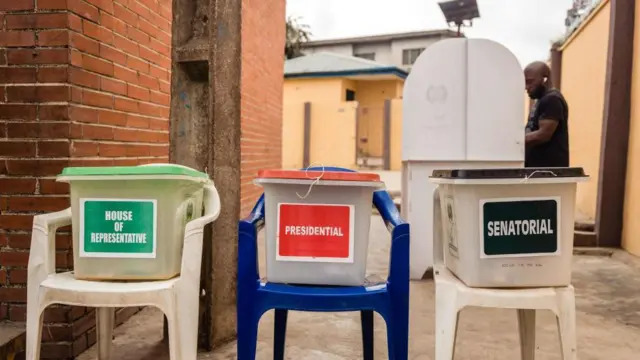
The more contested question is evidentiary weight rather than admissibility. The Act creates a statutory hierarchy in which the manual Form EC8A is described as ‘the primary source’ when communication failure is claimed. In such circumstances, IReV data functions as corroborating rather than determinative evidence. Tribunals encountering a conflict between the two will face a question the Act leaves entirely unanswered: what standard of proof governs a challenge to a presiding officer’s claim of communication failure? Legal analysts writing in TheCable and on OAL Law’s platform have identified this gap as the most likely generator of appellate litigation after 2027, with first-instance decisions likely to diverge before higher courts establish a consistent standard.
The Undefined Loophole: What ‘Communication Failure’ Does Not Mean
The Act nowhere defines ‘communication failure.’ It does not state whether the term covers complete network absence, intermittent connectivity, server congestion at INEC’s end, equipment malfunction, human error in operating the device, or deliberate interference. It establishes no procedure for certifying that failure has occurred. It creates no independent verification mechanism, no requirement for INEC technical staff to investigate, and no standard by which a collation officer can reject a claimed failure and demand electronic submission.
This is not a hypothetical concern. In 2023, INEC cited ‘technical glitches’ to account for delays in uploading results, and the commission offered no detailed explanation. The institution that failed to upload 68.2 percent of presidential results within 36 hours of polls closing remains the institution that would, under the 2026 Act, have primary discretion in determining when transmission has failed. Commentators including the EiE Nigeria civic organisation and Premium Times have made this point directly: the law mandates transmission without protecting the legal integrity of what transmission produces.
Kenya’s approach is frequently cited as a contrasting model. Kenya’s electoral commission is legally required to test and certify its transmission infrastructure at least 60 days before any election, and electronic results form part of the official legal record from the moment of upload. Nigeria’s law takes a different path: the obligation to transmit exists, but the mechanism for its enforcement remains substantially in the hands of the same institutional actors whose discretion the 2022 Act had already made problematic.
The Broader Reforms: BVAS, PVC Downloads, and Penalties
Electronic transmission dominated the public debate, but the 2026 Act introduced several other changes with direct practical consequence. Section 47 gives BVAS statutory recognition for the first time, removing the ambiguity that allowed some polling units during 2023 to revert to manual accreditation without legal challenge. BVAS had been deployed under INEC’s operational guidelines rather than an explicit statutory mandate, which created the same vulnerability that the 2022 Act created for IReV.

The Act also allows registered voters to download their Permanent Voter Cards directly from INEC’s website. In 2023, millions of PVCs went uncollected because physical collection involved wrong centres, inadequate notice, and logistical failures that fell hardest on working Nigerians in urban areas. Digital access removes that barrier without requiring any change to the underlying registration system.
On campaign finance, the Act introduces limits on spending and strengthens the framework for pre-inauguration dispute resolution, requiring election petitions to be filed and resolved before a declared winner takes office. On penalties for vote-buying, the Senate removed a proposed 10-year ban for persons convicted of purchasing voter cards, describing it as disproportionate, and replaced it with a N5 million fine and a two-year custodial sentence.
The Act also reduces the timeline for releasing election funds to INEC from 12 months to 6. The funding timeline change has drawn less attention but carries real risk. Before the 2022 Act, INEC had no guaranteed timeline at all and negotiated funds from the executive each cycle. Halving the planning window reduces the commission’s buffer against late disbursements, particularly for an election spread across presidential, National Assembly, governorship, and state assembly contests.
What Signing Within 24 Hours Signals
The speed of assent drew pointed commentary. President Tinubu signed the bill within roughly 24 hours of passage, while acknowledging Nigeria’s broadband limitations as a reason not to require real-time transmission. Critics noted the contrast between that pace and bills that had waited years for executive attention, reading the timing as evidence of tacit coordination between the Presidency and the National Assembly to close the matter before pressure could build for a stronger Clause 60.

At the signing ceremony, Senate President Akpabio described Tinubu as ‘the first president to introduce electronic transmission of results from the polling units to the entire world,’ and noted that even where network is absent, officials can carry a result to a networked location for later upload. Transparency advocates responded that ‘later upload’ is exactly the window through which manipulation has historically occurred, and that the law as signed does not close it.
The Implementation Test That Matters
Nigeria’s electoral challenge has historically been less about the absence of law than about enforcement discipline. The 2022 Act was, by the standards of Nigerian electoral legislation, a progressive document. What happened in 2023 was not a failure of statute so much as a failure of institutional compliance, political will, and judicial capacity to impose consequences in real time.
The 2026 Act is more explicit than its predecessor. Electronic transmission is now mandatory by statute, BVAS has legal backing, IReV data is admissible in court, and presiding officers face a specific criminal penalty for wilful non-compliance. These are genuine advances. Whether they translate into a meaningfully different 2027 election depends on four things that no statute can directly control: whether INEC builds and certifies infrastructure before polling day, whether the commission documents and accounts for any claimed transmission failures, whether tribunals apply the new evidential framework with consistency, and whether political actors with influence over presiding officers find the cost of obstruction has actually risen.
The 2027 general elections are scheduled for the 16th of January (presidential and National Assembly) and the 6th of February (governorship and state assemblies). That timetable leaves INEC a narrower runway than any comparable election cycle since the return of democracy in 1999. The Electoral Act 2026 has changed the legal architecture. Whether the institution meets the architecture is the question that will be answered at the polls.