In the absence of a marketable and competitive league, local Academies are one of the reliable and strategic routes for a player to ply his trade in Europe. With the right policies and investment in sport, particularly football, in Nigeria, the country can leapfrog other nations and become a powerhouse in the export of football players.
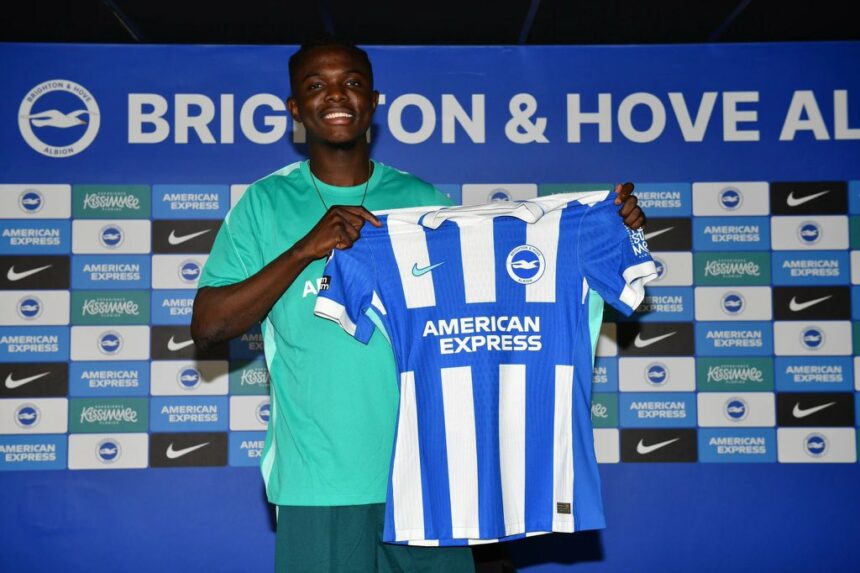
Last week, English football club, Brighton Albion, announced the signing of talented and sensational teenager, Zadok Yohanna, from AIK Stockholm for £21.5 million. The signing of Yohanna sparked a frenzy, leaving social media abuzz. The signing dominated public discourse on social media. The development was as surreal as it was delightful and heartwarming. At a time when Nigerian football is short on joyful and inspiring news, Yohanna’s move to Brighton and the story of his meteoric rise to stardom are an uplifting and cheerful silver lining for many forlorn football aficionados in Africa’s most populous nation.
Yohanna’s story is what unfolds when raw talent, hard work, tenacity and determination meet grace, humility and luck. As early as last year, he was playing football on the streets of Kaduna. Just two or three years ago, Yohanna was on June 29, 2007, in the backwaters of Bauchi state in North East Nigeria. Where he was born, civilisation and the trappings of modernity are a thing of distant allure for a prodigious child like Yohanna. Determined to make it, the talented teenager, armed with nothing but discipline and determination to make it, took an audacious decision to leave his bucolic hometown and journeyed to Kaduna for prospects and better opportunities.
Yohanna’s story, while distinct in its reality, underscores what Nigerian football has become. A place where talents are nurtured, refined and harnessed, a pipeline of prodigious and determined footballers that feeds the demands of foreign football clubs who want talented but relatively cheap players. A cauldron of stylish, brilliant and fascinating footballers waiting to explode. Like Zadock, hundreds and thousands of players migrate to other countries in search of experience and life-changing opportunities as part of the Nigerian football player export boom.
According to the 2026 CIES Observatory player exports, Nigeria is once again ranked 6th, maintaining its enviable position as the top player-exporting country in Africa and top-10 in the world. A total of 565 players of Nigerian origin moved to around 75 countries in the 2025-2026 season compared to over 300 that moved in 2021.
The Czech Republic (46), Serbia (29), and Slovakia (23) are the top three destinations for Nigerian players.
Nigerian Football Player Export: Czechia Pathway
CIES Migration Atlas disclosed that Czechia is the top destination for Nigerian player exports. Also, according to FBref, Nigeria is the second-most popular foreign nationality in the 2025/26 Czech First League, both for the number of players to feature and their combined minutes; only Slovakia has more.
Approximately 45 Nigerian players are competing across the top two tiers of Czech football and its youth ranks. A strategic route brings many Nigerian players to the country, with several high-performing and standout U19 prospects making their mark and dominating the league.
Football Academy Routes
In the absence of a marketable and competitive league, local Academies are one of the reliable and strategic routes for a player to play for a European club. This is why Banik Ostrava appointed Babawo Mohammed as the chief scout for Africa.
Babawo Mohammed is a formidable and consequential figure in the business of moving Nigerian players to Czechia, acting as both scout and agent. In an interview with SportsIntel, he reveals why Czechia is the destination of choice for Nigerian players.
“Playing time allows African players to showcase themselves and to develop themselves because they don’t have a limit on foreigners in their youth. And their youth league is very very competitive, more than many countries in Europe. So that’s the reason a lot of your African players are going there,” he said.
Just like Banik Ostrava, Slavia Prague signed a lengthy partnership deal with the Right2Win Academy, headquartered in Umuahia with strong ties to the capital city of Abuja.
Global Ranking: CIES football observatory 2025
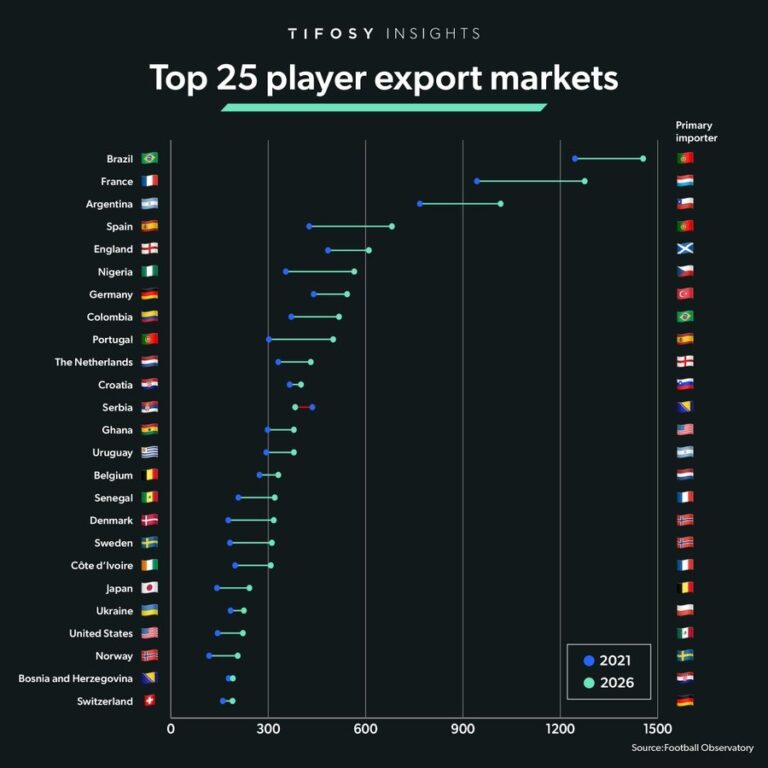
Brazil keeps its position as the world’s leading exporter of men’s footballers, with nearly 1,500 players shipped to foreign football markets.
Among the top 25 exporting nations, the total number of players sent abroad has increased by 33% compared to 2021, underscoring a significant increase in international migration at the top of the market, with growth in the next 25 nations reported at 16%.
The top three markets account for nearly one-third of all exports from the group, with France reporting the biggest exponential increase. Considerable growth was also recorded in Spain, Nigeria and Portugal, whilst only one country experienced a decline in the number of players exported.
With the right policies and investment in sport, particularly football, in Nigeria, the country can leapfrog other nations and become a powerhouse in the export of football players.