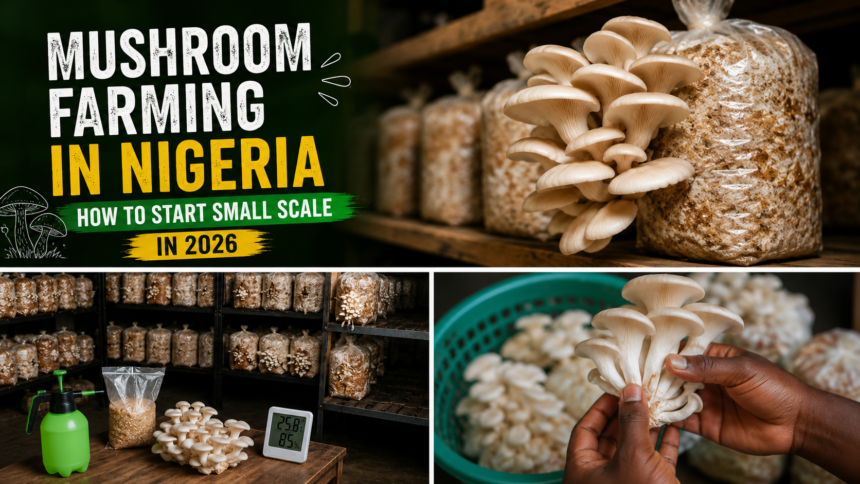
Nigeria grows roughly 300 tonnes of mushrooms a year. The country needs about 1,200. That gap, confirmed by the National Farmers Information Service, is not a crisis on paper but a live business opportunity sitting in plain sight. The difference is being covered by imports while local farmers, many of whom do not even know mushroom cultivation is an option, leave that market completely untouched.
This is a crop that does not need land in the conventional sense. A spare room, a shaded shed, even the back of a rented apartment space in Lagos or Ibadan can host a functioning mushroom farm. The inputs are largely agro-industrial waste: sawdust from timber yards, rice bran, corn cobs, cassava peels. These are materials people in Nigeria literally burn or throw away. Meanwhile, the retail price of oyster mushrooms in Lagos and Abuja markets sat between roughly N7,280 and N13,195 per kilogram in 2025, according to pricing data from Selinawamucii. The numbers are hard to argue with.
What keeps most people out is not cost or space. It is unfamiliarity. Mushroom farming looks complicated from the outside, particularly to someone who grew up knowing mushrooms only as things that appear on dead wood after rain. But the process, once broken down, is more manageable than many other small-scale farming ventures Nigerians already take on.
Mushroom Farming Nigeria: How to Start Small Scale
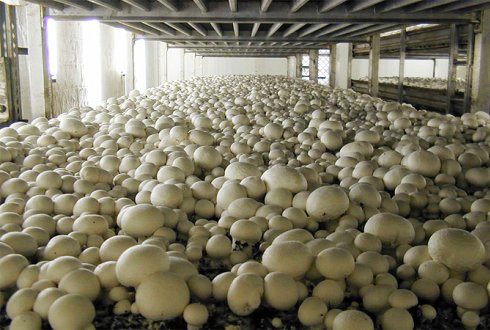
Mushroom farming in Nigeria is one of those agricultural businesses where the gap between what the country produces and what it actually consumes does most of the selling for you. Understanding the process, the costs, the right species, and where to find buyers is what separates the people making money from it and the people still wondering whether it is real.
Why Nigeria Still Imports Most of Its Mushrooms
The production deficit is not a recent development. Nigeria has never come close to meeting its own mushroom demand, and that has been the reality for years. While countries like China dominate global mushroom output and supply much of what ends up on shelves worldwide, Nigeria’s own cultivation sector has remained at the fringes of its agricultural economy.
Part of the reason is perception. For a long time, mushrooms were treated as something found in the wild, not something grown deliberately. Many Nigerians, particularly outside urban centres, associate edible mushrooms with the seasonal clusters that appear on tree stumps during the rainy season. The idea of growing them indoors on sawdust year-round, at scale, and selling them to hotels and supermarkets felt distant from that image.
Another factor is awareness. Unlike poultry or catfish farming, mushroom cultivation never had a strong extension service push in Nigeria. The Federal Institute of Industrial Research Oshodi (FIIRO), which has been working on mushroom cultivation research and training since 1988, remains one of the few formal institutions actively promoting it. Their spawn production centre was built precisely to supply the needs of smallholder farmers across Nigeria and the broader West African region. But knowledge of that resource has not reached most Nigerians who could benefit from it.
The result is a country where over 90 percent of the mushrooms consumed are sourced from outside its borders. That figure, repeated across multiple agribusiness analyses, reflects a structural gap that small-scale farmers can begin to fill without needing millions of naira to get started.
The Species That Actually Make Sense for Nigerian Farmers
Not every mushroom that exists is practical to cultivate in Nigeria. Some require highly controlled temperature environments that are difficult and expensive to maintain in a tropical climate. Others have limited market awareness, which means even a good harvest creates a sales problem. The species that Nigerian smallholders consistently succeed with are a shorter list.
Oyster mushrooms (Pleurotus species) are the most popular for good reason. They grow quickly, reaching harvest in as little as five to six weeks from spawning. They tolerate Nigerian temperature conditions better than most varieties, can grow on almost any organic substrate, and have a broad enough market base that buyers are not hard to find. Oyster mushrooms are what most training programmes, including FIIRO’s, focus on first.
Button mushrooms (Agaricus bisporus) are widely consumed and well-known in Nigerian urban markets, particularly among expatriates, upscale hotels, and restaurants. However, they require a more specific compost preparation process and a narrower temperature range, which makes them more technical to cultivate. For beginners, they are generally not the starting point.
Shiitake mushrooms have strong medicinal appeal and command premium pricing. They are increasingly sought after in health-conscious consumer markets in Lagos and Abuja. They grow on hardwood sawdust and take longer to produce, but the higher price point rewards farmers who manage the extra effort.
For a first-time mushroom farmer in Nigeria operating on a small budget, oyster mushrooms are the obvious starting choice. Low cost substrate, fast turnaround, established buyers, and relatively forgiving growing conditions make them the most practical entry point into the market.
What You Need to Set Up a Small-Scale Mushroom Farm
The minimum you need to start is a space you can control. That means somewhere sheltered from direct sunlight, with enough ventilation to maintain air flow, and where you can keep a consistent level of humidity. A small room, a converted store, a greenhouse-style structure, or even a shaded outdoor shed with plastic sheeting can work. Mushrooms do not need soil and they do not need large acreage.
Temperature management matters more than most beginners expect. Oyster mushrooms grow best between 15 and 30 degrees Celsius. In most of southern Nigeria, ambient temperatures fall within that range for much of the year, but during the dry season when heat peaks in the afternoon, growers often need to manage conditions through regular misting or shade materials. Fans help with air circulation, which is critical because stale, humid air without movement encourages contamination.
Startup costs at small scale are genuinely low compared to most agricultural ventures. Etimbuk Imuk, founder of Eti Farms Global in Lagos, one of the most recognized mushroom enterprises in Nigeria, has stated that with N50,000 to N100,000 a person can cultivate mushrooms for home use or small commercial purposes, depending on whether growing space is already available or needs to be built. For anyone who has a room or shed they can repurpose, the cost drops significantly toward the lower end of that range.
Scaling up costs more. A micro operation (under 100 bags) can be started for around N50,000. A medium-scale setup running 200 to 500 bags typically sits between N80,000 and N200,000 depending on structure costs. A fully commercial setup with 1,000 bags or more, including building a proper growing house, can run from N300,000 to N1 million or beyond. But none of this needs to happen at once. Many successful Nigerian mushroom farmers start with 20 or 30 bags, learn the process, find their buyers, and scale from there.
Basic equipment needed includes polythene bags for substrate preparation, a sterilization setup (most small-scale farmers use a drum and firewood for heat treatment), hand gloves, methylated spirit for hygiene, and a spraying bottle or pump for misting. None of these are expensive items in Nigerian markets.
Substrate: The Material Your Mushrooms Will Grow On
Because mushrooms are saprophytic, they feed on decaying organic material rather than soil. The substrate is the growing medium, and choosing the right one, preparing it correctly, and sterilizing it before inoculation with spawn is the most critical part of the entire process. Get this wrong and contamination will destroy a batch before it ever produces anything.
Sawdust from timber yards is the most commonly used substrate in Nigeria and the cheapest. FIIRO itself built much of its current cultivation technology around sawdust, supplementing it with rice bran, wheat bran, or palm kernel cake to increase yields. These additives provide extra nitrogen that the mushrooms need to produce well. Bags of sawdust are available for almost nothing near any active timber or furniture workshop, and in a country where sawdust is typically burned as waste, sourcing it is straightforward.
Other materials that work well include corn cobs, cassava peels, cotton waste, plantain leaves, and rice husks. The specific substrate mix will affect how much the mushrooms produce. Pure sawdust without supplements generally yields less than sawdust mixed with wheat bran at a ratio of roughly 85 to 15. Farmers who spend time getting this right usually see noticeably better harvests.
Heat treatment before spawning is non-negotiable. Competing microorganisms in the substrate, including bacteria and moulds, will outcompete mushroom mycelium if they are not eliminated first. Small-scale farmers typically pack the prepared substrate into polythene bags, then steam or boil them using a drum setup for one to three hours. After cooling for 24 hours in a clean environment, the substrate is ready for inoculation. Any shortcut at this stage is the fastest way to lose an entire batch.
The Growing Process, Step by Step
Once the substrate bags are sterilized and cooled, spawn is introduced into each bag. This is done by layering spawn and substrate alternately inside the bag, or by mixing them before bagging depending on the farmer’s method. The bags are then sealed and moved to the growing room, where they remain during the colonization phase.
Colonization is the period when the mycelium spreads through the substrate. The bags look white and web-like inside as the fungal network grows. This phase takes roughly two to four weeks depending on species, temperature, and substrate quality. During this time, the bags need minimal intervention beyond ensuring the room stays at the right temperature and has some indirect light. Complete darkness slows the process slightly.
After full colonization, the bags are moved to the fruiting stage. This is where conditions shift. Growers cut small holes or slits into the bags, which triggers the formation of fruiting bodies. The room needs increased humidity at this point, typically maintained through regular misting of both the bags and the growing room floor. Oyster mushrooms produce visible pins within a few days of shifting to fruiting conditions, and are ready for harvest when the caps are fully open but before the edges start to curl under.
Harvesting is done by twisting the mushroom cluster off the bag at the base. If done cleanly, the bag will produce two to four more flushes before yields decline. This is the key economic advantage of mushroom farming over many other crops: one investment in spawn and substrate produces multiple harvests from the same bag over the span of several weeks.
After the final flush, the spent substrate is not waste. It can be composted or used as animal feed supplement, completing a cycle that produces almost no material loss.
Where to Get Spawn in Nigeria
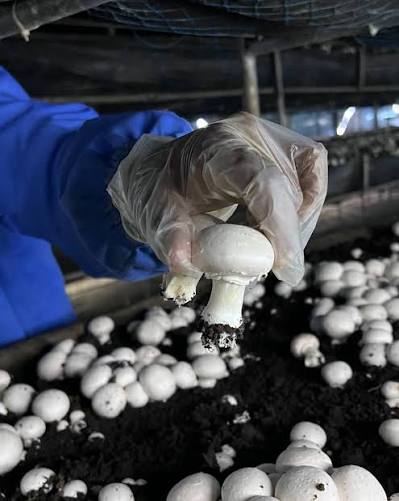
Spawn is the mushroom equivalent of seeds, and sourcing it from a reliable supplier is one of the most important decisions a beginning farmer makes. Low-quality or contaminated spawn produces poor yields or fails entirely, which is exactly the kind of early loss that discourages new farmers from continuing.
FIIRO in Oshodi, Lagos is the most widely cited institutional source for spawn in Nigeria. The centre was set up specifically to supply spawn to smallholder farmers and has been operational since the late 1980s. They produce and sell oyster mushroom spawn among other varieties, and also offer training on cultivation techniques. For anyone starting in Lagos State, FIIRO is the most accessible formal source.
Outside Lagos, the Rivers State University hosts DILOMAT, another known spawn supplier that has been referenced in agricultural guides for Nigerian mushroom farmers. Universities of Agriculture and relevant research institutes in other states sometimes provide spawn as well, though availability varies.
Private suppliers have also emerged in recent years, selling spawn through online marketplaces and agricultural forums, including listings on platforms like Nairaland’s agriculture section. When buying from private sellers, first-time farmers should verify the supplier’s track record, look for references from other buyers, and start with a small quantity before committing to a large purchase. Poor spawn quality is not always visible to the eye, which makes supplier reputation the main filter.
Training programmes are worth factoring into early planning. Several established mushroom farmers in Nigeria offer hands-on workshops that cover substrate preparation, spawn inoculation, and farm management. The cost varies, but a weekend or week-long practical session with an experienced farmer is often worth more than any amount of reading alone. Etimbuk Imuk of Eti Farms Global, who trained at FIIRO before building her own operation, described how she spent time working on another farmer’s mushroom operation before starting her own. As she explained in an interview with Punch: “When I could no longer meet the demand for mushrooms from the person’s farm, I knew I had to start my own farm.” That progression from learning on someone else’s setup to building your own is a pattern that comes up repeatedly among successful Nigerian mushroom farmers.
What Mushrooms Actually Sell For, and Who Is Buying
Pricing is where mushroom farming becomes genuinely compelling for anyone doing the maths. Fresh oyster mushrooms in Nigeria’s major urban markets currently sell at retail between N7,280 and N13,195 per kilogram in Lagos and Abuja, based on 2025 price data. Dried mushrooms fetch significantly more per kilogram because the weight reduces dramatically in drying but the nutritional content concentrates.
Agric consultant Chinedu David, cited in a Tribune Online report on mushroom farming, spelled out the arithmetic with oyster mushrooms: 25 growing bags yield approximately 500 kilograms of produce, and at N2,000 per kilogram, that is N1,000,000 from a single growing cycle. The scale of that number surprises people who assume you need a large farm to generate meaningful revenue, but mushroom farming’s yield-per-square-metre is higher than almost any other crop Nigerians commonly grow.
The buyers are already there. Hotels, particularly four- and five-star properties in Lagos and Abuja, use mushrooms consistently in their kitchens. Mid-range restaurants and upscale food spots serving continental or Asian-inspired menus need reliable fresh mushroom supply and often struggle to find local sources. Supermarkets are another major channel. Eti Farms Global, based in Lagos, supplies over 70 supermarkets nationwide, which gives a sense of how far a well-run small operation can grow its distribution.
Health-conscious urban consumers are a growing direct market. Instagram and WhatsApp-based food businesses have made it easier for mushroom farmers to sell directly to buyers at full retail price rather than the discounted wholesale rate. Mushroom powder, dried mushroom packs, and processed mushroom products also add value-added options that extend shelf life and open new price points. A kilogram of fresh oyster mushrooms is one thing; 150 grams of sun-dried oyster mushrooms, packaged neatly, carries a premium that the fresh market does not always reach.
The Real Challenges You Will Face
Mushroom farming has genuine advantages but it is not straightforward, and the things that go wrong for new farmers are predictable enough that they are worth naming directly.
Contamination is the most common and most frustrating problem. If substrate sterilization is incomplete, or if the growing room is not kept clean, mould competes with the mushroom mycelium and destroys batches. Green mould (Trichoderma) is the most common culprit in Nigerian conditions. It is fast-spreading and very difficult to treat once established in a bag. The only real defence is discipline with hygiene at every stage.
A study published through ResearchGate examining mushroom farmers in Oyo State, Nigeria, found that the main constraints they faced were poor marketing channels (reported by 72.7 percent of farmers), lack of access to credit facilities (71.3 percent), and inadequate information on cultivation (68.5 percent). The last two are solvable over time, but the marketing challenge is real. Growing mushrooms is only half the work. Consistent selling requires building relationships with buyers before harvest, not after.
Power supply affects farms that depend on fans or electric misters for humidity and ventilation control. A farm that is functioning well during a long power outage can tip into contamination or dryness problems faster than expected. Generators add to operating costs, and the economics need to account for that fuel expense honestly.
Storage is another consideration. Fresh mushrooms have a short shelf life of a few days at room temperature. Without refrigeration or access to rapid buyers, a large flush can spoil before it is sold. Learning to dry or process excess harvest is a skill that protects against this, but it requires understanding the market for dried product as well.
What Small-Scale Mushroom Farming Success Looks Like in Nigeria
The mushroom farming success stories coming out of Nigeria share a few consistent patterns. They almost never started large. Etimbuk Imuk of Eti Farms Global, whose NAFDAC-certified products now reach supermarkets across multiple states, began by learning the trade at FIIRO and then working with another farmer before launching her own operation in August 2019. She holds a degree in Soil Science from the University of Calabar and has since trained over 58 people in mushroom cultivation. Her farm in Lagos has produced more than 100,000 packs of mushrooms and is recognized as the leading mushroom startup in the city.
Etimbuk Brownson, whose Mushroom Meals Hangout in Lagos has become a hub for mushroom enthusiasts, has made a similar point about the logistics of getting started. His farm sits on a quarter plot of land, and he has emphasized that the crop requires no pesticides or chemicals: “You don’t need chemicals or pesticides to grow mushrooms. It’s an organic farming system whose duration is not time consuming,” he told Daily Trust in 2025.
The pattern that connects successful Nigerian mushroom farmers is not the size of their initial investment. It is how early they built their market. Almost every farmer who succeeded prepared their buyers before their first harvest, not after. They sold to one restaurant or one supermarket contact while they were still in the learning phase. By the time they had produce to move, they had somewhere to move it.
The global mushroom farming market was valued at USD 76 billion in 2025 by IMARC Group and is projected to grow toward USD 123.7 billion by 2034. That trajectory is driven by rising demand for plant-based protein, health foods, and sustainable agriculture. Nigeria sits at the precise intersection of all three trends, with a young urban population increasingly concerned with what it eats and a domestic supply chain that cannot yet keep up with the market it has already created.
The Opportunity Is Not Getting Smaller
Mushroom farming in Nigeria is one of those businesses where the structural case for it is almost too obvious. The local market is undersupplied. The raw materials are cheap and widely available. The startup costs are low enough that a person with N50,000 and a spare room can test the business without betting their savings on it. The buyers, ranging from hotels to supermarkets to individual health-conscious consumers ordering through WhatsApp, are already there and looking for reliable local suppliers.
What the industry still lacks is enough knowledgeable farmers working at small and medium scale to close the production gap. FIIRO in Oshodi remains the most accessible formal resource for Nigerians who want to learn the craft properly, and the practical route of training under an experienced farmer before starting independently has proven itself repeatedly.
This is not a business where the question is whether there is demand. The question is whether the person asking is willing to go through the learning curve that sterilization, hygiene, and market development require. For those who are, the numbers that Chinedu David laid out, N1,000,000 from 25 bags of oysters, are not exaggerations. They are what the market already pays. The farm just has to be built first.