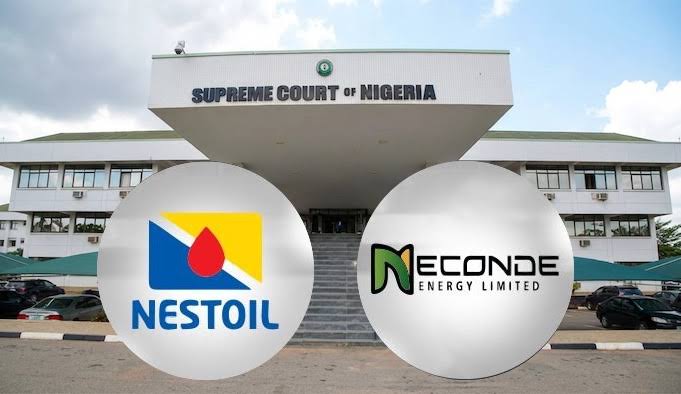
Nigeria’s oil finance ecosystem rarely moves quietly when large scale credit structures begin to strain under pressure, especially when upstream energy assets sit at the center of repayment obligations that stretch into billions of dollars. The dispute involving Nestoil Limited and Neconde Energy Limited has drawn sustained attention because it unfolds at the intersection of lending power, petroleum revenue flows, and judicial authority over corporate control. What began as structured financing arrangements tied to oil production assets gradually evolved into a legal contest that now sits within the highest tiers of Nigeria’s judicial system.
Financial exposure estimated at 1.1 billion dollars set the tone for a dispute that quickly moved beyond routine credit recovery discussions. The involvement of major financial institutions such as FBNQuest Merchant Bank and First Trustees Limited introduced additional layers of complexity because syndicated lending structures often rely on coordinated enforcement actions when repayment challenges arise. As the matter progressed through interim orders, receivership arrangements, and appellate scrutiny, the central question shifted toward how far courts can go in protecting creditor interests before a full trial determines liability.
Public attention intensified when interim judicial decisions began affecting operational control of energy assets linked to production and revenue generation. Each procedural step added new dimensions to the dispute, especially as freezing orders and asset oversight mechanisms intersected with active petroleum operations. By the time the matter reached the Supreme Court in June 2026, the case had already become a defining reference point for discussions on financial enforcement boundaries in Nigeria’s energy sector.
Formation of Credit Exposure Structure
Credit relationships between large scale energy operators and financial institutions typically begin with structured financing agreements tied to projected production capacity and revenue performance. The arrangement at the center of this dispute was built around upstream petroleum development funding and associated operational expansion within oil producing assets. Lending decisions were anchored on expected cash flow stability derived from crude oil output and joint venture participation structures that supported repayment scheduling.
Within this structure, syndicated lenders led by FBNQuest Merchant Bank extended facilities designed to support both operational continuity and asset development. The exposure reached approximately 1.1 billion dollars, reflecting multiple layers of credit instruments rather than a single loan agreement. Trust administration and security perfection responsibilities were partially coordinated through First Trustees Limited which played a role in structuring creditor safeguards tied to underlying collateral arrangements.
Operational expectations were closely linked to petroleum output performance, which meant that repayment capacity depended heavily on uninterrupted production flow. The financing architecture assumed stable oil revenue generation over time, supported by contractual protections embedded within asset backed lending frameworks. As global oil price fluctuations and domestic operational variables interacted, pressure began to build on repayment timelines, creating early signals of financial stress within the structure.
Emergence of Repayment Dispute
Tensions began to surface when repayment obligations under the financing agreements were not fully met within expected timelines. The lenders position centered on the assertion that contractual repayment terms had been breached, triggering enforcement rights under the syndicated facility documentation. Attention shifted quickly toward recovery mechanisms designed to protect the outstanding exposure, particularly given the scale of financial commitment involved.
The borrowing entities maintained that enforcement actions required careful judicial oversight due to the complexity of asset structures involved in upstream oil operations. Production linked revenue streams formed the core of the repayment architecture, which meant that any aggressive enforcement strategy risked disrupting operational continuity. As disagreements intensified, legal filings became the primary mechanism through which both sides attempted to assert control over interpretation of contractual obligations.
At this stage, the dispute was no longer limited to repayment timing alone. It expanded into questions surrounding valuation of secured assets, interpretation of collateral rights, and the extent of creditor authority over operational infrastructure tied to petroleum production. These issues created the foundation for subsequent court intervention that would significantly shape the trajectory of the dispute.
Judicial Intervention Sequence Begins
Court involvement commenced when lenders initiated formal recovery proceedings seeking protective orders over assets linked to the credit exposure. The initial objective focused on preventing dissipation of assets while litigation remained ongoing. Applications for interim relief were presented to preserve the financial position of the lenders pending final adjudication of liability.
Judicial authorities granted interim protective measures that included asset restraint mechanisms affecting corporate accounts and operational control structures. These orders were designed to maintain the status quo while legal arguments were examined in greater detail. The presence of upstream petroleum assets added urgency to judicial consideration because revenue flows were continuous and potentially subject to rapid movement within commercial systems.
As proceedings expanded, receivership arrangements were introduced to supervise or manage certain operational components associated with the disputed assets. This development marked a significant escalation because it introduced external control elements into active corporate operations. The legal environment shifted from purely financial dispute resolution toward structured oversight of business activity under court supervision.
Asset Freezing Measures Expansion
Asset freezing orders became a central feature of the early enforcement phase. These measures were intended to prevent movement of funds or restructuring of assets that could undermine recovery efforts. The orders extended across multiple financial accounts and operational revenue channels connected to the borrowing entities.
Operational implications were immediate because petroleum revenue cycles depend on continuous access to liquidity and transactional flexibility. Restrictions placed on financial accounts created operational pressure that affected administrative and commercial decision making. The freezing structure effectively placed limitations on how revenue generated from oil production could be utilized during the pendency of litigation.
Judicial justification for these measures rested on the need to preserve asset integrity pending resolution of disputed financial obligations. However, the scope and timing of the orders became points of contention as proceedings advanced. The balance between creditor protection and operational continuity emerged as a recurring theme throughout the dispute.
Receivership Control Mechanisms
Receivership arrangements introduced a formal structure for oversight of assets associated with the disputed credit exposure. External managers were appointed to supervise or control aspects of asset administration where necessary to protect creditor interests. This structure is commonly used in high value financial disputes involving secured lending arrangements.
Within the context of upstream oil operations, receivership carried significant operational implications because production assets generate continuous revenue streams that require active management. The presence of external oversight introduced new layers of decision making into corporate operations. Coordination between operational management and court appointed oversight structures became essential to maintain production continuity.
Disagreement emerged regarding the scope of receivership authority and the extent to which operational control could be exercised without affecting core business functions. These concerns contributed to escalating legal arguments that eventually moved into appellate review.
Court of Appeal Controversy Phase
Proceedings at the Court of Appeal introduced a more contentious phase of the dispute. Decisions issued during this stage reinforced certain asset control measures, including continuation of freezing orders and support for receivership structures. These rulings were delivered in a manner that significantly influenced operational control before full resolution at trial level.
Concerns arose regarding procedural scope, particularly around the issuance of ex parte orders that carried substantial operational consequences. The effect of these rulings extended beyond temporary preservation of assets and began to resemble structural control over ongoing business activity. This raised questions about whether interim relief mechanisms were being applied in a manner consistent with procedural fairness principles.
At this stage, judicial intervention had become deeply intertwined with operational governance of energy assets. The dispute was no longer confined to financial repayment arguments but had evolved into a broader examination of judicial authority in commercial asset management during litigation.
Supreme Court Decision June 1 2026
A decisive moment occurred on June 1 2026 when the Supreme Court of Nigeria reviewed the appellate court orders. The ruling focused on the procedural validity of asset freezing measures and the jurisdictional boundaries within which such orders were issued. The Supreme Court set aside the asset freezing orders issued by the Court of Appeal, identifying procedural overreach as a central concern.
The Court determined that the appellate body exceeded its jurisdiction in granting orders that had significant finality effects at an interim stage. Emphasis was placed on the importance of maintaining proper separation between trial level proceedings and appellate intervention. The judgment also highlighted concerns regarding issuance of ex parte orders that substantially altered operational control before full hearing of all parties.
Crucially, the Supreme Court did not determine the underlying debt liability. The question of whether the 1.1 billion dollar exposure is valid remains unresolved and continues to be subject to ongoing litigation. The ruling was procedural in nature, aimed at correcting judicial process rather than resolving substantive financial claims.
Legal Boundaries Reinforced
The Supreme Court decision reinforced a critical principle in commercial litigation involving large scale corporate assets. Interim injunctions must not function as instruments of effective corporate takeover before full adjudication of disputes. Judicial restraint in the application of freezing orders was emphasized as necessary to preserve fairness in complex financial disputes.
This principle carries particular significance in sectors where operational assets generate continuous revenue streams, such as petroleum production. Excessive restriction at interim stages can disrupt economic activity while legal questions remain unresolved. The judgment therefore rebalanced procedural authority within the judicial system.
Receivership Position After Judgment
Following the Supreme Court ruling, clarification emerged that receivership structures were not automatically dissolved. The decision addressed specific appellate orders rather than eliminating all enforcement mechanisms tied to the underlying credit dispute. As a result, operational oversight arrangements remained subject to ongoing judicial consideration.
Lenders maintained that recovery actions were still active, while the borrowing entities continued to contest aspects of enforcement scope. This created a legal environment where multiple procedural layers remain active simultaneously. Debt liability, asset control, and operational governance issues continue to progress through the judicial system.
Economic Stakes Within Oil Sector
The scale of 1.1 billion dollars places the dispute among significant financial exposures within Nigeria’s private sector energy financing landscape. Upstream oil assets form a critical component of national production capacity, which means disputes involving such assets carry broader economic relevance beyond the immediate parties involved.
Revenue generation from petroleum production directly influences liquidity cycles that support both operational sustainability and financial obligations. Disruption in control structures can therefore have cascading effects on production efficiency and financial stability. The dispute highlights the sensitivity of linking large scale credit facilities to commodity based revenue streams.
Current Legal Position
Current proceedings remain active at lower court levels following Supreme Court intervention. Debt liability has not been determined and receivership related questions continue to evolve through judicial review. Both lenders and borrowing entities remain engaged in procedural litigation that will determine the final outcome of financial obligations and asset control structures.
What began as structured lending arrangements evolved into a multi layered legal contest that reached the Supreme Court on June 1 2026 without resolving the underlying debt question. The ruling reset procedural boundaries while leaving substantive financial liability open for determination. As proceedings continue, the case remains a reference point for how large scale credit disputes are managed within Nigeria’s legal and energy systems, particularly where operational assets and syndicated lending structures converge under judicial scrutiny.