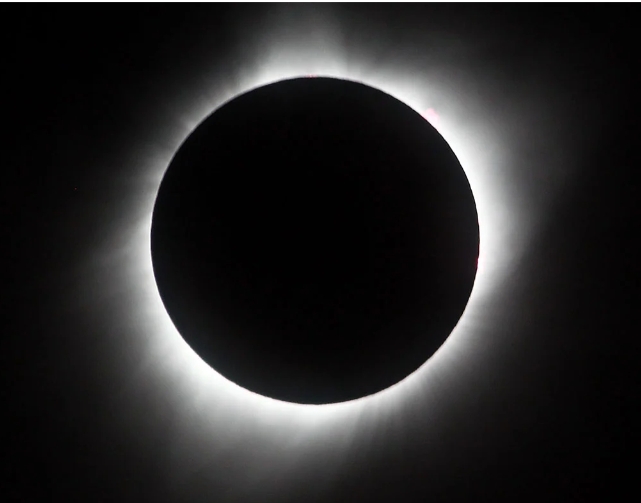
Skywatchers across several parts of the world are preparing for a rare astronomical event on August 12, 2026, when the moon will move directly between the Earth and the sun, producing a total solar eclipse in some regions and a partial eclipse in others.
According to the National Aeronautics And Space Administration, the phenomenon will be visible across parts of Europe, Greenland, Iceland, Russia, North America and Africa, although the extent of visibility will differ from one location to another.
A solar eclipse occurs when the sun, moon and Earth align in such a way that the moon passes between the Earth and the sun, blocking some or all of the sunlight reaching the planet.
As the moon travels across the face of the sun, daylight can dim significantly, creating one of the most striking celestial spectacles observed from Earth.
Astronomers classify solar eclipses into four categories known as total, partial, annular and hybrid eclipses.
A total solar eclipse takes place when the moon completely obscures the sun, temporarily plunging affected areas into darkness and revealing features of the sun that are normally hidden by its brightness.
A partial solar eclipse occurs when only a portion of the sun is covered, leaving part of its surface visible throughout the event.
An annular eclipse happens when the moon appears slightly smaller than the sun because of its distance from Earth, creating a bright ring of sunlight often referred to as the “ring of fire”.
A hybrid eclipse combines characteristics of both total and annular eclipses, appearing differently depending on the observer’s location.
For the August 12 event, observers in some regions will experience totality, while others will witness only a partial eclipse.
NASA stated that the path of totality will extend through parts of northern Russia, Greenland, Iceland and northern Spain, where residents will see the moon completely cover the sun for a brief period.
People within this narrow corridor will first observe a gradual partial eclipse before the moon entirely blocks the sun, creating darkness in the middle of the day.
Although the eclipse process will unfold over roughly one and a half to two hours, the phase of complete coverage is expected to last less than two and a half minutes.
Outside the path of totality, millions of people will witness a partial eclipse as the moon obscures only part of the sun.
The partial eclipse will be visible across large sections of Europe, parts of North America and areas of north-western Africa, including Morocco, Algeria and Senegal.
The percentage of the sun covered will vary considerably depending on location, with some cities experiencing a much more dramatic view than others.
In Dakar, Senegal, for example, the moon is expected to cover approximately 37 per cent of the sun, while London could experience as much as 91 per cent coverage.
Scientists explain that the differences arise from the structure of the moon’s shadow, which falls on only a limited portion of the Earth during an eclipse.
The shadow consists of two sections known as the umbra and the penumbra.
The umbra represents the darkest central region where the sun is completely hidden, allowing observers within it to witness a total eclipse.
The penumbra forms the lighter outer region where only part of the sun is obscured, resulting in a partial eclipse.
This distinction means that people located in the umbra will experience totality, while those in the penumbra will see only a partial covering of the sun.
Experts have also stressed the importance of observing the eclipse safely to avoid permanent eye damage.
NASA advises that people should never look directly at the sun during a partial eclipse without certified eclipse glasses or approved handheld solar viewers.
Observers situated within the path of totality may briefly remove their protective eyewear only when the sun is completely covered by the moon.
Once sunlight begins to reappear, eclipse glasses must be worn again immediately before looking at the sky.
For those without specialised viewing equipment, indirect methods such as pinhole projectors provide a safer alternative for watching the event.
Astronomers further caution that ordinary sunglasses, cameras, telescopes, binoculars and mobile phone cameras do not offer adequate protection for direct solar observation.
Nigeria has previously witnessed a total solar eclipse, most notably on March 29, 2006, when the moon completely covered the sun for about four minutes in parts of the country.
The 2006 eclipse was visible in states including Benue, Katsina, Zamfara, Jigawa and Oyo.
Looking ahead, astronomers project that Nigeria’s next total solar eclipse will occur on March 20, 2034.
Before then, Nigerians are expected to witness another solar event on February 6, 2027, when different parts of the country will experience either an annular or partial solar eclipse depending on their location.
With the August 12 eclipse drawing global attention, scientists say the event offers both a rare viewing opportunity for the public and a reminder of the remarkable alignment of celestial bodies that continues to captivate observers around the world.