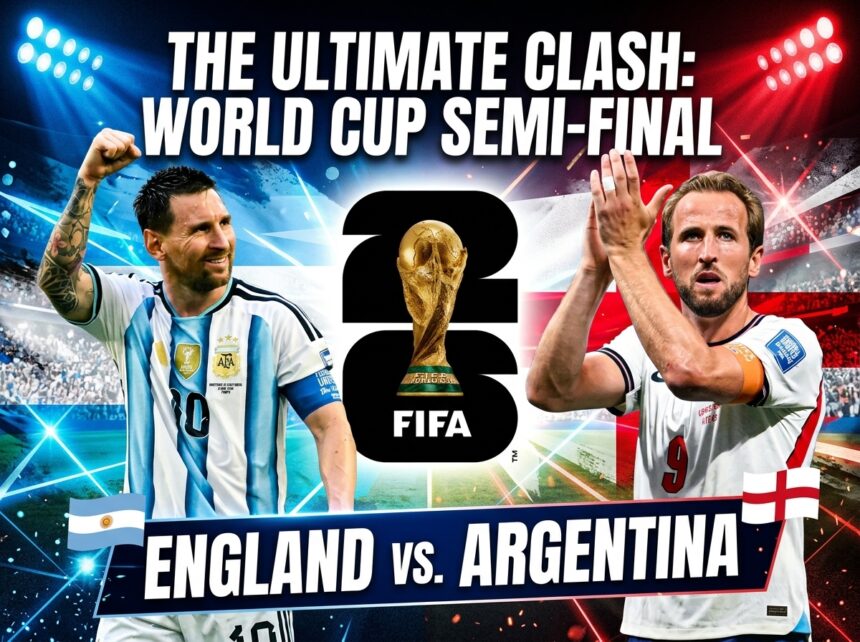
Atlanta gets the fixture every football fan circled the moment the semi-final draw came out. England against Argentina, in a World Cup semi-final, with Lionel Messi on one side and Jude Bellingham on the other. It doesn’t get much bigger than this.
Kick-off at Mercedes-Benz Stadium is 3 pm ET on Wednesday, July 15, 8 pm in London, 4 pm in Buenos Aires. FOX has the English-language broadcast in the US, with Telemundo and Peacock carrying the Spanish feed. Whoever wins goes through to Sunday’s final against Spain, who beat France to book their spot. Whoever loses plays France for third place on Saturday.
There’s history here too, and not the friendly kind. Maradona’s Hand of God in 1986. Beckham’s red card for kicking Diego Simeone in 1998. Beckham’s redemption penalty in 2002, the last time these two actually met at a World Cup. Add in the fact that Rattín, Argentina’s captain, sent off in the 1966 quarter-final against England, died just days ago at 89, on the same weekend both nations booked their semi-final spots, and the whole thing feels loaded before a ball is kicked.
The Numbers Behind the Names
Argentina are the tournament’s top scorers, with 17 goals from eight different players. That’s the detail that should worry England more than any single name on the team sheet: this isn’t a one-man show they’re facing, even if Messi is the one everybody’s talking about.
And there’s plenty to talk about. At 39, Messi has scored in every match up to the round of 16 and now has 21 World Cup goals, the most anyone has ever scored at this tournament. He’s tied for the Golden Boot with eight. What’s strange is how little running he’s actually doing to get there. Among forwards who’ve played 90 minutes or more, he’s covering just 7.84km and making 64 high-speed runs per 90, the lowest figures in the tournament. Messi isn’t chasing games anymore. He’s waiting for them to come to him, then finishing them in two or three touches.
England have their own story. Harry Kane and Bellingham have six goals apiece, with Kane doing most of his damage in the group stage and Bellingham stepping up when it mattered in the knockouts, including the brace that dragged England past Norway and Erling Haaland in extra time. Bukayo Saka and Anthony Gordon have three assists each, and Marc Guehi and Elliot Anderson have quietly been two of the more important names in this run.
Opta’s model gives England a 52.9% chance of winning this one, as close to a coin flip as these things get. France are favoured in the other half of the draw, but England still carry a 22.6% chance of lifting the whole thing.
Man-Marking Messi? Tuchel Isn’t Ruling It Out
Tuchel has spent the build-up talking almost as much about Messi as about his own team, and he hasn’t been shy about admitting he’s tempted by an old-fashioned solution.
“I was thinking about this, whether we do an old-school man mark,” he told reporters, before adding he wasn’t sure England would actually go through with it. “Everyone knows the spaces where he wants to show up. If you analyse matches, he sees things faster. The ball drops to him, and he finds the gap. We have found some patterns in their games, but if you close the pattern, they will find a new one.”
That’s the honest problem with Messi at this stage of his career. You can scout him, you can set traps for him, and he’ll still find something nobody planned for. Tuchel’s own conclusion was blunt: “It is his super strength, it is just what it is.”
Djed Spence has the pace and one-on-one defending to be the man tasked with shadowing him if England do go that route, with the back three staying intact behind him. But there’s a real risk in isolating one man against Messi specifically. Argentina, under Lionel Scaloni, don’t leave him stranded out wide anymore. They build central overloads around him instead, usually starting from a compact 4-1-3-2 before shifting into rotations near the edge of the box. Man-mark him, and you might just be inviting the chaos Argentina actually want.
Where This Game Could Actually Be Won
Strip away the individual duels, and there’s a clearer tactical picture underneath.
England have edged Argentina on some of the territorial numbers, passes into the box, touches inside the area, big chances created. Argentina, though, lead on the more direct measures: expected goals, shots, and fast breaks. Roughly 74% of England’s threat has come down the flanks, split fairly evenly left and right, while Argentina’s danger has sat more centrally, unsurprising given where Messi likes to drift.
Set pieces might decide it. No team at this World Cup has scored more from corners than England and Argentina, and England have been the strongest team in the air throughout the tournament. That sets up one of the cleaner sub-plots of the match: England’s dead-ball delivery against a side that has, at times, looked vulnerable defending exactly that.
There’s also a specific weakness worth watching. England’s defensive solidity has dropped off as matches have worn on, and most of the assists conceded by Tuchel’s side have come down their right flank. Argentina’s wide players tend to sit deeper than orthodox wingers, closer to auxiliary midfielders, which could open space for England’s full-backs to push forward. But it cuts both ways. Messi’s tendency to drift, Argentina’s midfield rotations, and right-back Nahuel Molina’s runs from deep could all target that same side of the pitch. Reece James’s return to right-back for England may end up mattering more than people realise.
Squad News: Rice Passes His Fitness Test
There was a genuine scare in the England camp over Declan Rice’s fitness after he picked up a stomach bug, but Sky Sports News understands he’s overcome it and is available to start. Given how much England lean on Rice to shield the back line and dictate the tempo in midfield, that’s a significant boost heading into a game where control in the middle of the pitch could be everything.
On the Argentina side, Scaloni has left the door open to lineup changes, adding a layer of uncertainty about how his side will actually set up. Argentina have had their own scares in the knockout stages; Switzerland exposed some gaps in behind, and Egypt caused problems in transition, so this isn’t a team without cracks, even with the trophy from 2022 still on the mantelpiece.
Not Just a Messi Problem
Tuchel has been careful, publicly at least, not to let this turn into a one-man obsession. “We don’t speak, my team and me, about the historic events. The tension is big enough,” he said, when asked about the weight of the England-Argentina rivalry. “We try to reduce information the bigger the stage gets and the bigger the tension.”
He’s also had to manage a small internal storm of his own. After England’s stuttering extra-time win over Norway, Tuchel was openly critical of his side’s performance, “sloppy, a lot of technical mistakes, not fast enough”, comments that clearly didn’t sit well with Bellingham, who responded to the criticism afterwards. Tuchel has downplayed any lasting rift, insisting the pair are simply competitive people who want the same thing. Whether that friction sharpens England’s focus or becomes a distraction is one more subplot to watch on the touchline.
What Tuchel does seem clear on is that stopping Argentina can’t be reduced to stopping Messi. Argentina’s central overloads, their patient buildup through midfield, and their ability to win second balls all matter just as much as anything Messi does individually. England’s better route through this game may be to press Argentina’s centre-backs before they can dictate the tempo, target the aggression of Cristian Romero at the back, and trust Bellingham to keep finding pockets between the lines, rather than build an entire game plan around denying one player the ball.
What It Would Mean
England have reached only three World Cup semi-finals since they won the whole thing in 1966: this one, the penalty shootout defeat to West Germany in 1990, and the loss to Croatia in 2018. Get past Argentina and Tuchel’s side would be one win away from ending 60 years of waiting.
For Argentina, it’s about defending what they already have. Messi came back for one more World Cup at 39, chasing something most assumed was already finished after Qatar. Beat England, and he gets a shot at going back-to-back, a feat no side has managed since Brazil in 1962.
Wednesday won’t be short of storylines. It rarely is when these two meet. But underneath the history and the noise, this is a genuinely tight, well-matched semi-final that could come down to a well-defended corner, an exploited right flank, or one moment of Messi doing what Messi does, no matter how well anyone plans for it.