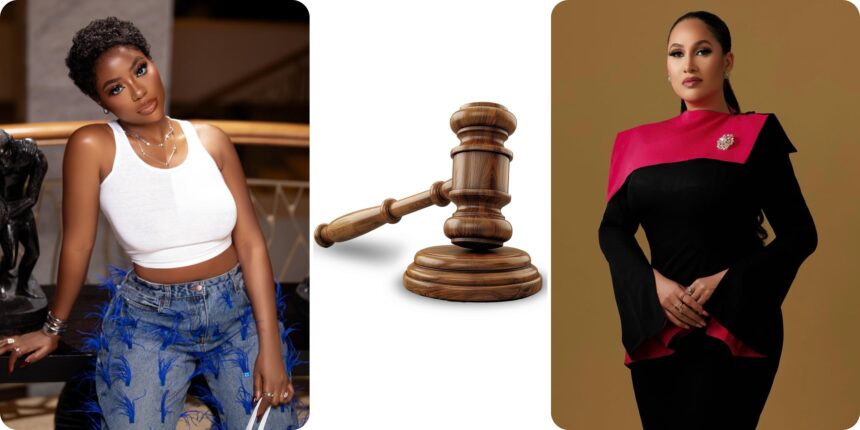
When Caroline Hutchings shared a series of emotional Snapchat posts in early July, she never mentioned Sophia Momodu by name.
Yet, within days, Sophia Momodu served the actress and former Real Housewives of Lagos star with a Notice of Intended Legal Proceedings, demanding an immediate retraction, an unreserved public apology, compensation and threatening a ₦10 billion defamation lawsuit if her demands are not met.
The development has sparked debate on social media. While some believe Caroline cannot be sued because she never identified anyone, others argue that people immediately linked the posts to Sophia, making the issue more complicated than simply whether a name was mentioned.
The dispute raises an important legal question that goes beyond celebrity drama: Can someone be defamed without being named?
What Caroline Hutchings Posted

The controversy began after Caroline Hutchings took to Snapchat on July 3, with a series of strongly worded posts about a woman she claimed had betrayed her. In one of the posts, she wrote:
“Funny how I pretend I am stupid but I know the girl I defended on national TV was sleeping with my man while I was with him… I act like I don’t see it but I see it all.”
She went on to accuse the unnamed woman of secretly having a relationship with her former partner while publicly pretending to be friendly. Caroline also wrote:
“Now I know why your baby daddy didn’t chose you, you are dirt… you sleep with your friend’s man.”
The actress continued with more insults, describing the woman as:
“The dirtiest part of dirt.”
She also added:
“Will never defend you again… You will pretend like you like us, but you sleep with your friend’s man.”
Despite the harsh accusations, Caroline never mentioned any person’s name in the posts.
However, almost immediately after the messages went viral, netizens began speculating about who she was referring to. Many pointed fingers at Sophia Momodu. That online speculation would later become one of the key issues in the legal dispute.
Why Sophia Momodu Believes the Posts Were About Her

Although Caroline Hutchings did not expressly identify Sophia Momodu, the legal notice argues that the posts were understood by many members of the public to refer to her.
According to the Notice of Intended Legal Proceedings issued by Ahonaruogho, Ahonaruogho & Co. (Paradise Law Firm), Sophia’s lawyers say she was overwhelmed with calls and messages while she was in Kaduna State after the Snapchat posts surfaced.
The notice states:
“Almost immediately after the said publication, the contents thereof were reproduced and widely disseminated across several blogs, online news platforms and various social media channels.”
The lawyers further argue that the public had little difficulty identifying who they believed Caroline was referring to. According to the notice:
“Numerous members of the public identified and understood the person referred to in your publication, by implication and innuendo, to be our Client.”
Sophia’s legal team says that identification exposed her to:
“Widespread ridicule, cyberbullying, insults, malicious comments, public opprobrium and unwarranted attacks.”
The notice also claims the alleged damage went beyond online criticism. It states that Sophia suffered:
“Considerable embarrassment, emotional distress, damage to her reputation and standing amongst members of the public, her family, friends, business associates and the society at large.”
Sophia Says She First Tried to Resolve the Matter Privately
One of the more notable revelations in the legal notice is the claim that Sophia initially tried to settle the issue without involving lawyers. According to the notice, she personally contacted Caroline on 3 July 2026.
The letter states:
“Our Client personally sent you a private message… requesting that if your publication was not directed at her, you should issue an unequivocal clarification… expressly stating that our Client was not the person referred to.”
The lawyers allege that Caroline neither replied nor issued any clarification. Instead, they claim she allowed public speculation to continue. According to the notice:
“You failed, refused and/or neglected to issue any clarification whatsoever, despite being fully aware that members of the public had associated the defamatory publication with our Client.”
The legal team argues that this alleged failure worsened the reputational damage.
What Exactly Is Sophia Demanding?

Sophia’s lawyers are asking Caroline to take several steps before the matter reaches court. Mo Among the demands are:
- An immediate and unequivocal retraction of the publication.
- An unreserved public apology on Snapchat and every other social media platform under Caroline’s control.
- Publication of the apology in two national newspapers, subject to the lawyers’ approval.
- Monetary compensation for the alleged reputational damage, emotional distress and legal expenses.
- A written undertaking not to publish similar statements in future.
If those demands are not met within the stipulated period, the notice says legal proceedings may follow. Among the reliefs Sophia intends to seek are:
- A declaration that the publication was false, malicious and defamatory.
- A court order compelling a public retraction and apology.
- ₦10 billion in general and aggravated damages.
- A perpetual injunction restraining further alleged defamatory publications.
- ₦50 million as legal costs.
The notice nevertheless leaves the door open for settlement, stating that Sophia remains willing to resolve the dispute amicably without going to court.
Can Someone Be Defamed Without Naming Them?
This is perhaps the most important question raised by the dispute. Many people assume that a defamation claim can only succeed if a person’s name appears in the publication. That is not necessarily how defamation law works.
One of the issues courts often consider is whether the claimant was identifiable from the words used. In other words, would an ordinary reasonable person, reading or hearing the statement in its full context, understand it to refer to that individual?
That is why Sophia’s lawyers repeatedly rely on phrases such as “by implication and innuendo” and argue that members of the public identified her from Caroline’s posts.
If a claimant can show that people reasonably understood the publication to refer to them, the absence of their name does not automatically prevent a defamation claim.
However, whether that standard has been met depends on the evidence presented and is ultimately for a court to determine if proceedings are filed.
The Arguments Both Sides Could Make

From Sophia’s perspective, the legal notice argues that the issue is not whether Caroline mentioned her name. Instead, her lawyers say the public identified her anyway.
The notice also argues that Caroline allegedly became aware of that public perception and still failed to issue any clarification after receiving Sophia’s private message.
Caroline, on the other hand, has not publicly responded to the legal notice at the time of writing.
If litigation proceeds, one potential argument could be that she never identified Sophia by name and that any conclusions drawn by members of the public were their own. She may also raise other legal defences depending on the precise allegations and evidence before the court.
Which argument ultimately succeeds would depend on the facts, the evidence and the applicable law, rather than public opinion.
What Happens Next?
For now, Sophia’s legal notice is not a court judgment. It is a formal warning that legal action may follow if the demands outlined in the letter are not met.
The coming days may determine whether the matter is resolved through an apology or clarification, settled privately, or proceeds to court, where a judge would decide the issues based on the evidence and the law.
Conclusion
Celebrity disputes often dominate social media for a few days before fading away. But the disagreement between Sophia Momodu and Caroline Hutchings raises a broader question about the power and consequences of online statements.
At the centre of the controversy is not just what Caroline wrote, but whether people could reasonably identify the person she was referring to despite the absence of a name.
The answer to that question will not be decided by netizens. If the dispute reaches court, it will be for the court to determine whether the publication was capable of identifying Sophia Momodu and, if so, whether it amounted to defamation under the law.