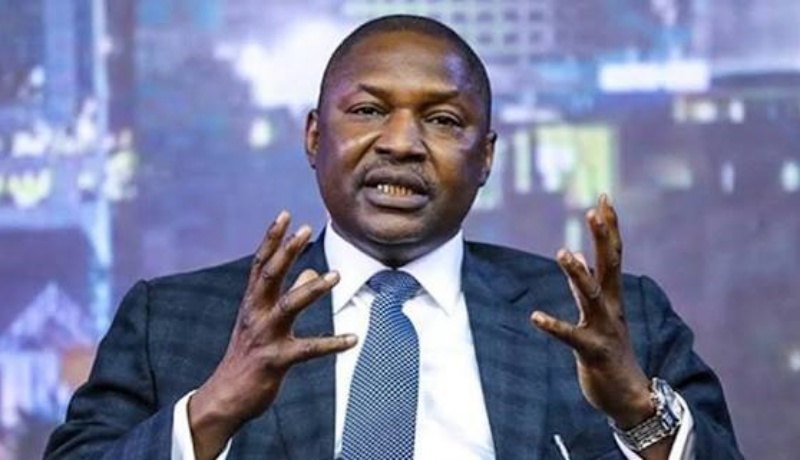
While Malami and his ilk are currently being justifiably hounded and being made to pay for their troubling financial crimes, whatever their public trial and prosecution are meant to achieve amounts to papering over the cracks and will definitely not deal with the root cause of the issue, which gives them the unfettered and ample opportunity to carry out these astounding heists in the first place
Before the All Progressives Congress (APC) came to power in 2015, it portrayed and positioned itself, through its electioneering and many public engagements, as a party that would address and end the scourge of corruption that had devastatingly plagued the nation for years and brutally stunted its development. And to show how serious, at least that was what many thought at the time, it was about checking the menace of corruption and etched this performative fury at corruption and impunity in government in the mind of the people, the party decided to field a frail, sickly late Muhammadu Buhari whom the Nigerians were made to believe was frugal, spartan and had zero tolerance for corruption, as its presidential candidate.
It didn’t take long for well-meaning and discerning majority Nigerians to realise that the anticorruption rhetoric that was at the core of APC electioneering was a ruse to capture power and that the party and its leaders, particularly the president Muhammadu Buhari, had little or no interest in fighting graft and larceny in government and that, if anything, it would become a festering, debilitating cankerworm under them. Aside from its many sins like the callous mismanagement of the Nigerian economy and appalling human rights record, under the Buhari government and by extension his party, massive looting and plundering of Nigerian resources the likes of which Nigerians had not seen before were perpetrated and nobody best exemplifies and embodies this grand larceny than Abubakar Malami who served as the former minister of justice and attorney General of the Federation throughout Buhari’s presidency. He is the poster boy of everything that was wrong with the Buhari administration.
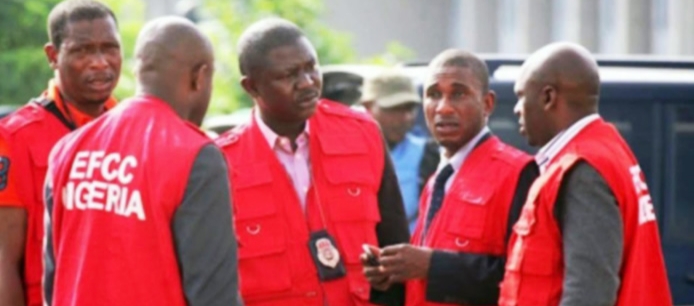
On Thursday, the Economic and Financial Crimes Commission (EFCC) announced that it had secured the forfeiture of 48 properties belonging to Malami, including a university and a radio station. According to the anti-graft agency, among the forfeited properties are Rayhaan University, Kebbi State, including the Rayhaan University Permanent Site, Rayhaan University Temporary Site, Rayhaan University Third Site, the Rayhaan University Vice Chancellor’s House and Rayhaan Radio along Sani Abacha Bypass Road, Birnin Kebbi. All the properties recovered from Malami are reportedly worth over 200 billion naira.
Malami’s case of unbridled and brazen theft of public funds is not an isolated case; it is a disturbing phenomenon that has come to be the legacy of the man he served under. Virtually everyone who held a critical and sensitive position under Buhari betrayed public trust, abused their office and used the opportunity to corruptly enrich themselves.
Former Accountant General Ahmed Idris was charged with diverting ₦109.5 billion. Former Minister of Power Saleh Mamman has been convicted over the criminal diversion of ₦33.8 billion. Former CBN Governor Godwin Emefiele is facing multiple criminal prosecutions over the diversion of ₦154.39 billion and has already forfeited 753 housing units to the Federal Government.
Beyond the unconscionable avarice that characterised the action of these looters, one thing we cannot afford to lose sight of is the weak system and shambolic institution that made it possible for them to orchestrate this large-scale siphoning and embezzlement of public funds. It is quite disconcerting how the nation’s chief law officer could accumulate such massive wealth in such a relatively short period of time. For Malami, what makes his own graft and the abuse of office distasteful is how he gamed the system and bent the rules to achieve his nefarious objectives. He was not in charge of a ministry that directly handles the nation’s finance, but by using his influence and closeness to Buhari, he was able to get into a vantage position that saw a humongous sum of repatriated money that was purportedly looted under the late General Sani Abacha land on his lap. Through his shenanigans and his ability to convince a largely diffident Buhari, he was able to shut out the finance ministry, which should ordinarily be in charge of the repatriated funds and monitor their use, and get the ministry of justice, which he led, to oversee how the funds are expended.
It goes without saying that much, if not all, of the repatriated Abacha loot was looted by Malami. We can excoriate Malami and decry his mindless and primitive acquisition of questionable wealth, but characters like him will never cease to exist if the very conditions and environment that made it possible for them to engage in this wilful disregard for basic human decency and allow them to perpetuate their crime against Nigerians are not wholesomely fixed. At the core of this unrelenting assault on the nation’s common wealth and resources, which should be used for the development of the nation, is a weak system and institutional failure.
The public institutions that were created to check the unrestrained impunity and massive corruption have deviated from their primary objectives and have largely become an appendage of any ruling party in power. While Malami and his ilks are currently being hounded and being made to pay for their troubling financial crimes, whatever their public trial and prosecution are meant to achieve amount to papering over the cracks and will definitely not deal with the root cause of the issue which gives them the unfettered and ample opportunity to carry out these astounding heist in the first place, and going by what we have seen so far under Tinubu, the pervasion of public office and the sinister embezzlement of taxpayers money that we witnessed under Buhari has also continued unencumbered under the current government and it is worse than anything we’ve ever seen.
The only way to stem this vicious tide of destructive corruption is to build strong institutions and robust systems that will not only ensure that these economic and financial crimes are nearly impossible to orchestrate and commit but also ensure that those with a penchant for such shenanigans do not have a free run at power.