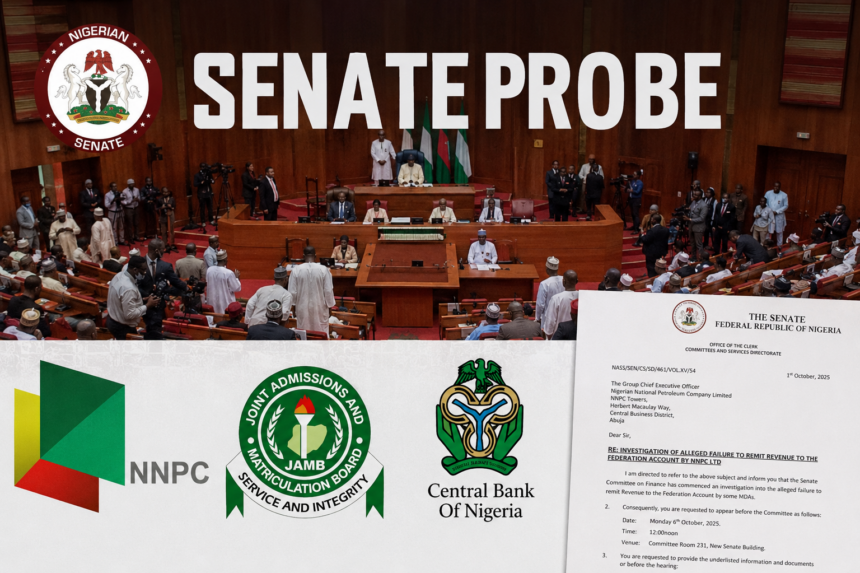
Nigeria’s public finance system has entered another major accountability moment as the Senate begins a fresh examination of how some of the country’s biggest revenue generating institutions manage and return funds belonging to the Federation. The move has placed attention on 47 Ministries, Departments and Agencies, including some of the most powerful institutions in the economy, as lawmakers demand explanations over alleged revenue remittance gaps and financial compliance concerns.
The investigation has immediately drawn attention because the agencies involved cut across critical sectors that influence government income, national development planning, petroleum operations, banking regulation, transportation, education, infrastructure and public services. At the centre of the development are questions surrounding how much revenue these institutions generate, how much they are expected to return to government accounts, and whether existing financial rules are being fully followed.
The Senate’s action is not a final judgment against any of the affected institutions. Rather, it represents the beginning of a legislative process aimed at reviewing financial records, understanding reported discrepancies and obtaining explanations from the agencies involved. The outcome will depend on documents presented, responses provided and findings from the committee’s review.
Senate Finance Committee Begins Fresh Review Of Agency Revenues
The latest development emerged from the activities of the Senate Committee on Finance, which began examining the financial activities of revenue generating agencies across the country. The committee, chaired by Senator Sani Musa, raised concerns over alleged failures by some institutions to comply with financial obligations required under Nigeria’s public finance laws.
The committee’s focus is linked to provisions of the Fiscal Responsibility Act 2007, which outlines how certain government owned enterprises are expected to manage their earnings and remit operating surpluses to the Federal Government after approved expenses have been deducted.
Government agencies created to generate revenue are expected to operate within established financial guidelines. Their responsibilities include maintaining proper records, accounting for income generated from operations, making approved deductions and transferring required balances into government accounts.
The Senate’s concern is that some agencies may not have fully complied with these obligations, creating questions about whether government revenue available for national budgets reflects the actual income generated by these institutions.
The lawmakers also expressed concerns about cooperation from some agencies invited to provide information during the review process. The committee maintained that public institutions handling government resources must be able to provide clear explanations regarding their financial activities when requested by the National Assembly.
Agencies Mentioned In The Senate Investigation
The list of institutions reportedly affected by the Senate’s review cuts across several major areas of Nigeria’s economy. Petroleum related organisations attracted significant attention because oil revenue remains one of the country’s most important sources of government income.
The Nigerian National Petroleum Company Limited, NNPCL, is among the major institutions invited to respond to questions surrounding revenue management. Other petroleum sector agencies mentioned include NNPCL Retail Limited, the Nigerian Upstream Petroleum Regulatory Commission, NUPRC, and the Nigerian Midstream and Downstream Petroleum Regulatory Authority, NMDPRA.
The financial sector also features prominently in the investigation, with the Central Bank of Nigeria, CBN, the Office of the Accountant General of the Federation and the Nigeria Deposit Insurance Corporation, NDIC, listed among institutions expected to provide clarification.
Transport and infrastructure agencies are also part of the review. These include the Nigerian Ports Authority, NPA, the Nigerian Maritime Administration and Safety Agency, NIMASA, the Federal Airports Authority of Nigeria, FAAN, and the Nigerian Railway Corporation, NRC.
Other agencies reportedly included in the exercise are the Joint Admissions and Matriculation Board, JAMB, the National Examinations Council, NECO, the National Hajj Commission of Nigeria, NAHCON, the Standards Organisation of Nigeria, SON, the Transmission Company of Nigeria, TCN, and the Small and Medium Enterprises Development Agency of Nigeria, SMEDAN.
The wide range of institutions involved shows that the Senate’s concern extends beyond one sector, focusing instead on the broader system of government revenue collection, accountability and remittance.
Why NNPC Has Become The Biggest Focus Of Attention
The involvement of NNPCL has attracted particular interest because of the company’s central position in Nigeria’s economy. The petroleum industry remains a major contributor to government earnings, making the management of oil related revenues a sensitive national issue.
NNPCL, which transitioned from the former Nigerian National Petroleum Corporation into a limited liability company under the Petroleum Industry Act signed in 2021, has continued to play a major role in Nigeria’s upstream and downstream petroleum activities.
The company manages key aspects of Nigeria’s participation in the oil industry, including crude oil operations, partnerships with international oil companies and domestic petroleum activities. Because of this role, questions surrounding its financial reporting and remittance obligations often receive significant public attention.
Previous years have seen several government reviews and public discussions concerning NNPC’s financial records, crude oil proceeds, deductions and operating expenses. These reviews have often focused on understanding how petroleum revenues move from production activities into government accounts.
The latest Senate action brings those concerns back into focus, with lawmakers seeking updated explanations from the company and other agencies involved.
However, an invitation by the Senate does not automatically mean an institution has committed an offence. Legislative investigations are designed to gather information, examine documents and determine whether financial procedures were properly followed.
Meaning Of Failure To Remit Public Funds
The phrase failure to remit funds refers to allegations that an organisation did not transfer money that should have been paid into government accounts within the expected period or according to established rules.
For revenue generating agencies, the process usually involves several stages. The agency earns income through its activities, removes expenses that are legally permitted, calculates the amount required for remittance and transfers the appropriate funds to the government treasury.
Problems arise when there are differences between expected remittances and the amounts actually returned. Such differences may come from several issues, including disagreements over allowable deductions, delays in payment, incomplete financial information or disputes over calculations.
The Senate’s investigation is expected to determine whether the reported concerns are caused by administrative issues, accounting differences or deeper compliance problems.
The affected agencies will have the opportunity to present financial records, explain their procedures and provide information regarding their revenue activities.
Legal Powers Behind The Senate Action
The Senate’s investigation is based on the oversight responsibilities granted to the National Assembly under Sections 88 and 89 of the 1999 Constitution of the Federal Republic of Nigeria.
These sections empower lawmakers to investigate matters relating to how public funds are managed, examine government activities and request information from institutions connected to public administration.
Through these powers, committees of the Senate can summon government officials, review documents and make recommendations based on their findings.
The Senate leadership has maintained that agencies receiving public funds or generating government revenue must remain accountable and transparent in their operations.
The investigation therefore represents part of the National Assembly’s constitutional role of monitoring government financial activities and ensuring that public resources are properly managed.
The Fiscal Responsibility Act 2007 At The Centre Of The Dispute
The Senate’s latest move is closely connected to Nigeria’s Fiscal Responsibility Act 2007, a law created to promote transparency, accountability and discipline in the management of public finances.
The law provides guidelines for how government institutions should handle revenue generated from their activities. Certain agencies classified as government owned enterprises are expected to remit a portion of their operating surpluses to the Federal Government after accounting for approved expenses and operational requirements.
The purpose of this arrangement is to ensure that money generated by public institutions contributes to national development instead of remaining outside the central government revenue system.
The Federal Government relies heavily on revenue collected through different agencies to finance annual budgets, infrastructure projects, social programmes and other public obligations. Any gap between expected revenue and actual remittance can affect government planning and spending capacity.
The Senate’s concern is centred on whether all affected institutions have fully complied with these obligations and whether the government has received all funds due from agencies operating with public resources.
The investigation will therefore focus on financial records, statutory obligations, audited accounts and explanations from the affected institutions.
Previous Questions Around Government Revenue Management
Nigeria’s struggle with revenue management has remained a recurring issue for several years, particularly because of the country’s dependence on limited sources of income and the pressure to fund increasing public demands.
Revenue generating agencies have frequently come under government review over how they collect, manage and transfer funds. These reviews have often involved questions about deductions, operating costs, financial reporting and compliance with established regulations.
The petroleum sector has received some of the highest attention because crude oil earnings have historically represented a major part of Nigeria’s government revenue.
Before its transition into a limited liability company in 2021, the former Nigerian National Petroleum Corporation faced several public reviews concerning its financial operations, crude oil sales and remittance arrangements.
Following the implementation of the Petroleum Industry Act 2021, NNPCL adopted a new corporate structure designed to operate more commercially while still carrying out responsibilities connected to Nigeria’s petroleum interests.
Despite the changes, the company remains closely monitored because of its connection to oil revenues and national economic planning.
The Senate’s current investigation follows this broader pattern of legislative oversight aimed at understanding whether public institutions are meeting their financial responsibilities.
What The Senate Wants From The Agencies
The Senate Finance Committee is expected to request detailed financial information from the affected institutions as part of its review process.
The agencies may be required to provide records showing revenue generated, expenses deducted, operating costs, financial statements and evidence of payments made to government accounts.
For institutions such as NNPCL, the committee’s interest is expected to include petroleum related income, deductions from revenue streams and explanations surrounding amounts transferred to government accounts.
The Central Bank of Nigeria, CBN, may also be required to clarify financial matters connected to its statutory responsibilities and revenue related activities.
Other agencies will similarly be expected to explain their financial operations and demonstrate compliance with existing regulations.
The process is designed to compare information provided by the agencies with available government records to identify whether there are gaps requiring further explanation.
The committee’s review will likely determine whether differences are caused by accounting interpretations, delayed payments, administrative challenges or possible violations of financial rules.
Why Revenue Remittance Matters To Nigeria’s Economy
Government revenue remains one of the most important factors determining how effectively a country can fund public responsibilities.
Nigeria’s annual budgets depend on income from several sources, including petroleum earnings, taxes, customs collections and revenue generated by government institutions.
When expected funds are not fully available, government agencies may face difficulties implementing planned projects, meeting financial commitments and reducing dependence on borrowing.
Revenue challenges have been a major issue in Nigeria due to factors such as oil production difficulties, economic pressures, rising public expenditure and fluctuations in global energy markets.
For this reason, lawmakers have continued to emphasise the importance of ensuring that every government institution follows established financial procedures.
The Senate’s investigation into 47 agencies reflects a broader effort to examine whether public revenue systems are working as designed.
Senate’s Warning Over Cooperation From Agencies
The Senate has also raised concerns about the response of some institutions invited during the oversight process.
Lawmakers have argued that government agencies have a responsibility to cooperate with constitutional investigations, especially when public funds are involved.
The National Assembly’s oversight committees often depend on access to documents, financial reports and explanations from government officials to complete investigations.
Failure to provide requested information can slow down investigations and create additional concerns regarding transparency.
The Senate leadership has indicated that agencies that refuse to cooperate may face further action within the limits of the law.
The next stage of the process will depend largely on how the invited institutions respond and the quality of information they present before the committee.
Investigation Does Not Mean Guilt
The Senate’s action has generated public attention because of the names involved, but the investigation remains at the stage of allegations and financial review.
Being listed among agencies invited by lawmakers does not mean an institution has been found guilty of wrongdoing.
The purpose of the investigation is to establish facts, examine records and determine whether there are genuine financial discrepancies that require correction.
Government institutions have the opportunity to explain their accounting procedures, defend their decisions and provide evidence supporting their financial activities.
Only after reviewing the available information can the committee determine whether further action is necessary.
Possible findings may range from confirmation that procedures were properly followed to recommendations for recovering funds, improving reporting systems or taking additional steps where violations are established.
NNPCL’s Role In Nigeria’s Revenue Structure
The attention on NNPCL during the Senate review is connected to the company’s position within Nigeria’s petroleum industry and its importance to national revenue generation.
Nigeria’s oil sector has traditionally been one of the largest contributors to government income, making every aspect of petroleum revenue management a major issue for lawmakers, regulators and economic planners.
NNPCL operates as a commercial entity following the reforms introduced by the Petroleum Industry Act 2021, but it continues to maintain responsibilities connected to Nigeria’s petroleum interests.
The company participates in activities covering crude oil production partnerships, petroleum products supply and other areas of the energy value chain. Because of this position, its financial records are closely linked to broader discussions about government revenue.
The Senate’s interest is focused on understanding how funds generated from these activities are accounted for, what deductions are made, and whether required payments have been properly transferred according to existing regulations.
Previous public discussions around NNPC and later NNPCL have often involved issues such as crude oil revenue, subsidy related deductions, operational expenses and financial reporting.
The latest investigation provides another opportunity for lawmakers to examine current records and receive explanations directly from the company.
CBN’s Place In The Senate Review
The Central Bank of Nigeria is another major institution mentioned in the Senate’s investigation due to its national importance and financial responsibilities.
The CBN plays a central role in Nigeria’s monetary system, regulating banks, managing monetary policy and overseeing important financial operations within the economy.
Questions involving the apex bank attract significant attention because of its influence on banking stability, foreign exchange management and financial regulation.
The Senate’s review is expected to examine issues connected to the institution’s financial obligations and compliance with relevant government requirements.
The investigation does not suggest that the CBN has been found responsible for any offence. Like other agencies involved, the bank will have the opportunity to provide information and clarify matters raised by lawmakers.
The process is expected to focus on financial documentation, statutory responsibilities and compliance with established rules.
NPA, NIMASA, FAAN And Other Agencies Under Review
Beyond the petroleum and financial sectors, several transport and infrastructure agencies are also part of the Senate’s examination.
The Nigerian Ports Authority, NPA, remains one of Nigeria’s key revenue generating institutions because of its involvement in port operations, maritime activities and fees collected from activities at the nation’s seaports.
The Nigerian Maritime Administration and Safety Agency, NIMASA, also plays an important role in regulating maritime activities, promoting safety standards and managing revenue connected to the maritime sector.
The Federal Airports Authority of Nigeria, FAAN, operates major airports across the country and generates income through aviation related activities.
The Nigerian Railway Corporation, NRC, represents another important public institution involved in transportation services and infrastructure development.
The Senate’s decision to include agencies from different sectors shows that the review is not limited to petroleum revenue but covers the wider government revenue network.
Each institution will be expected to explain how it manages income generated from its activities and how it meets obligations established by government financial regulations.
What Happens During A Senate Financial Investigation
A Senate investigation into government agencies usually follows a structured process designed to gather information before making recommendations.
The first stage involves issuing invitations to relevant agencies and officials responsible for financial decisions.
Representatives of the affected institutions are expected to appear before the committee, answer questions and submit documents requested by lawmakers.
The committee then examines the information provided and compares it with available records.
Where inconsistencies appear, lawmakers may request further explanations or additional documentation.
After completing its review, the committee prepares findings and recommendations that may be presented to the Senate for further consideration.
The outcome depends on evidence obtained during the investigation and the explanations provided by the institutions involved.
Possible Outcomes After The Review
The final outcome of the Senate investigation could take several directions depending on what lawmakers discover from the financial records.
If agencies are found to have outstanding obligations, the Senate may recommend that the affected institutions pay amounts identified as due to the Federation Account.
Where financial reporting issues are discovered, lawmakers may request improved documentation procedures and stronger compliance measures.
If serious violations are established, the matter could be referred to relevant government bodies for additional action.
The investigation may also lead to recommendations aimed at improving how government agencies track revenue and submit financial reports.
The main objective remains ensuring that funds belonging to the government are properly accounted for and used for national priorities.
The Bigger Picture Behind The Investigation
The Senate’s review comes at a time when Nigeria continues to face pressure to improve government revenue performance and reduce financial challenges.
Public funding remains critical for infrastructure development, education, healthcare, security and other national programmes.
Every naira generated by government institutions forms part of the resources available for addressing these responsibilities.
The investigation into NNPCL, CBN and 45 other agencies therefore highlights the importance of transparency in the management of public funds.
As the Senate begins its review, attention will remain on the documents submitted by the agencies, the explanations provided and the recommendations that will follow.
The outcome could shape future conversations about financial accountability, government revenue collection and the relationship between public institutions and the Federation Account.