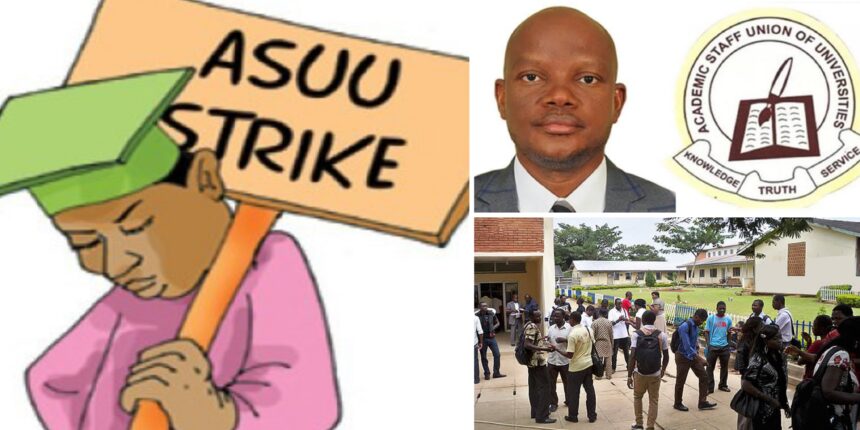
For thousands of students across Nigeria, the next 14 days could become a defining period in the 2026 academic calendar, with developments unfolding around some of the country’s public universities after a fresh decision by the Academic Staff Union of Universities, ASUU. What began as another round of negotiations over agreements reached between lecturers and government has now moved into a more serious phase, putting several institutions under renewed pressure while students wait to see how the situation develops.
The latest development comes at a particularly sensitive moment for the university system, where academic calendars have struggled for years under the weight of funding disputes, unpaid salaries, inadequate facilities, allowances, conditions of service and repeated industrial actions. The agreement reached between the Federal Government and ASUU in December 2025 was widely regarded as an important attempt to address some of these long running problems, yet questions surrounding its implementation have continued to create tension across different institutions.
The latest resolution has therefore brought attention back to an issue many students and parents had hoped was gradually moving away from the centre of university life. With specific branches now authorised to issue 14 day ultimatums, the coming days could determine whether the current dispute ends around the negotiation table or develops into another disruption for students already navigating demanding academic schedules.
How the latest ASUU crisis began
The latest development can be traced to the National Executive Council meeting of ASUU held at the University of Abuja on August 8 and August 9, 2026. The meeting brought together the union’s national leadership as it reviewed the state of implementation of the agreement reached with the Federal Government in December 2025.
Following the meeting, ASUU President, Professor Christopher Piwuna, announced a resolution authorising branches in affected universities to begin the process of industrial action. The instruction allows the branches to issue 14 day ultimatums to the relevant authorities, giving them an opportunity to resolve outstanding matters before industrial action can commence.
That distinction is important because the latest decision does not amount to an immediate nationwide strike by every public university in Nigeria. The resolution is targeted at specific university branches where ASUU says significant implementation problems remain unresolved. The affected institutions therefore have their own processes to follow before any strike action can begin.
The development has nevertheless attracted national attention because it comes less than a year after the Federal Government and ASUU reached their latest agreement following more than 16 years of negotiations. The agreement was expected to provide a fresh framework for improving lecturers’ remuneration, academic allowances, research conditions, infrastructure, staff welfare and other issues affecting Nigeria’s university system.
The 20 universities at risk
The universities named in the latest reports represent institutions spread across different parts of the country, with several of them being state owned universities where implementation responsibilities involve state governments as well as university authorities.
The institutions identified are Nasarawa State University, Keffi, Ibrahim Badamasi Babangida University, Lapai, University of Medical Sciences, Ondo, Gombe State University, Plateau State University, Bokkos, Adekunle Ajasin University, Akungba Akoko, Ambrose Alli University, Ekpoma, Olusegun Agagu University of Science and Technology, Okitipupa, Abia State University, Uturu and University of Education and Entrepreneurship, Akamkpa.
The list also includes Emmanuel Alayande University of Education, Oyo, Kaduna State University, Kano State University of Science and Technology, Wudil, Northwest University, Kano, Enugu State University of Science and Technology, Imo State University, Owerri, Niger Delta University, University of Africa, Toru Orua, Bayelsa Medical University and Taraba State University, Jalingo.
There has been some variation in the way individual reports have described the number of institutions involved, with one report referring to 21 universities. The more consistently reported figure from several major reports, however, is 20 universities, which is the number associated with the latest ASUU resolution.
Another naming issue concerns the Kano institution on the list. Some reports continue to use Kano State University of Science and Technology, Wudil, while BusinessDay referred to the institution by its current name, Aliko Dangote University of Science and Technology, Wudil. The difference relates to the institution’s name rather than the existence of an additional university on the list.
The 14 day window
The next stage of the process is centred on the 14 day ultimatum. The affected ASUU branches have been authorised to issue the ultimatums to the relevant authorities, after which the institutions will have a defined period within which the outstanding issues can be addressed.
The significance of the 14 days lies in what happens before the deadline expires. If the relevant authorities reach satisfactory resolutions with the affected ASUU branches, the threatened industrial action could be avoided. If the disputes remain unresolved, the branches have been authorised to proceed with strike action.
This means the immediate situation is better understood as a warning period rather than an announcement that lecturers across all 20 universities have already stopped work. Students should therefore distinguish between the existence of a strike threat and the commencement of an actual strike.
The process could also unfold differently from one university to another because the affected branches may issue their ultimatums on different dates. Consequently, the expiration of the 14 day period may not necessarily occur on one single day for every university on the list.
The agreement behind the dispute
At the centre of the latest disagreement is the renegotiated Federal Government ASUU agreement reached in December 2025. The agreement followed more than 16 years of negotiations between the union and government, making its eventual conclusion one of the most significant developments in the relationship between university lecturers and the Federal Government in recent years.
The agreement was designed to address several longstanding problems within the public university system. These included lecturers’ salaries, academic allowances, research funding, infrastructure, staff welfare, conditions of service, institutional development and the broader financing of public universities.
One of the most prominent provisions was a 40 percent increase in academic staff remuneration, scheduled to take effect from January 1, 2026. The Federal Government announced in February 2026 that implementation of the salary increase had commenced.
The current dispute, however, is centred on the broader implementation of the agreement. ASUU has maintained that implementation has not been uniform across the university system, with some provisions allegedly yet to be fully implemented in several institutions.
Funding dispute
Funding is one of the major issues running through the current confrontation. ASUU has accused the Federal Government of showing what it described as a lackadaisical attitude towards the release of the funding or subvention required for full implementation of the agreement.
The union’s position is that an agreement cannot achieve its intended purpose if the financial commitments attached to it are not provided in full. For lecturers, the issue extends beyond the headline salary increase because the agreement contains several other financial provisions affecting academic work, professional development and staff welfare.
State owned universities face another layer of difficulty because their funding responsibilities are not limited to the Federal Government. State governments and university authorities also have obligations concerning the implementation of provisions affecting staff within their institutions.
This has made the dispute more complicated than a simple disagreement between ASUU and the Federal Government. Different universities may face different financial circumstances, while the responsibility for implementing particular provisions may depend on whether the institution is federally or state owned.
Academic allowances under scrutiny
One of the important elements of the 2025 agreement is the Consolidated Academic Tools Allowance, commonly referred to as CATA. The allowance is designed to support expenses associated with academic work, including journal publications, membership of learned societies, conferences, internet access, books and other academic resources.
For university lecturers, such expenses are not merely occasional professional costs. Academic staff are expected to conduct research, publish scholarly work, attend conferences, maintain professional networks and remain connected to developments within their disciplines. The financial burden associated with these activities has therefore remained an important part of ASUU’s negotiations with government.
The agreement also introduced the Professorial Cadre Allowance. Under the reported terms, professors are entitled to an annual allowance of ₦1.74 million, equivalent to ₦145,000 per month, while readers are entitled to ₦840,000 annually, equivalent to ₦70,000 per month.
Another major component is the Earned Academic Allowance, known as EAA. The allowance relates to additional academic responsibilities, including postgraduate supervision and other duties undertaken by academic staff.
These allowances have become part of the wider implementation argument because ASUU’s concern is not restricted to the basic salary adjustment. The union wants the provisions of the agreement to be implemented in a manner that reflects the terms negotiated and accepted by both sides.
What haphazard implementation means
The phrase haphazard implementation has become central to ASUU’s explanation of the latest dispute. The union’s argument is essentially that some parts of the agreement have moved forward while other provisions remain outstanding, creating differences between institutions and categories of staff.
TheCable reported that ASUU believes only about 10 state universities had fully implemented the agreement, while more than 57 others remained in limbo. That figure represents ASUU’s reported assessment and should therefore be understood as the union’s position rather than an independently verified government figure.
The problem created by uneven implementation is particularly serious in a university system where lecturers performing similar duties may work under different financial conditions depending on the institution involved. One university may have implemented certain provisions while another may still be waiting for funding or administrative approval.
That unevenness is part of the reason ASUU has moved towards branch based action. Rather than waiting indefinitely for a uniform resolution across every institution, affected branches have been authorised to take steps based on their individual circumstances.
Why state universities are central
A significant number of the universities listed in the latest resolution are state owned institutions. This means their situations cannot be understood entirely through the relationship between ASUU and the Federal Government.
State governments are responsible for funding and administering their respective state universities, although the broader agreement between ASUU and the Federal Government has national implications for academic staff. When state authorities fail to provide the necessary financial backing, the implementation of agreed provisions can become difficult or impossible.
ASUU has therefore placed responsibility on both levels of government in different areas. The Federal Government has been criticised over funding and subvention connected to the national agreement, while state governments and university authorities have been accused of failing to properly implement the agreement within their institutions.
This explains why the current ultimatum involves relevant authorities rather than students. The dispute is fundamentally about the implementation of an agreement involving academic staff, governments and university management.
The warning signs before August
The latest ASUU resolution did not emerge without earlier disputes. Several university branches had already been raising concerns about salaries, allowances and the implementation of the 2025 agreement before the August NEC meeting.
Adekunle Ajasin University in Ondo State provides one of the clearest examples. In July 2026, the university’s ASUU chapter embarked on an indefinite strike over unpaid salaries. The branch stated that lecturers had not received their May and June 2026 salaries.
Other warnings had also emerged from universities in Lagos, Gombe and Plateau. ASUU had accused some state governments of failing to properly implement the 2025 agreement, with the disputes adding to concerns that the agreement was not being implemented consistently across the country.
The Lagos situation had previously involved threats of industrial action affecting Lagos State University, Lagos State University of Science and Technology and Lagos State University of Education. These earlier disputes created a backdrop for the national discussion that followed the August NEC meeting.
The Sokoto Zone development
The situation also extends beyond the 20 universities prominently identified in the latest reports. ASUU disclosed that branches within its Sokoto Zone had already issued a two week ultimatum over implementation related concerns.
The Sokoto Zone development shows that the current dispute is not confined to one geographical area or a small number of institutions. Different branches have been dealing with their own concerns while the national leadership has continued to monitor the broader implementation of the agreement.
The existence of separate branch actions also means that the next phase may not unfold as one single nationwide event. Individual branches have their own disputes, timelines and local circumstances, even though they are operating within the larger framework of ASUU’s national position.
What happens when the deadline expires
The outcome of the 14 day period will depend heavily on whether the outstanding issues are resolved to the satisfaction of the affected branches. Where satisfactory agreements are reached, the threatened industrial action could be suspended or avoided.
Where negotiations fail, however, the affected branches have been authorised to commence strike action. The immediate consequences for students could include interruptions to lectures, examinations, project supervision and other academic activities.
Students could also face changes to academic calendars if a strike lasts for an extended period. Examinations may be postponed, graduation schedules may be affected and students working towards project completion could experience delays if supervisors become unavailable because of industrial action.
The consequences would not necessarily be identical across the 20 universities. The length and nature of any disruption would depend on the individual branch, the outcome of negotiations and the response of the relevant government or university authority.
The possible effect on academic calendars
University students are particularly vulnerable to disruptions because academic calendars operate around fixed periods for lectures, examinations, projects, admissions, industrial training and graduation exercises. A strike that lasts several weeks can therefore create effects that continue long after lecturers return to classrooms.
An interruption during the examination period could force universities to reschedule papers, while a disruption during project supervision could affect students approaching graduation. Fresh students may also experience changes to their academic schedules if the strike occurs during lectures or assessment periods.
The possibility of another disruption is particularly sensitive because public universities have spent years dealing with academic calendar instability. Many students and families have already experienced the financial and emotional consequences of prolonged strikes.
The present situation therefore carries significance beyond the immediate disagreement between lecturers and government. The manner in which the current 14 day period is handled could influence whether another round of academic disruption takes hold in the affected institutions.
Security enters the ASUU discussion
The August NEC meeting also addressed security concerns within Nigerian universities. ASUU raised concerns about incidents of insecurity affecting members and directed affected branches to report such incidents to the police and other relevant security agencies.
Branches were also instructed to compile reports concerning security incidents for submission to the national leadership. This part of the NEC resolution shows that the union’s concerns extend beyond salaries and allowances.
University security has become an increasingly important issue for academic staff, students and other members of university communities. Lecturers require safe environments to teach and conduct research, while students depend on universities to provide secure spaces for learning, accommodation and other academic activities.
Although security is separate from the financial dispute at the heart of the latest strike ultimatum, its inclusion in the NEC discussions adds another layer to the concerns being raised by the union.
Disputes over academic promotions
ASUU’s August NEC meeting also considered issues relating to academic appointments and promotions. The union commended the withdrawal of 2 professorial appointments at Federal University Lokoja following resistance and investigations involving the university’s ASUU branch.
The union also raised concerns at Federal University Wukari regarding the promotion of a former registrar to the professorial cadre. ASUU subsequently directed its branches to resist the promotion of bursars and registrars who do not meet the applicable requirements for professorial promotion.
These developments demonstrate that the issues considered at the NEC meeting were broader than the implementation of salaries and allowances. The union was also examining questions concerning academic standards, appointments, promotions and institutional procedures.
For ASUU, such matters are connected to the wider functioning of the university system. The union’s position is that academic appointments and promotions must follow established standards and procedures.
The timeline behind the current crisis
The current situation has a clear sequence that helps explain how the country arrived at the August 2026 ultimatum.
In December 2025, the Federal Government and ASUU reached the renegotiated agreement after more than 16 years of negotiations. The agreement was intended to address several longstanding issues affecting university lecturers and public universities.
From January 1, 2026, the 40 percent increase in academic staff remuneration was scheduled to take effect. The Federal Government later announced in February 2026 that implementation of the salary increase had commenced.
Between May and July 2026, complaints over implementation, salaries and allowances became increasingly prominent at different universities. Some branches entered disputes with their university authorities or state governments, with Adekunle Ajasin University becoming one of the institutions where industrial action occurred.
On August 8 and August 9, 2026, ASUU’s NEC met at the University of Abuja to review the state of the agreement and other issues affecting university staff. The meeting resulted in the decision authorising affected branches to issue 14 day ultimatums.
On August 10 and August 11, 2026, reports of the resolution became widely public, bringing the issue into national focus and placing the 20 universities identified in the reports under renewed attention.
The next major stage is the 14 day window issued by the affected branches. During that period, the relevant governments and university authorities have an opportunity to resolve the outstanding issues.
ASUU has also scheduled an emergency NEC meeting for the end of August or early September 2026 to review developments and determine its next steps.
What students should watch
Students at the affected universities will be watching the actions of their university management, state governments, the Federal Government and their local ASUU branches during the coming days. Statements from individual branches could become particularly important because the ultimatum process is branch based rather than an immediate nationwide shutdown.
The most important development will be whether the outstanding provisions of the agreement are addressed before the relevant deadlines expire. Where negotiations produce satisfactory outcomes, students may continue with their academic programmes without interruption.
Where negotiations fail, the affected branches could move from an ultimatum to industrial action. That would create a new set of academic uncertainties for students whose universities are directly involved.
Students should therefore pay attention to official announcements from their universities and ASUU branches rather than relying on social media claims that may confuse a strike threat with an actual strike declaration.
The bigger picture
The latest dispute highlights a difficult reality within Nigeria’s public university system. Reaching an agreement is one stage of resolving a long running dispute, but implementing the agreement fully can create another challenge when funding, administrative responsibilities and institutional differences are involved.
The December 2025 agreement was reached after years of negotiations, creating expectations that some of the recurring causes of university strikes could finally be reduced. The emergence of fresh disputes over its implementation less than a year later shows how fragile that progress can become when agreed provisions are not carried out consistently.
The 14 day ultimatum has therefore placed the focus squarely on implementation. ASUU has made its position clear through the decision of its NEC, while the relevant authorities now have a defined period within which they can address the outstanding concerns.
For the students of the 20 universities, the immediate concern is straightforward. Academic activities can continue if the issues are resolved, but unresolved disputes could open the door to another period of disruption.
The next 14 days
The coming days will be closely watched because they represent the period available for the affected authorities to prevent the situation from escalating. The current resolution gives room for negotiation, which means the possibility of avoiding industrial action remains open.
The important point is that there is no nationwide ASUU strike in force as a result of the August 8 and August 9 NEC meeting. The latest decision places specific university branches on a path towards possible industrial action if their outstanding grievances are not resolved.
The situation is therefore not yet a repeat of the nationwide university shutdowns Nigerians have witnessed in previous years. It is a branch based warning involving 20 universities, with other branches such as those within the Sokoto Zone also pursuing related implementation concerns.
The next turning point will come as the individual 14 day ultimatums are issued and the affected authorities respond. The outcome of those discussions will determine whether the current dispute ends with fresh agreements or moves into another chapter of industrial action within Nigeria’s public university system.