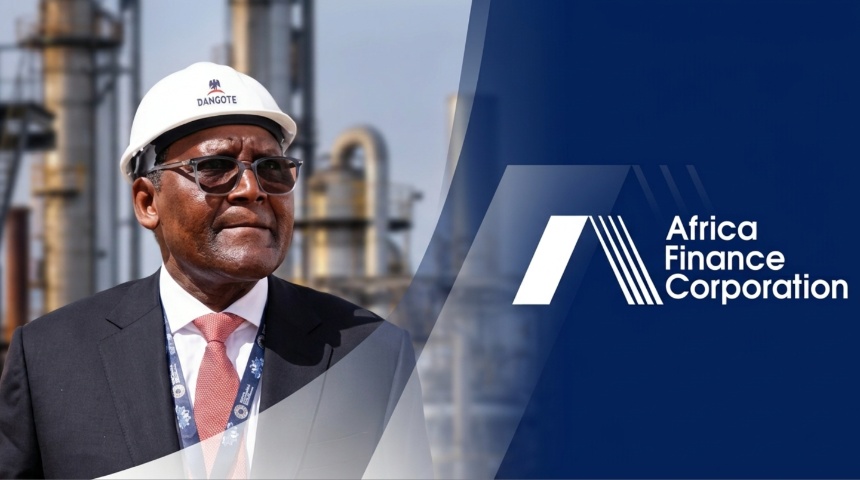
Lagos has a new headline number to talk about: $2.5 billion. That’s how much Dangote Petroleum Refinery and Petrochemicals FZE (DPRP) has raised in fresh equity, in a private placement led by the Africa Finance Corporation (AFC). The offer was oversubscribed 3.7 times over, and the company is calling it Africa’s largest publicly disclosed primary equity private placement by value.
For a refinery that’s been in the news almost constantly since it started production, this deal is different from the usual loan-and-repayment stories. This is fresh equity, new investors buying into the company itself, not just lending it money.
What actually happened
AFC led a group of strategic investors into the placement, which closed with strong demand from international and African institutional investors, sovereign-related investment vehicles, development finance institutions, and long-standing strategic partners. The refinery raised approximately $2.5 billion in fresh equity after concluding a private placement that was 3.7 times oversubscribed.
The transaction marks DPRP’s first equity capital raise to include new investors beyond its legacy ownership structure. Until now, Dangote Petroleum Refinery has stayed a tightly held company. This is the first time outside shareholders have been let in.
Who’s behind DPRP, and why the deal matters
DPRP owns the roughly $20 billion integrated refining and petrochemical complex on a 2,500-hectare site in Lagos, with a nameplate capacity of 650,000 barrels of crude oil per day, processing crude into petrol, diesel, aviation fuel, LPG, naphtha and other refined products. It’s already Nigeria’s biggest single industrial asset, and one of the largest refineries anywhere in the world.
AFC’s relationship with the project didn’t start with this cheque. AFC acted as Co-Coordinating Bank on a $3 billion syndicated loan for DPRP and recently received full repayment of its foundational $300 million senior term loan to Dangote Industries Limited, the loan that helped move the refinery from concept to reality. So this equity investment is less a new relationship starting and more an old one changing shape, from lender to shareholder.
AFC President and CEO Samaila Zubairu framed it that way himself. “AFC’s participation in this transaction reflects our continued conviction in DPRP as one of the most consequential industrial assets on the continent,” he said, adding that AFC had provided catalytic capital to the project from its earliest stages, including through syndicated financing and working capital support during commissioning.
There’s a line from him that’s worth sitting with: “This is what long-term partnership looks like: capital that remains engaged as a project develops, becomes operational and matures into a stable, cash-generating industrial platform.” It’s a tidy summary of AFC’s whole playbook, get in early with risk capital, stay through the hard years, then convert that early support into an equity stake once the asset is actually making money.
What Dangote himself said
Aliko Dangote, president and CEO of Dangote Industries Limited and chairman of DPRP, described the raise as a strategic step towards deepening and institutionalising the company’s shareholder base, saying the new capital would complement DPRP’s internal cash flows and external debt as the company pushes ahead with its expansion plans.
He tied it directly to the bigger picture too: “This further demonstrates our profound commitment to developing domestic refining and petrochemical capacity, reducing Africa’s reliance on imported refined products and supporting the continent’s energy security.” That’s the line Dangote has repeated for years, and this raise gives it fresh backing in dollar terms.
Where the money is going: 650,000 to 1.4 million barrels a day
The headline plan attached to this raise is capacity expansion. As part of Dangote Group’s Vision 2030, the company intends to more than double the refinery’s nameplate capacity to 1.4 million barrels per day by 2028. That’s not a modest upgrade, it would put the Lagos complex in a different league entirely, competing more directly with the largest refineries in the world rather than just the largest in Africa.
The petrochemical side of the site isn’t standing still either. The adjoining petrochemical plant produces polypropylene from refinery-derived propylene, supplying a raw material used in packaging, textiles, household goods, automotive components and medical products. Expansion here matters just as much as the crude-processing numbers, since it’s what lets Dangote sell into manufacturing supply chains, not just fuel pumps.
It’s worth being precise about what kind of money this is, because Nigerian business headlines tend to blur “investment,” “loan” and “raise” together. This one is explicitly equity, separate from the debt Dangote has previously taken on. The $2.5 billion equity placement operates independently of the prior debt financing AFC provided, which included a $300 million senior loan nested within roughly $5.6 billion in debt packages arranged by commercial lenders, development finance institutions and export credit agencies.
Why does that distinction matter to anyone outside a finance department? Because equity doesn’t come with a repayment schedule breathing down the company’s neck. Debt has to be serviced whether the refinery has a good quarter or a bad one. Equity investors are betting on the company’s future value instead, which tells you something about how confident this group of institutional investors is in DPRP’s next few years.
According to Dangote Petroleum Refinery, the funds will support its expansion, strengthen its capital structure and increase its financial flexibility. David Bird, DPRP’s managing director and CEO, pointed to the 3.7x subscription level as proof of just how much appetite there was for a piece of the company once it was finally offered.
Why AFC keeps showing up in Dangote’s story
If you’ve followed Nigerian infrastructure financing for any length of time, AFC’s name isn’t new. The Abuja-headquartered institution has built its reputation on exactly this kind of move, stepping in early with risk capital on projects most conventional lenders won’t touch, then staying attached long after the asset is running. It did it with the refinery’s construction financing years ago, and it’s doing it again now with equity.
For Zubairu, this deal is also a statement about what AFC is trying to be across the continent, not just in Nigeria. Since taking over as president and CEO, he’s overseen a period where the corporation’s total assets have grown several times over and its investment portfolio has expanded well beyond its early years. This raise slots neatly into that broader ambition: proving that African-led capital can lead, not just co-sign, the continent’s biggest industrial deals.
What it means for Nigeria’s fuel market
For everyday Nigerians, the direct effect of an equity raise isn’t obvious the way a fuel price change is. But indirectly, this matters. A better-capitalised refinery with a clearer path to 1.4 million barrels a day is a refinery less dependent on external debt cycles, less exposed to naira volatility when it needs dollar financing, and better positioned to keep domestic refined product supply stable.
Nigeria has spent decades importing the bulk of its petrol and diesel despite being a major crude producer. Dangote’s refinery was built specifically to break that cycle. Whether this $2.5 billion actually accelerates that outcome, or simply strengthens the balance sheet without changing much at the pump in the short term, is the part worth watching over the next year or two.
Strip away the corporate language and what you’re left with is this: one of Africa’s largest industrial projects just proved it can attract serious outside capital on its own terms, not just loans backed by government guarantees or export credit agencies. That’s a milestone for DPRP specifically, but it’s also a data point for anyone trying to gauge whether large-scale African infrastructure can pull in global institutional money without the usual scaffolding.
Whether the 1.4 million barrels a day target is hit by 2028 is a separate question, and expansion timelines in heavy industry rarely land exactly on schedule. But the $2.5 billion is real, it’s already in the bank, and it changes who has a stake in Dangote Refinery’s next chapter.