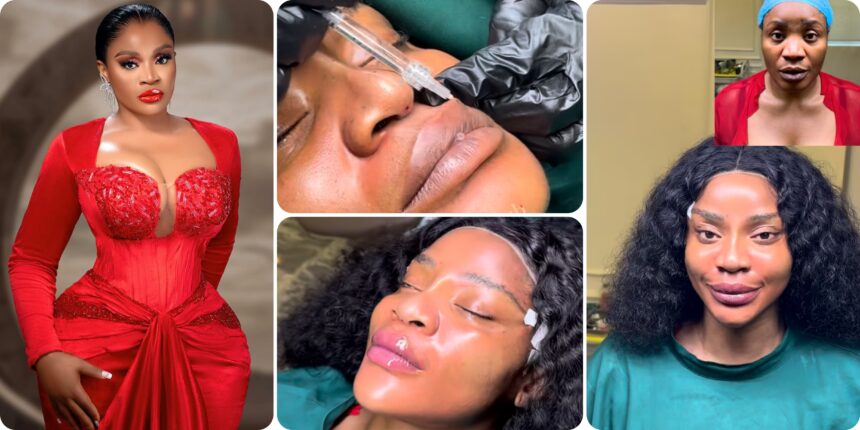
On Thursday, August 13, 2026, Uche Ogbodo appeared on social media with a message that immediately caught attention: “I GOT ME A NEW FACE!”
The Nollywood actress, film producer and entrepreneur was not talking about a new makeup look or a change in hairstyle. She had undergone a facial rejuvenation procedure and shared a clip showing parts of the process.
But while the actress revealed she was happy with the result, her decision also raises questions that go beyond her new appearance. What exactly did she have done? What do threads, fillers and PDO mean? How are they supposed to work? How long do the results last? And what should anyone considering a similar procedure know before making the decision?
Uche Ogbodo’s personal decision came from the belief that if there is something you do not like and you have the power to change it, then it’s okay to go ahead.
“I’m a woman who believes in one thing: IF YOU DON’T LIKE IT, CHANGE IT!” she wrote in the caption accompanying her video.
She added that she loves her face and herself, but believes there is always room to improve. That philosophy has now taken her into another stage of a transformation journey that she has openly documented over the past year.
Uche Ogbodo’s “New Face” Comes After a Year of Transformation

The facial rejuvenation did not happen in isolation. WITHIN NIGERIA recalls that Uche Ogbodo had already made headlines in 2025 after deciding to undergo body-contouring procedures. On May 5, 2025, she underwent a tummy tuck, liposuction and Brazilian Butt Lift (BBL) at a medical facility in Ajah, Lagos.
The actress had explained that the decision came after changes to her body following childbirth and weight gain. She had initially considered travelling to Turkey for the procedure but eventually chose to have it done in Nigeria.
The surgery was part of what she presented as a personal decision to improve how she felt about her body. She later spoke about the effect the transformation had on her confidence and mental wellbeing.
In October 2025, about five months after the first procedure, she returned for another phase of body sculpting to refine the earlier results.
In 2026, however, attention shifted from her body to her personal life.
In July, Ogbodo publicly confirmed the breakdown of her marriage to Bobby Maris after years together. The couple had started their relationship in 2018, welcomed their daughter Chimsimdiri in 2021 and married in January 2023. They also welcomed a son in October 2023.
Ogbodo’s announcement about her facial procedure came only weeks after the marriage split became public.
On August 13, she explained that she had a facial rejuvenation and underwent threads, fillers and PDO.
According to her, the aim was to lift her face, restore volume, smooth lines and create a fresh, youthful and well-rested appearance without surgery.
She also used the post to promote her aesthetics consultancy, which she said was created to help women find appropriate doctors, clinics and aesthetic professionals for plastic surgery and aesthetics procedures. In her words:
“DON’T LIKE IT? CHANGE IT. WANT TO ENHANCE IT? ENHANCE IT. BUT PLEASE, DO IT WITH THE RIGHT PEOPLE!”
So, What Exactly Did Uche Ogbodo Do?
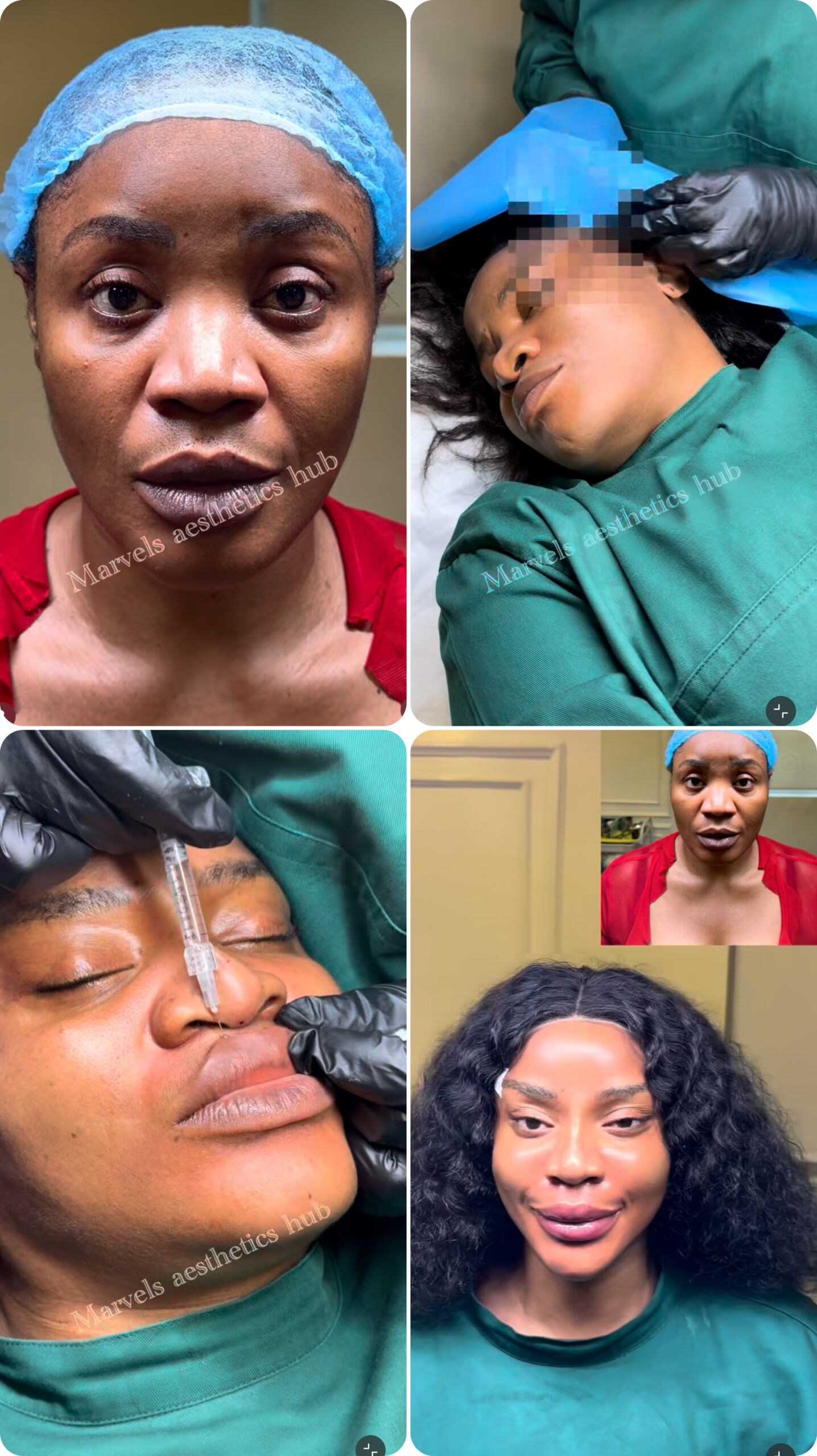
Ogbodo described her treatment as “Threads + Fillers + PDO.” Those words can sound confusing, especially because PDO is itself commonly associated with absorbable cosmetic threads.
A thread lift is a minimally invasive cosmetic procedure in which dissolvable threads are placed beneath the skin to provide some lifting and tightening. PDO, short for polydioxanone, is one of the materials used to make these absorbable threads.
So, “threads” and “PDO” should not automatically be understood as three completely separate procedures.
The exact products and techniques used during Ogbodo’s treatment are not fully detailed in her public post. What she did confirm is that the treatment combined threads, fillers and PDO and was intended to lift, restore volume and smooth lines.
How a PDO Thread Lift Works
Unlike a traditional facelift, a thread lift does not involve cutting away excess skin. A medical professional places absorbable threads underneath the skin. Some lifting threads have small barbs or other structures designed to grip tissue. Once positioned, the threads can provide a mechanical lifting effect.
There is also a second part to the treatment. As the body responds to the absorbable material, it can produce new collagen around the treated area. Collagen is one of the proteins that helps give skin its structure and firmness.
The result is therefore not simply about physically pulling the skin upward. The procedure is also intended to encourage some tightening and collagen production over time.
Different types of threads can be used for different purposes. Barbed or cog threads are designed primarily for lifting, while smooth threads are generally used more for collagen stimulation. Twisted or screw threads may be used where some added fullness or tissue stimulation is desired.
A thread procedure is sometimes marketed as a “lunchtime facelift” because it generally requires less downtime than surgical facial surgery. But that nickname should not be confused with an actual facelift. A thread lift cannot remove large amounts of excess skin or reproduce the same results as surgery.
And Then There Are Fillers
Dermal fillers work differently. Instead of physically lifting tissue with threads, fillers are injectable materials placed under the skin to add or restore volume. Many commonly used fillers are made from hyaluronic acid, a substance that occurs naturally in the body and helps retain water.
Depending on where they are placed, fillers can be used to restore lost facial volume, improve the appearance of certain lines, enhance the cheeks, lips, chin or jawline, or improve facial balance. This is why fillers and threads can be used together. One can provide structural lifting while the other restores volume.
They are not, however, permanent. The length of time a filler lasts depends on factors including the type of filler, where it is injected and the individual receiving it. That temporary nature is also part of why Ogbodo ended her announcement by reminding her followers that results are not permanent and that maintenance and touch-ups may be needed.
Fillers Are Not Botox
Another common source of confusion is the difference between fillers and wrinkle-smoothing injections such as Botox. Fillers like Uche Ogbodo’s procedure adds volume.
Botulinum toxin injections work by temporarily reducing the movement of specific muscles that create certain expression lines. So, although both are used for facial rejuvenation, they solve different problems.
The Pros: Why People Choose Threads and Fillers
There is a reason procedures like these have become popular. For someone who does not want surgery, facial threads can provide a degree of lifting and tightening without the incisions associated with a traditional facelift. The procedure may also involve less downtime than surgery.
Fillers provide another option for people who want to restore volume or alter certain facial contours without undergoing an operation. Together, different treatments can be used to address different concerns.
Someone with mild sagging may be interested in lifting. Someone with volume loss may benefit from filler. Someone concerned about certain lines may require an entirely different treatment.
The appeal is partly the ability to make targeted changes without committing to a major operation.
There is also the fact that the results are temporary. For some people, that can be a disadvantage. For others, it can be reassuring because the face is not permanently changed by one decision.
But “less invasive” does not mean “without risk. And that is where the other side of the conversation begins.
The Cons: What You Should Know Before Following Her Lead
A person considering a thread lift or filler should not make the decision based only on before-and-after photographs. Threads can cause swelling, bruising, soreness and a tight or pulling sensation after treatment. There can also be irregularities, dimpling, asymmetry, thread visibility, infection, migration or extrusion.
In some cases, the cosmetic result may simply not be what the patient expected. There is also a limit to what a thread lift can achieve.
Someone with significant excess skin or advanced facial sagging may not get the kind of result that a surgical facelift can provide. Threads can lift tissue, but they do not cut away excess skin.
Fillers come with their own risks. Swelling, bruising, tenderness, lumps and asymmetry can occur. In some cases, filler can migrate or produce an overly full appearance if too much product is used.
One of the most serious complications is vascular occlusion. This can happen when filler accidentally enters or compresses a blood vessel, blocking blood flow. Although uncommon, a severe vascular complication can cause tissue death and, in rare cases, serious vision problems including blindness.
That is why the person performing the procedure matters so much. A cheap procedure performed by an unqualified person is not necessarily a bargain. A complication can be far more expensive, painful and difficult to correct than the original treatment.
There is also the question of expectations. Social media can make cosmetic procedures look simple because viewers usually see the final result. They may not see the consultation, medical assessment, injection risks, swelling, bruising, recovery or the possibility of an unsatisfactory outcome.
That means anyone who chooses these procedures should understand that maintaining the look can require future treatments, and therefore future costs and risks.
The decision should also take individual health into account. Active skin infections, certain medical conditions, medications that affect bleeding, pregnancy or breastfeeding and other circumstances may require delaying a procedure or avoiding it altogether.
The answer is not the same for everyone.
Before You Get Threads or Fillers, Ask These Questions
If Ogbodo’s transformation has made you consider facial rejuvenation yourself, the most important lesson from her post may actually be the advice she gave at the end:
“DO IT WITH THE RIGHT PEOPLE.”
Before undergoing treatment, ask who will perform it and what qualifications they have.
Find out exactly what product will be used. If you are getting a filler, know the product and understand whether it is appropriate for the area being treated. If you are getting threads, ask what type of thread is being used and why.
Ask what result is realistically possible rather than relying on a photograph of someone else.
Ask how long the result is expected to last.
Ask about recovery, possible complications and what the clinic will do if something goes wrong.
And make sure the procedure is being performed in an appropriate medical setting with access to the equipment and expertise needed to manage complications.
Most importantly, do not assume that a procedure is safe simply because it is called “non-surgical.”
A needle going into the face is still a medical procedure. A thread being placed beneath the skin is still an invasive procedure. The absence of a large surgical incision does not remove the need for proper medical care.
Conclusion

Uche Ogbodo has never been particularly shy about cosmetic enhancement.
From the body-contouring procedures she underwent in 2025 to the facial rejuvenation she unveiled on August 13, 2026, she has chosen to make many parts of her transformation public.
Her reasoning is straightforward. She loves herself and her face, but believes that loving yourself does not mean refusing to change something you would rather improve. That is her choice.
But her story also provides an opportunity to look beyond the finished photographs and understand what happens behind them.
Threads can lift. Fillers can restore volume. PDO threads can stimulate collagen. None of them, however, are magic, permanent or completely risk-free.