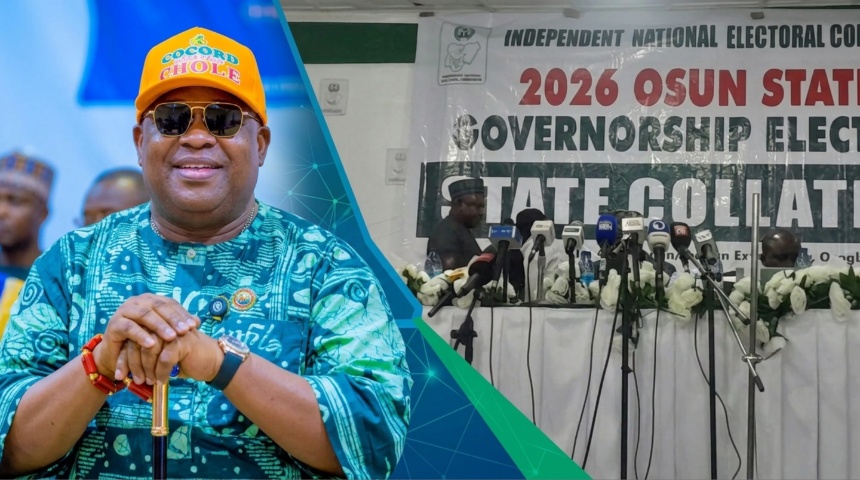
Osogbo — Sunday, August 16, 2026. Governor Ademola Adeleke is holding a commanding lead over the All Progressives Congress candidate, Bola Oyebamiji, as the Independent National Electoral Commission works through collation of Saturday’s governorship election. This report will keep updating as INEC releases fresh figures, so check back for the latest Osun State election result.
As of the last major update, taken from result sheets uploaded to INEC’s IReV portal at 7:59 p.m. on Saturday, Adeleke had polled 452,072 votes against Oyebamiji’s 373,003, a gap of 79,069 votes. That was with 3,291 of the state’s 3,763 polling units accounted for, roughly 87.5 percent of the total. Najeem Salaam of the African Democratic Congress sits a distant third, nowhere near troubling the top two.
Nothing here is final. INEC’s returning officer has not stepped up to the podium at the state collation centre in Osogbo to declare a winner, and until that happens, every number in this article is provisional. Prof. Joshua Ogunwole, Vice Chancellor of Federal University Oye-Ekiti, is presiding as State Returning Officer, and the commission only began formally reading out LGA-level results in the early hours of Sunday morning after polls closed at 2:30 p.m. Saturday.
How we got here
Saturday’s vote was originally billed for August 8 before INEC pushed it back a week. Fourteen parties were cleared to field candidates, though the two heavyweights that mattered most, the Peoples Democratic Party and the Labour Party, didn’t present anyone. That left the race as effectively a three-horse contest, and really more of a two-horse one: Adeleke, who defected from the PDP to the Accord Party ahead of this election, defending the seat he first won in 2022, and Oyebamiji, a former Osun finance commissioner running on the APC ticket.
The build-up wasn’t quiet. The EFCC froze the Osun State government’s accounts just ten days before voters went to the polls, part of an ongoing investigation the anti-graft agency hasn’t fully detailed. Adeleke’s camp called it politically timed, and given the election was already on the calendar, it’s hard to blame them for reading it that way. Whether it moved a single vote is another matter entirely.
The numbers, LGA by LGA
Collation is happening ward by ward, then local government by local government, and results are landing unevenly. Here’s what’s been announced so far from some of the 30 LGAs, based on figures read out at the collation centre:
| Local Government | Accord (Adeleke) | APC (Oyebamiji) | ADC (Salaam) |
|---|---|---|---|
| Boluwaduro | 7,118 | 7,050 | 179 |
| Ede South | 26,188 | 6,219 | 390 |
| Ife Central | 21,171 | 15,913 | — |
Two things jump out. First, Boluwaduro was nail-bitingly close, decided by fewer than 70 votes out of over 14,000 cast, and it even threw up a small twist at the polling-unit level: at Ward 6, Polling Unit 006 in that same LGA, Oyebamiji actually beat Adeleke 68 to 39. Local contests inside a bigger result are like that. Second, Ede South tells a completely different story, a near five-to-one landslide for the governor that shows exactly where his strongholds sit.
Zooming out to the cumulative picture from an earlier point in the count, when 10 LGAs had reported, Adeleke was sitting on 143,234 votes to Oyebamiji’s 126,391, with Salaam trailing on 3,774. The gap has widened as more results have come in, not narrowed, which is generally not the direction a challenger wants to see once the count is past the halfway mark.
Turnout and the mood on the ground
Osun has more than 2 million registered voters, and 81.5 percent of them collected their Permanent Voter Cards ahead of the election. Early figures suggest turnout in the areas counted so far sits around 45 percent of registered voters, valid and rejected ballots combined. That’s a modest uptick from 2022, when turnout came in at 42.16 percent, and it matters because a governor seeking a second term usually wants to see engagement holding steady or climbing, not collapsing.
Voting itself ran from around 9 a.m. to roughly 2:30 p.m. across most polling units, and domestic observers monitoring the process described it as largely peaceful, though not without hiccups. There were reports of disruption in Modakeke Ward 10, where individuals suspected to be police allegedly seized materials at a polling location, an incident that’s still being looked into.
What happens next
INEC still has to finish collating results from the remaining local governments before Prof. Ogunwole can make a formal declaration at the Osogbo collation centre. Nigerian electoral law requires a candidate to score the highest number of votes and at least 25 percent of votes in two-thirds of the state’s local government areas to be declared winner outright, so the LGA-by-LGA spread matters just as much as the topline national figure.
Given how far ahead Adeleke is with the bulk of results already in, Oyebamiji would need a genuinely lopsided run through the outstanding polling units to close a gap this size. It’s not mathematically impossible, but it’s a tall order.
We’ll update this article the moment INEC’s returning officer makes it official. Follow #OsunDecides2026 for real-time developments from Osogbo.