The Osun governorship election offered the All Progressives Congress more than a defeat; it provided a detailed lesson in how political power, campaign strategy and public perception can combine to produce an unexpected outcome.
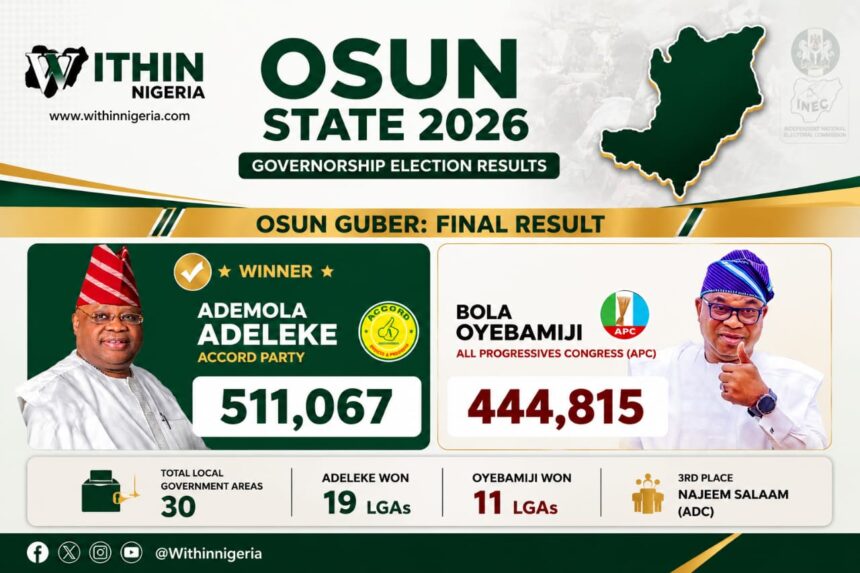
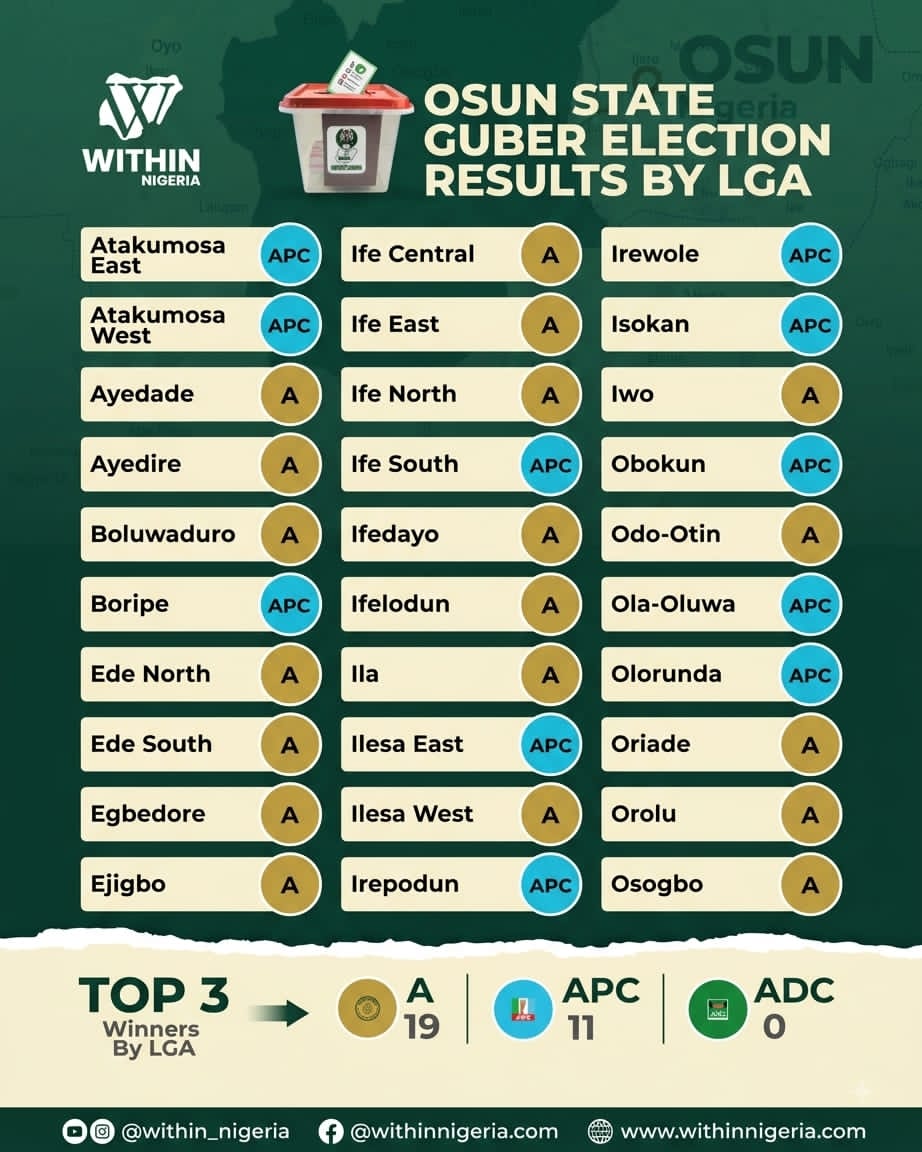
Governor Ademola Adeleke, the Accord Party candidate, secured 511,067 votes against 444,815 recorded by the APC candidate, Bola Oyebamiji, winning in 19 of the state’s 30 local government areas and earning another four years in office.
In this article, WITHIN NIGERIA’s ABDULSALAM ABDULLAH examines how a party with every structural advantage — federal backing, a well-funded machine, and a candidate marketed as competent and experienced — still found itself out-manoeuvred not by its rival’s strategy, but by a string of its own missteps.
The analysis that follows traces how the APC’s handling of the EFCC controversy, the religious undertones of the campaign, and its reliance on federal muscle combined to hand Adeleke a narrative he did not have to build for himself.
On the surface, Saturday’s result could easily be attributed to Adeleke’s popularity, his public image, the influence of the Adeleke family or the excitement surrounding his campaign style.
But such explanations only capture part of what happened.
The more revealing story lies in the environment created during the campaign and the way the APC’s considerable political advantages were used.
The party entered the contest with the backing of the Federal Government, an established political structure, prominent national figures and a candidate it portrayed as experienced and technically capable.
Yet, instead of keeping the contest focused on the incumbent’s record, the APC increasingly found itself at the centre of controversies that gave Adeleke alternative ways to connect with voters.
In that sense, the party’s challenge was not simply defeating an incumbent governor; it was preventing the election from becoming a referendum on the APC itself.
When the EFCC controversy changed the conversation
Few developments altered the political atmosphere as sharply as the Economic and Financial Crimes Commission’s restriction of the Osun State Government’s accounts shortly before the election.
Adeleke described the action as an attempt to weaken his administration before voters went to the polls, while the APC maintained that the state government should face scrutiny over alleged financial misconduct.
The EFCC may have had legal or investigative grounds for its decision, but the political consequences were shaped largely by when the action occurred.
With the election only days away, the restriction became much more than an investigative issue; it became campaign material.
For Adeleke’s supporters, the timing fitted neatly into a narrative that the Federal Government was attempting to undermine an opposition-controlled state before the election.
Once that interpretation gained traction, the APC faced the more difficult task of persuading voters to separate the EFCC’s actions from the political contest.
The situation became even more complicated when President Bola Tinubu directed that the restriction on the state account be lifted.
The reversal inevitably raised political questions, regardless of the legal merits of the original action.
Why impose the restriction so close to an election if it was necessary, critics could ask, and why remove it if it was justified?
Those questions did not determine the legal status of the EFCC matter, but they influenced the political narrative.
Adeleke was consequently able to portray himself as an incumbent facing pressure from a powerful Federal Government, a position that could resonate strongly with voters who were sensitive to perceived external interference.
Religion became part of the contest
Another issue that complicated the APC’s campaign was the place of religion in the election.
Oyebamiji’s consultations with Muslim leaders and organisations, some of which publicly supported his candidacy, were not in themselves unusual or improper.
The difficulty came from the broader interpretation of such engagements in a state known for religious diversity and a long history of interaction between Muslims and Christians.
Once political activity begins to acquire a religious character, voters can start evaluating candidates through concerns that go beyond policies and performance.
The APC did not necessarily originate every religious narrative that emerged during the campaign, but it appeared unable to keep the issue from becoming part of the election’s dominant conversation.
That was significant because the contest could have centred more firmly on matters such as employment, education, healthcare, security, infrastructure, roads and the incumbent’s record.
Instead, religion became another issue through which voters could interpret what an APC victory might mean.
In elections, perceptions can sometimes matter as much as intentions.
A candidate does not necessarily lose support because voters oppose him personally; some may simply become uncomfortable with what they believe his victory could represent.
The risk of making Abuja the selling point
The APC also faced the political difficulty of emphasising its access to federal power.
The argument behind such a strategy is familiar: a governor belonging to the same party as the President could potentially have an easier route to federal projects, attention and resources.
Yet the same message can produce an entirely different reaction among voters.
Instead of hearing a promise of cooperation, some voters may interpret it as an appeal to support the party because it controls the Federal Government.
That distinction matters in an election where questions of autonomy and local choice are important.
The stronger the campaign appeared to lean on the influence of Abuja, the easier it became for Adeleke to present the contest as a choice between Osun determining its own political direction and the Federal Government extending its influence into the state.
That was a narrative that favoured an opposition candidate.
The APC therefore faced a paradox: one of its greatest advantages nationally could become a liability locally.
Political statements acquired a life of their own
Campaign rhetoric provided another source of difficulty.
Statements attributed to prominent APC figures, including Senator Francis Fadahunsi, became part of the wider controversy, with opposition politicians criticising what the PDP described as “hurtful rhetorics” from APC figures.
Whether individual remarks were interpreted fairly is a separate question.
What mattered politically was how those words were received and circulated.
Election campaigns rarely give politicians the luxury of explaining every statement at length.
A comment delivered at a rally can quickly find its way into WhatsApp groups, social media platforms, markets, religious gatherings and private conversations, often reaching audiences far removed from the original setting.
By the time a speaker provides context or clarification, the initial impression may already have taken hold.
For a party attempting to reassure voters, inflammatory or threatening interpretations can therefore become particularly damaging.
The APC’s difficulty was not merely what its politicians said, but the broader political meaning voters attached to those statements.
How the incumbent became the underdog
Perhaps the most striking feature of the campaign was the extent to which Adeleke was able to occupy the emotional position of an underdog despite being the sitting governor.
Ordinarily, an incumbent seeking another term carries the burden of defending his administration’s performance.
That should have given the opposition a straightforward line of attack: ask voters whether Adeleke had delivered enough to deserve another term.
The APC had several potential areas from which to build that argument.
Adeleke had faced controversies and political challenges, while his departure from the Peoples Democratic Party to contest under the Accord platform could also have been used to question his political consistency.
Yet those issues did not ultimately dominate the election.
Instead, the controversies surrounding the APC campaign gave Adeleke material with which to present himself as a governor under pressure.
The EFCC dispute supported that argument.
The religious controversy gave it another dimension.
The emphasis on federal influence reinforced the perception of external pressure.
Comments attributed to APC figures added further weight to the narrative.
Adeleke could therefore ask voters to see the election not simply as a decision on his record, but as a choice over whether Osun should resist political pressure from outside the state.
That was a considerably stronger emotional proposition than a simple incumbent-versus-challenger contest.
The referendum the APC could have created
The more direct strategy would have been to make Adeleke’s performance the central issue of the election.
The opposition could have concentrated on asking what had changed in Osun under his administration, whether employment opportunities had improved, how effectively security had been handled, what had happened in the education and health sectors, how sustainable the state’s finances were and which campaign promises had been fulfilled.
Such questions would have placed the incumbent on the defensive.
Instead, the APC increasingly had to explain the circumstances surrounding its own campaign.
That does not mean Adeleke’s victory can be explained solely by APC errors.
Osun voters made individual choices, and those decisions cannot simply be reduced to the mistakes of one political party.
But the APC’s campaign environment helped amplify Adeleke’s existing political strengths.
He could point to the EFCC controversy, present himself as resisting federal pressure, appeal to voters concerned about religious division and challenge the idea that control of Abuja should determine who governs Osun.
For an electorate with a strong sense of political ownership, the question of whether the Federal Government should determine the state’s leadership was particularly potent.
Tinubu’s influence has a ceiling
The outcome also carries implications beyond Osun, especially as Nigerian parties prepare for the 2027 political contest.
President Tinubu remains a powerful political figure, but the Osun result demonstrates that presidential influence cannot simply be transferred to another candidate at the ballot box.
Voters can support a President while rejecting the candidate of his party at the state level.
They can recognise the Federal Government’s authority while insisting that the choice of their governor remains their own.
They can also acknowledge a candidate’s experience or competence while taking issue with the political circumstances surrounding his campaign.
The ballot, in other words, is not an automatic expression of party loyalty.
Nigeria’s electorate can make different choices at different levels of government, and political parties that assume otherwise risk misunderstanding the voters they are trying to persuade.
The harder question for the APC
For the APC, the most useful post-election question may therefore not be who defeated the party.
A more difficult question is whether the party’s own strategy created conditions that made Adeleke’s victory easier.
The APC possessed political machinery, access to federal power, influential figures, religious and political endorsements, and a candidate it considered experienced and capable.
Despite those advantages, Adeleke finished with 511,067 votes, while Oyebamiji recorded 444,815, leaving a difference of 66,252 votes.
That margin is substantial enough to require more than an explanation based on celebrity appeal, dancing or family popularity.
It represents a political verdict.
In the end, the APC may have given Adeleke several of the narratives he needed to win without having to create them himself.
An election that could have revolved around the incumbent’s record instead became increasingly associated with federal intervention, political pressure, religion and the exercise of power.
By election day, the central question for many voters was no longer simply whether Adeleke had earned another term.
It had become whether the APC should be entrusted with control of Osun.
The voters answered that question in Adeleke’s favour.
Adeleke now faces a different test
The outcome also carries a warning for the governor.
The sympathy that may have helped an incumbent through a difficult campaign cannot substitute for effective administration.
Neither public performances nor the strength of the Adeleke family name can deliver infrastructure, improve healthcare, create employment, strengthen security or raise the standard of education.
A second term therefore changes the nature of Adeleke’s political challenge.
The electorate that rejected the APC will eventually assess what Accord and Adeleke do with the mandate they have received.
The same voters who resisted federal political machinery can also turn against an administration that fails to meet their expectations.
That may ultimately be the clearest lesson from Osun.
The result was not simply a victory for Adeleke or Accord, nor merely a defeat for the APC.
It was a demonstration of the limits of political machinery, federal influence and endorsements when voters reach the ballot box.
Presidents can campaign, parties can mobilise, political leaders can endorse candidates and resources can shape an election.
But once the votes are counted, it is the electorate that determines who receives power.