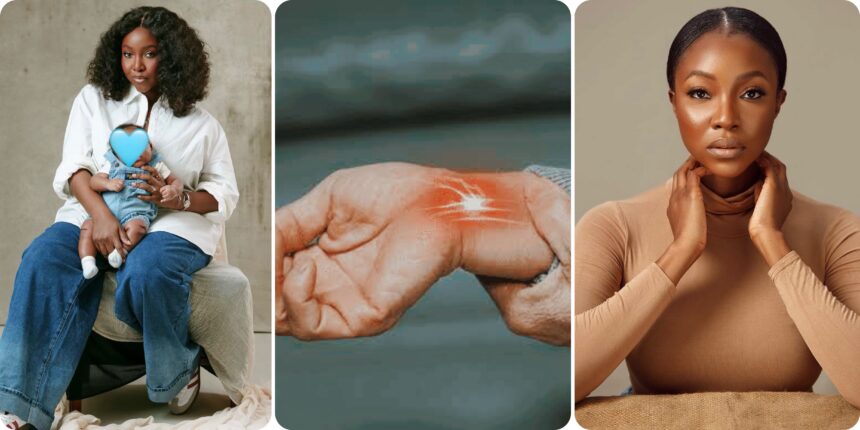
Motherhood has brought a new chapter for actress Ini Dima-Okojie, but alongside the joy of caring for her first child has come a painful condition she did not expect.
The Nollywood actress recently gave followers a glimpse into her life as a new mother, sharing both the emotional changes that have come with motherhood and a physical challenge that has left her searching for relief.
Her comment has drawn attention to a condition that many people may have heard described as “mum wrist” without knowing exactly what it means, why it happens or how painful it can become.
A New Chapter For Ini

Ini’s post came a few months after she and her husband, Dr Abasi Ene-Obong, welcomed their first child. The actress announced the arrival of their baby boy in June 2026, sharing the news around her 36th birthday celebration.
By September, her latest update showed a different side of the transition into motherhood. Sharing photos of herself and her baby in multiple slides, Ini reflected on how much her life had changed in the months since becoming a mother. She wrote:
“Life lately. A little glimpse of the last few months. So much has changed, and I’m still finding my way through it all.”
Her message was not only about the physical changes that come with having a baby. She also spoke to new mothers who may struggle to recognise themselves after childbirth.
“To the new mums who may not quite recognise themselves yet, be patient with yourself,” she said, adding that their bodies had “done something incredible.”
She continued:
“Give yourself grace and time.
Slowly but surely, you’ll find your way back to yourself. And maybe, you’ll discover a new version of you along the way.”
For Ini, however, there was another reality beneath the encouraging message: pain in her wrist.
The Pain Behind ‘Mum Wrist’
After encouraging other new mothers to give themselves time and grace, Ini added a personal request for help. She added:
“PS: Pls, who has a remedy for Tenosynovitis (mum wrist)? I’ve been in so much pain.”
That question brought attention to tenosynovitis, a condition involving inflammation or irritation of the protective sheath around a tendon.
The term “mum wrist” is commonly used for De Quervain’s tenosynovitis, a painful condition affecting two tendons on the thumb side of the wrist. It can make everyday movements such as gripping, lifting or turning the wrist painful.
For a new mother, those movements can become part of everyday life. Picking up a baby, holding the baby during feeding, carrying the child and repeatedly using the hands and wrists can put additional strain on the affected area.
A medical case report describes “mommy’s thumb” as a lay term for De Quervain’s tenosynovitis in mothers of newborns and young children, with carrying the child and repeated wrist use among the possible reasons.
What Exactly Is Tenosynovitis?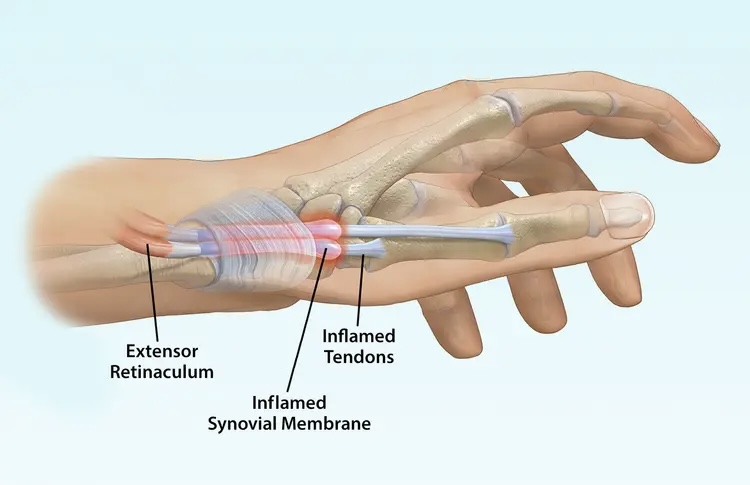
To understand the condition, it helps to first understand tendons. Tendons are strong tissues that connect muscles to bones and help parts of the body move. They are surrounded by a protective covering that allows them to move smoothly.
When that covering becomes irritated and swollen, it can interfere with the normal movement of the tendon.
In De Quervain’s tenosynovitis, the problem affects tendons on the thumb side of the wrist. Mayo Clinic notes that repetitive hand movements such as lifting, gripping and twisting can irritate the covering around these tendons.
The result can be pain and tenderness around the wrist and base of the thumb. And that pain can become noticeable during activities that appear simple, such as picking something up or making a fist.
Why New Mothers Can Develop ‘Mum Wrist’
The phrase “mum wrist” is not simply a nickname based on motherhood. There is a practical reason the condition is associated with new mothers.
A newborn needs to be carried, held and supported repeatedly throughout the day. These activities can involve keeping the wrist in awkward positions or repeatedly gripping and lifting. Over time, the repeated strain may irritate the tendons around the thumb and wrist.
Research and medical literature have linked “mommy’s thumb” in new mothers to overuse from carrying a child. Fluid retention associated with lactational changes has also been suggested as another possible factor.
This means that a mother can find herself dealing with pain in the same hand she relies on to care for her baby.
What Does ‘Mum Wrist’ Feel Like?
One of the most common signs is pain on the thumb side of the wrist. The pain may become worse when gripping or pinching something, turning the wrist or making a fist. There can also be tenderness, swelling or difficulty moving the thumb and wrist normally.
For someone caring for a baby, this can make routine tasks uncomfortable. Lifting the baby, holding a bottle, carrying a bag or even opening a container can put pressure on the affected area. This helps explain why the condition can become more than a minor inconvenience for a new mother.
How Is It Diagnosed?
Persistent wrist pain should not simply be assumed to be “mum wrist.” A healthcare professional can assess the symptoms and examine the hand and wrist to determine what is causing the pain.
For De Quervain’s tenosynovitis, doctors can use physical examination techniques that place the thumb and wrist in specific positions to see whether the characteristic pain is reproduced. A report notes that one such assessment is the Finkelstein test.
This is important because wrist pain can have different causes, and the appropriate treatment depends on what is actually causing it.
How Is It Treated?
Treatment depends on the severity of the condition, but the aim is generally to reduce irritation and give the affected tendons time to recover.
Resting the affected hand and wrist can help. A doctor or hand therapist may also recommend a splint or brace to support the thumb and wrist and limit movements that aggravate the pain.
Ice may also help relieve symptoms, while pain-relieving or anti-inflammatory medication may be considered where medically appropriate.
If symptoms do not improve, a healthcare professional may consider other treatments, including steroid injections. Surgery is generally reserved for cases where other treatments have not provided enough relief.
So while social media may offer plenty of home remedies, persistent or severe pain should not be self-diagnosed or ignored.
Ini’s Experience Highlights A Less-Talked-About Side Of Motherhood

Ini Dima-Okojie’s post was ultimately about much more than a wrist problem. Her message captured the mixture of joy, adjustment and physical challenges that can accompany becoming a mother for the first time.
She reminded new mothers that they may not immediately feel or look the way they did before childbirth and encouraged them to be patient with themselves before sharing about being “in so much pain.”
That contrast is what makes her experience worth paying attention to. Behind the photographs of a happy new mother and her baby can also be a woman adjusting to a body that is still recovering, while dealing with the physical demands of caring for a newborn.
Conclusion
For Ini, the journey into motherhood is still new. Her June announcement marked the beginning of a new chapter, while her latest post shows that the months that followed have come with their own adjustments.
Her experience with “mum wrist” also shines a light on a condition that can easily be dismissed as an ordinary ache.
Tenosynovitis can cause significant pain, and when it affects a new mother’s wrist, even everyday childcare activities can become difficult.
For new mothers experiencing persistent wrist or thumb pain, Ini’s experience is a reminder that pain should not simply be accepted as an unavoidable part of motherhood. Getting the right diagnosis and treatment can make the difference between struggling through the pain and getting back to caring for both the baby and oneself.