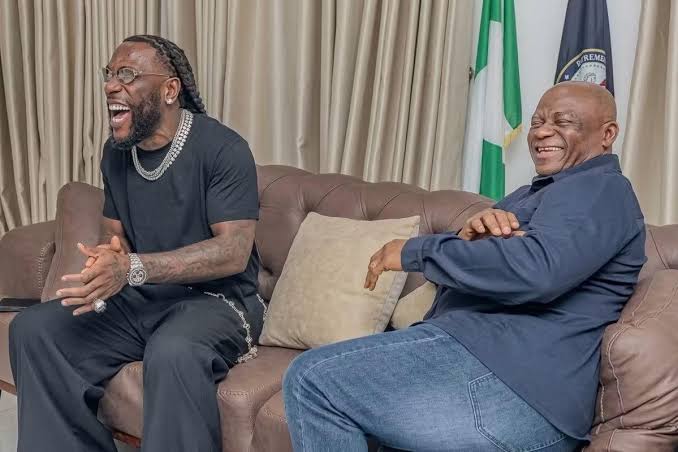
The sight of Burna Boy sitting down with Nigeria’s Inspector General of Police has naturally drawn attention, but the reason behind the meeting goes beyond the usual celebrity visit to a senior government official. On Saturday, October 3, 2026, the Grammy winning singer, whose real name is Damini Ogulu, met Inspector General of Police Olatunji Disu at Police House in Lagos, in a conversation that placed music, young Nigerians and the future of police public relations at the centre of attention. The meeting came at a particularly interesting time for the Nigeria Police Force, with its leadership increasingly speaking about public confidence, professionalism, technology and stronger relationships with communities.
For many Nigerians, Burna Boy is not simply another entertainer with a huge following. His music has repeatedly touched on social issues, politics, inequality and experiences that resonate strongly with young people, while his international profile has made him one of the most recognisable Nigerian artists around the world. That history gives his meeting with the IGP a different weight, especially because the conversation reportedly centred on the relationship between the police and younger Nigerians. There is therefore a bigger story sitting behind the photographs and the formal meeting, and it begins with what the Police Force believes the creative industry can bring to the conversation.
The October 3 meeting in Lagos
The meeting took place at Police House in Lagos on Saturday, October 3, 2026, bringing Burna Boy face to face with IGP Olatunji Disu as part of discussions around police public relations and engagement with Nigeria’s creative sector. The meeting was reported publicly on October 4, putting the development firmly into the national conversation as Nigerians continued to watch the direction of the Police Force under Disu’s leadership. The central issue was the possibility of using the influence of Nigeria’s entertainment industry to strengthen communication between law enforcement institutions and the public.
Burna Boy’s presence made the engagement particularly noticeable because of the size and character of his audience. His music reaches millions of listeners across Nigeria, Africa and the international community, with young Nigerians forming a major part of the audience that follows his career. For a police leadership interested in improving communication with younger citizens, engaging a personality with that kind of cultural reach presents an opportunity to take the conversation beyond traditional government channels and into spaces where young people already pay attention.
The meeting was therefore presented as an engagement between the Police Force and the creative industry rather than a gathering connected to a criminal allegation, police investigation or accusation involving Burna Boy. That distinction is important because the public attention surrounding the singer could easily have produced several assumptions about why such a meeting took place. The information available from the meeting instead points towards collaboration, communication and the wider question of how the Police Force can connect more effectively with a younger population.
Why Burna Boy’s name changes the conversation
Burna Boy carries a particular history when conversations about young Nigerians, policing and social issues are involved. His 2020 song 20 10 20 was released in connection with the October 2020 period surrounding the EndSARS protests and the Lekki tollgate shootings, making the singer one of the major Nigerian entertainers whose work became associated with that moment in the country’s recent history. His involvement in that period remains part of the wider public understanding of his music and social commentary.
That background makes his October 3, 2026 meeting with the IGP especially interesting because the conversation now involves two sides that have previously appeared in very different parts of Nigeria’s public discourse. Burna Boy represents a section of the creative industry with enormous influence among young Nigerians, while the Inspector General of Police represents the institution responsible for policing millions of citizens across the country. Bringing those two worlds together naturally attracts attention because the conversation is not merely about entertainment or police administration in isolation.
The importance of the meeting also comes from the fact that the Police Force is looking for ways to improve its relationship with younger Nigerians. Young people consume information differently, follow personalities differently and often respond to cultural voices more quickly than they respond to formal institutional announcements. The presence of Burna Boy therefore gives the discussion a cultural dimension that a conventional police briefing would not necessarily have.
Disu’s focus on Nigeria’s Orange Economy
The discussion also connects with an idea that IGP Disu has been highlighting in recent months, the enormous potential of Nigeria’s Orange Economy. The term refers broadly to the creative economy, covering areas such as music, film, fashion, digital content, entertainment, design and other creative businesses that contribute to economic activity and cultural influence.
Disu’s interest in the sector goes beyond the popularity of entertainers. The Police Force has a direct interest in protecting creative businesses and the people who work within them, particularly as the industry continues to generate substantial economic value and international attention for Nigeria. Issues such as piracy, counterfeiting and intellectual property related offences can affect artists, producers, filmmakers, fashion businesses and other creative professionals, creating a natural point of contact between the security sector and the creative economy.
That wider perspective helps explain why Burna Boy’s meeting with Disu fits into a broader conversation already taking place within the Police Force. Rather than treating entertainment simply as a source of publicity, the approach places the creative sector within discussions about economic protection, public communication, youth engagement and police community relations.
The September conversation that came before Burna Boy
The October 3 meeting did not emerge without a wider background. In September 2026, Disu spoke about the relationship between policing and Nigeria’s Orange Economy during an engagement at the National Institute for Policy and Strategic Studies in Plateau State. During that discussion, he highlighted the need for the Police Force to pay greater attention to the security challenges affecting Nigeria’s creative industries.
One of the proposals associated with that conversation was the creation of an Orange Economy Security and Intellectual Property Coordination Desk within an appropriate structure of the Police Force. The proposed desk was intended to provide a more coordinated response to crimes affecting creative businesses, including piracy, counterfeiting and offences involving intellectual property.
That September discussion provides useful context for the October 3 meeting because it shows that the Police Force’s interest in the creative industry had already entered the IGP’s public agenda before Burna Boy arrived at Police House. The meeting therefore sits within a developing policy conversation rather than appearing as an isolated celebrity encounter.
Why the youth angle is central
Young Nigerians are at the heart of the conversation because they represent one of the largest audiences for Nigeria’s creative economy and one of the most important groups in any discussion about the future relationship between citizens and the police. Music, film, social media, fashion and digital content have become powerful channels through which young Nigerians exchange information, form opinions and discuss public issues.
Traditional police communication often follows formal institutional structures, including statements, press briefings, official announcements and public engagements. Those channels remain important, but the Police Force also needs to communicate in environments where younger Nigerians already spend their time. Creative personalities can provide access to those audiences through a completely different form of communication.
Burna Boy is particularly relevant within that context because his influence extends beyond Nigeria. His international success has made him one of the country’s most visible cultural figures, while his music continues to connect strongly with Nigerian experiences. A conversation involving him can therefore attract attention from audiences that may never actively seek out a police statement or attend a conventional government event.
Burna Boy’s response to the proposal
Reports surrounding the meeting indicate that Burna Boy expressed support for the direction being pursued by Disu and showed willingness to contribute to efforts aimed at improving the relationship between the Police Force and Nigerians, particularly younger Nigerians. His reported position suggests that the singer is open to using his influence to support dialogue between the police and the public.
Burna Boy has not been publicly announced as a police ambassador as part of the October 3 meeting, and there is no confirmed information showing that he has received a formal position within the Nigeria Police Force.
The exact nature of that contribution, however, remains an important part of the story. There was no publicly announced detailed programme setting out specific activities that Burna Boy would undertake following the meeting. There was also no publicly released timetable showing when a joint initiative would begin or exactly how the proposed collaboration would operate.
The significance of the EndSARS connection
The October 2020 EndSARS period remains an important part of the context surrounding this meeting. Burna Boy’s 20 10 20 became closely associated with the events and public emotions surrounding that period, giving his music a direct connection to one of the most significant youth led social movements in recent Nigerian history.
That history means Burna Boy’s interaction with the Police Force carries a symbolic dimension that would not necessarily exist with every celebrity. His audience knows that his music has addressed police related issues before, while the Police Force is now seeking stronger relationships with the same generation that played a major role in the EndSARS movement.
The October 3 meeting therefore brings a different kind of conversation into view. It places a prominent creative figure who has previously addressed police related concerns through music in a room with the institution’s highest ranking officer, with both sides discussing how the relationship between police officers and the public can be strengthened.
Disu’s wider policing agenda
The meeting also comes during a period when Disu has been discussing several areas connected to changes within the Nigeria Police Force. His public messaging has included issues such as professionalism, accountability, technology driven policing, community relationships and implementation of the 2026 gazetted Police Regulations.
Those areas are important because public trust is rarely shaped by communication alone. How officers behave, how complaints are handled, how technology is used, how disciplinary matters are treated and how communities interact with police officers all contribute to how the institution is perceived.
The Police Force has also announced disciplinary action in cases involving allegations of unprofessional conduct by officers. Such actions form part of the broader institutional effort to demonstrate that professional standards are expected within the organisation.
The Burna Boy engagement fits into that wider picture because communication is one part of the relationship between the police and citizens. The creative industry can help create conversations and reach audiences, while the Police Force remains responsible for the institutional actions that ultimately determine how those conversations are received.
Why the Orange Economy matters to the Police
Nigeria’s creative industry has grown into a major part of the country’s cultural identity and economic activity. Nigerian music, film, fashion and digital content have audiences across Africa and around the world, creating businesses, jobs and international visibility for the country.
That growth also produces security challenges. Creative businesses can lose revenue through piracy, counterfeit products and other forms of intellectual property abuse. Artists, producers, filmmakers and other professionals can also face different forms of criminal activity connected to their work and commercial operations.
A Police Force that understands those challenges can engage the creative industry from another direction. Rather than seeing entertainers only as public figures, the institution can recognise them as participants in a major economic sector that requires security, legal protection and effective enforcement.
The proposed Orange Economy Security and Intellectual Property Coordination Desk reflects that thinking. If implemented effectively, such a structure could provide a clearer point of engagement between the Police Force and creative businesses dealing with security and intellectual property related concerns.
The meeting is bigger than a celebrity photograph
Celebrity meetings with government officials happen regularly, but this particular encounter has a clear institutional context. Burna Boy’s cultural influence intersects with the Police Force’s stated interest in rebuilding communication with young Nigerians, while Disu’s Orange Economy agenda provides an economic and security dimension to the conversation.
That combination explains much of the attention surrounding the meeting. The story is not simply that a famous musician visited the IGP. The more important development is the attempt to connect Nigeria’s creative influence with a national conversation about policing and public confidence.
Burna Boy can reach audiences through music and culture in ways that a formal police statement cannot. The Police Force, on the other hand, controls the institutional structures, policies and policing practices that affect the public every day. The meeting puts those two forms of influence in the same conversation.
What Burna Boy could bring to the conversation
The singer’s biggest potential contribution is his ability to communicate with young Nigerians using a language and cultural environment that already feels familiar to them. Music has long been used in Nigeria to discuss social realities, political developments, personal experiences and public concerns.
That influence could become useful if future collaboration focuses on genuine dialogue rather than simply publicity. Youth engagement programmes, conversations between creative professionals and police officers, public awareness campaigns and community focused initiatives are among the possible areas where the creative industry could contribute.
None of those possibilities should currently be presented as an established Burna Boy programme because no detailed project has been publicly announced. The meeting establishes an opening for collaboration, while the substance of any future initiative will depend on what both sides eventually announce.
What the Police Force wants from creative personalities
The Police Force’s interest in entertainers appears to be based largely on reach and influence. A popular artist can communicate with millions of people within minutes, while a conventional institutional message may struggle to receive the same level of attention.
That does not mean celebrities replace police communication. Rather, the creative sector can become an additional channel through which important conversations reach audiences that are difficult to engage through conventional methods.
The approach also recognises that policing is not only about officers, vehicles, weapons, arrests and investigations. Public confidence depends heavily on the relationship between the institution and the people it serves. Communication, visibility, community engagement and cultural understanding can all play a role in that relationship.
The unanswered part of the October 3 meeting
The biggest unanswered question is what comes next. The meeting has established contact between Burna Boy and the Police Force, and the singer has reportedly expressed willingness to support the broader objective, but the public has not yet been given a detailed roadmap.
There is no confirmed date for a follow up programme involving Burna Boy, no publicly released list of activities and no detailed announcement explaining how his participation would work. That leaves the next stage open.
Future developments could make the October 3 meeting more significant if a structured programme eventually emerges. A youth engagement initiative, creative industry security programme, community dialogue or public education campaign would provide a concrete form to the discussion that took place at Police House.
Until such a programme is officially announced, the meeting itself remains the confirmed development and the broader collaboration remains an emerging possibility.
Why October 2026 is an interesting moment
The timing of the meeting is also significant. It came in October, the same month associated with the EndSARS protests of 2020, when questions about police conduct, accountability and the relationship between young Nigerians and law enforcement became central to national discussion.
Against that historical background, Burna Boy’s October 3, 2026 meeting with the IGP naturally attracts more attention than an ordinary celebrity visit. The same artist whose music addressed the 2020 period is now sitting down with the country’s top police officer to discuss how the Police Force can strengthen its relationship with young Nigerians.
The circumstances are different, the people involved are engaging from a different setting and the purpose of the meeting is focused on collaboration, but the historical connection is difficult to ignore. It gives the encounter an additional layer that makes the October 3 meeting particularly notable.
The Police Force’s challenge
For the Police Force, the opportunity is clear but so is the responsibility that comes with it. Creative personalities can help open conversations, but lasting public confidence depends on the experiences Nigerians have when they interact with police officers.
That makes the proposed collaboration most meaningful when it is connected to practical institutional efforts. Better communication can help, youth engagement can help and partnerships with respected creative figures can help, but the public will ultimately judge police relationships through everyday experiences with officers and the wider institution.
The Police Force’s ongoing emphasis on professionalism, accountability, technology and community engagement therefore remains important to the larger conversation. Burna Boy’s involvement can bring attention to the issue, while the institution’s actions will determine the substance behind that attention.
What the meeting could mean for Nigeria’s creative sector
There is also a separate benefit for the creative industry if the Police Force follows through on its Orange Economy agenda. Artists and creative businesses require an environment where intellectual property is protected and commercial activities can operate without criminal interference.
A stronger relationship with the Police Force could give creative professionals a clearer channel for reporting security problems and intellectual property related offences. It could also create more understanding within law enforcement about the specific challenges faced by artists, producers, filmmakers, designers and digital creators.
That makes the meeting relevant beyond Burna Boy himself. The singer is one of the most visible figures in Nigeria’s entertainment industry, but the larger discussion concerns an entire sector that includes thousands of professionals whose work contributes to the country’s cultural and economic identity.
The significance of Disu’s approach
Disu’s recent public engagement with the Orange Economy suggests that the Police Force is looking at policing through a wider lens. The emphasis is not limited to traditional crime fighting but also includes relationships with sectors that influence Nigerian society and generate economic value.
The creative industry is particularly important because of its connection to young Nigerians. Music, entertainment and digital culture have become major parts of how young people communicate, express themselves and understand social issues.
Engaging that sector therefore gives the Police Force access to an important part of the national conversation. Burna Boy’s meeting with Disu provides one of the most visible examples of that approach so far.
The story is still developing
As of October 4, 2026, the confirmed picture remains relatively clear. Burna Boy met IGP Olatunji Disu at Police House in Lagos on October 3, and the discussion centred on the relationship between the Police Force, the creative industry and young Nigerians.
The IGP highlighted the influence and potential of Nigeria’s Orange Economy, while Burna Boy reportedly expressed willingness to support efforts aimed at strengthening police public relations and engagement with younger citizens. The meeting also fits into Disu’s wider discussions about the security needs of the creative sector and the proposed Orange Economy Security and Intellectual Property Coordination Desk.
The details of any future partnership remain open. There is no publicly announced formal police appointment for Burna Boy, no confirmed ambassadorial position, no announced financial arrangement and no detailed youth programme attached to his name as of October 4.
What Nigerians will be watching next
The next stage will be more important than the photographs from the meeting. Nigerians will be looking for evidence of whether the conversation develops into a practical initiative involving young people, creative professionals and police officers.
A structured programme would give the October 3 meeting a clear legacy and show how the creative industry could become part of a wider effort to improve communication between the Police Force and the public. It would also provide an opportunity to connect the Orange Economy discussion with real concerns affecting entertainers and creative businesses.
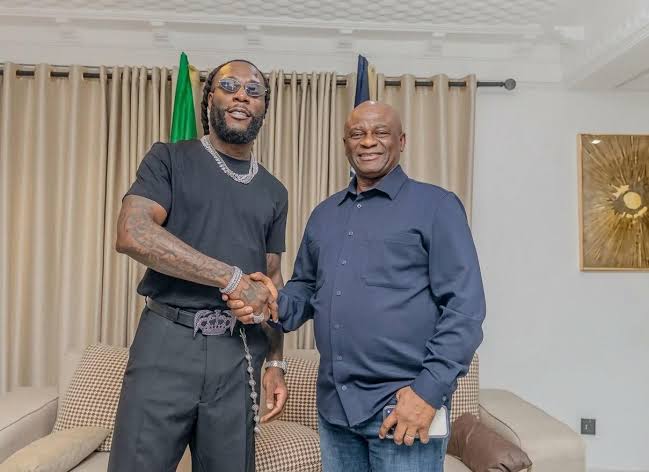
For now, Burna Boy’s meeting with IGP Disu represents an unusual but significant point of contact between Nigeria’s entertainment industry and its top police leadership. The singer brings enormous cultural influence and a long history of engaging with social issues, while the Police Force is seeking new ways to communicate with a younger generation and build stronger public relationships.
That combination is the reason the meeting has attracted attention. It is a conversation about music, policing, youth influence, public trust and the growing importance of Nigeria’s creative economy, all meeting at one table on October 3, 2026. The real significance will become clearer when the next step is announced.