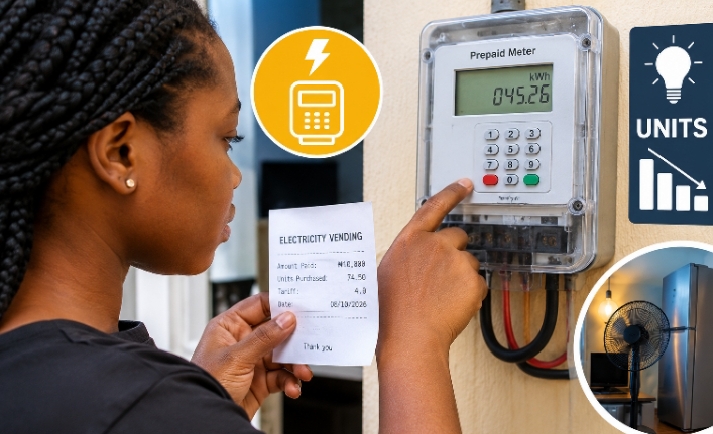
Many Nigerian households have become accustomed to monitoring their prepaid electricity meters, especially when the cost of keeping lights, fans, refrigerators and other essential appliances running continues to rise. A recharge that once seemed sufficient for several days may appear to run out much sooner, leaving residents wondering whether their electricity consumption has increased or something else has changed.
The experience can be particularly frustrating for families trying to manage their monthly expenses, tenants sharing electricity connections and small business owners who depend on regular power supply to keep their activities running. The amount paid for electricity may remain the same, yet the number of units received or the time they last can create a different picture of household spending.
Nigeria’s electricity regulations provide customers with ways to investigate suspected metering problems, check their applicable tariffs and seek assistance when a meter appears to be recording consumption incorrectly. The Nigerian Electricity Regulatory Commission also published a metering factsheet on October 14, 2026, outlining existing customer protections concerning metering, repairs and complaints.
Understanding the possible reasons behind rapidly disappearing units can help consumers identify the right questions to ask, the evidence to gather and the steps to take when their electricity consumption appears unusual.
Check the Number of Units Received After Each Recharge
The first step for prepaid meter users who notice their electricity credit finishing faster than expected is to examine their vending receipts. The amount paid for a recharge does not tell the complete story because the number of electricity units credited to the meter is equally important when comparing consumption over different periods.
For example, a customer who spends ₦10,000 on electricity should check the number of kilowatt hours credited after the transaction and compare that figure with previous purchases. If the same amount previously purchased more units, the customer needs to establish whether the applicable tariff, deductions or another factor explains the difference.
Electricity vending receipts provide useful information for this comparison, including the payment amount, the units purchased and any applicable tariff details. Customers should retain their receipts or electronic transaction records instead of relying on memory, particularly when several recharges occur within the same month.
A simple record covering 3 or 4 consecutive recharges can reveal whether the number of units received has changed significantly. It can also help establish whether the problem concerns the quantity purchased or the speed at which the household consumes the electricity credited to the meter.
Compare the Applicable Electricity Tariff
Electricity tariffs can influence the number of units a customer receives for a particular payment, making it important to check the rate applicable to the property. Customers should avoid assuming that every household in the same state pays the same tariff because the applicable rate can depend on the distribution company, customer category and other relevant billing arrangements.
Nigeria’s service based tariff framework uses Bands A, B, C, D and E, associated with minimum daily electricity supply commitments of 20, 16, 12, 8 and 4 hours, respectively, under the framework described in NERC’s published guidance. These commitments provide a basis for classifying customers according to their expected electricity supply, although the applicable tariff must still be checked against the customer’s actual category.
Customers can consult their electricity bills, prepaid vending receipts and the official information provided by their distribution company to establish the applicable rate. Where a customer believes a tariff has changed unexpectedly, the distribution company should be asked to explain the rate applied to the account and provide the relevant information.
The important point is to compare actual figures rather than assume that a tariff increase is responsible for every case of rapidly disappearing electricity units. A customer who receives fewer units after a recharge needs to distinguish between a change in the quantity purchased and unusually high consumption after the units have been credited.
Examine the Appliances Used at Home
Household appliances are among the practical factors consumers should investigate when their prepaid electricity balance appears to decline unusually quickly. Equipment that consumes substantial electrical power can use several units within a relatively short period, especially when it operates for many hours each day.
Air conditioners, electric irons, water heaters, electric cookers, hot plates, kettles and water pumps can contribute considerably to household electricity consumption. Refrigerators and freezers also use electricity throughout the day, although their actual consumption depends on their efficiency, condition, settings and operating environment.
A simple calculation can help customers understand the relationship between appliance power and electricity consumption. An appliance rated at 1,500 watts that operates continuously for 2 hours consumes approximately 3 kilowatt hours, equivalent to 3 electricity units, while a 2,000 watt appliance operating continuously for 1 hour consumes approximately 2 units.
These figures are estimates based on the appliances drawing their stated power throughout the specified periods, so actual consumption may differ. Equipment such as refrigerators and air conditioners often switches its compressor on and off, meaning its electricity use may be lower than a calculation based on continuous operation suggests.
Households should pay attention to changes in daily routines, including longer air conditioner use, additional cooking with electricity or a water pump running more frequently. Comparing these activities with earlier consumption patterns can help establish whether the apparent problem is connected to increased electricity demand.
Investigate Hidden Electricity Connections
Some customers may believe their prepaid meter supplies only the rooms or appliances they personally use, while the actual electrical installation serves additional areas. This possibility deserves attention in shared compounds, rented apartments, buildings with multiple occupants and properties where electrical connections have been modified over time.
Outdoor security lights, communal water pumps, corridor lighting and equipment in other parts of a building may contribute to the electricity consumption recorded by a meter. A tenant who assumes that the meter serves only one room could therefore misunderstand the amount of electricity being used if additional circuits are connected to the same supply.
Customers should establish which circuits are connected to their meters and whether any shared facilities draw electricity through the same installation. A qualified electrician can inspect the wiring and explain how the circuits are arranged without requiring the customer to interfere with the meter itself.
It is important to distinguish between an ordinary shared connection, an installation problem and suspected unauthorised use of electricity. Customers should not accuse neighbours of electricity theft without evidence, as the actual explanation may involve an arrangement that has existed since the property was built or occupied.
Where an installation appears to contain unauthorised connections or other irregularities, the customer can contact the relevant electricity distribution company for an investigation. NERC’s published consumer guidance also advises customers to report suspected tampering with electrical installations to their distribution company’s service centre.
Check for Changes in Appliance Performance
An appliance that develops a fault may consume electricity differently from its usual operating pattern, making it worth examining equipment that appears to run for longer than necessary. A refrigerator struggling to maintain its temperature, for example, may run its compressor more frequently, while a water pump that continues operating unnecessarily can add to household consumption.
Customers should pay attention to unusual operating sounds, excessive heat, repeated switching, longer running periods and other changes that may indicate a problem. Such observations can help a qualified technician determine whether an appliance needs servicing or whether another electrical issue requires attention.
Electrical wiring faults also deserve careful consideration because they can create safety risks beyond the cost of electricity. Burning smells, sparking sockets, unusually hot switches and exposed conductors require prompt attention from a qualified electrician rather than attempts at personal repairs.
Consumers should never open a sealed meter, remove its seals, bypass the equipment or interfere with exposed electrical connections to investigate their balance. These actions can expose people to dangerous electrical hazards and may create additional problems with the electricity supply.
Where appliance performance appears normal but consumption remains unusually high, the next step is to document the observations and seek a proper inspection. This allows the investigation to move beyond assumptions and focus on the electrical installation, meter readings and other available evidence.
Determine Whether the Prepaid Meter Is Faulty
A defective meter is one possible explanation for unexpected electricity consumption, but a rapidly declining balance does not automatically establish that the equipment is inaccurate. The problem may instead arise from the quantity of electricity purchased, increased household consumption, shared connections or another issue within the property.
Customers who suspect a fault should record the meter display, recharge dates, amounts paid and units credited after each transaction. Photographs of the display and copies of vending receipts can help create a clear record of the problem, especially when the customer needs to explain the situation to the distribution company.
It is also useful to record how long each recharge lasts and whether the household’s electricity usage has changed during the same period. A customer who can demonstrate that consumption has increased despite apparently unchanged usage will be better prepared to request an investigation.
The Nigerian Electricity Regulatory Commission’s published metering guidance explains that distribution companies can test customer meters for accuracy and determine whether repairs or replacement are necessary under the applicable procedure. Customers should therefore request an inspection through the appropriate service channel rather than conclude that the meter is faulty solely because the units finish quickly.
The findings of the inspection are important because they help distinguish a genuine metering fault from other causes of high consumption. Any decision about repair, replacement or an adjustment to the customer’s account should follow the applicable regulatory requirements and the evidence established during the investigation.
Understand the Rules on Faulty Meter Repairs
Nigeria’s electricity metering framework includes provisions intended to address confirmed meter faults and reduce the disruption customers experience when their equipment requires attention. These provisions are particularly relevant to prepaid meter users who have reported unusual consumption and subsequently discover that their meters require repair or replacement.
NERC’s published metering FAQ states that when a metering system fault occurs, the distribution company must arrange urgent repair or replacement as soon as reasonably practicable and, under the stated rule, within 2 working days of discovering the fault. The regulator’s October 14, 2026 metering factsheet also addresses repair and replacement timelines, stating that a faulty meter must be repaired or replaced within 48 hours of being reported.
Although both provisions concern the timely handling of faulty meters, their wording uses different reference points. The detailed FAQ refers to the discovery of the fault and specifies working days, while the newer factsheet refers to when the fault is reported and states 48 hours, so customers should consult the applicable regulatory requirements when resolving a specific complaint.
The rules should not be interpreted as a guarantee that every complaint about fast disappearing units automatically qualifies for immediate replacement. The distribution company may need to investigate the circumstances and establish whether a fault exists before determining the appropriate response.
NERC’s guidance also addresses the treatment of remaining credit when a faulty meter is replaced. Under its published FAQ, the customer and the distribution company’s representative should jointly record the units remaining on the old meter, and the customer should receive credit for those units within 48 hours after installation of the replacement meter.
Customers approaching a replacement should therefore keep their records, confirm the remaining balance and request documentation of the process. These steps can help reduce disputes about the credit carried over from the old meter to the replacement equipment.
Know Your Rights Under the October 14, 2026 Factsheet
The Nigerian Electricity Regulatory Commission published a metering factsheet on October 14, 2026, outlining existing provisions concerning meter installation, repairs, reimbursement, disconnection and complaint resolution. The document provides a useful reference for consumers seeking to understand their rights when metering problems arise.
The factsheet addresses the Meter Asset Provider scheme, under which customers who make the required upfront payment for a meter should have it installed within 10 days of full payment, according to the stated provision. It also explains that customers who pay for meters under the scheme are entitled to reimbursement through energy credits, while meters funded through the Meter Acquisition Fund and Distribution Sector Recovery Programme are identified as being supplied at no cost to customers.
These provisions concern meter acquisition and installation arrangements rather than a new programme specifically introduced to address prepaid units finishing quickly. Customers should therefore avoid interpreting the publication as evidence that the government has announced a new compensation scheme for every household reporting high electricity consumption.
The factsheet’s significance lies in bringing together information about metering arrangements and consumer protections in an official document. Customers experiencing unusual consumption can use the guidance alongside the regulator’s more detailed metering information when determining the appropriate way to report a suspected fault.
Before making a claim about a particular entitlement, consumers should establish which metering arrangement applies to their property and whether the circumstances meet the conditions specified by the regulator. This is especially important where reimbursement, replacement or other remedies depend on the particular facts of the case.
Submit a Complaint to Your Electricity Distribution Company
Customers who remain concerned after checking their receipts, appliance usage and electrical installation should submit a formal complaint to the Customer Complaints Unit of the distribution company serving their property. The complaint should clearly explain the unusual consumption, identify the meter and request an investigation into the recorded usage.
Supporting documents should include recent vending receipts, the amounts paid, the units received and the dates when the credit was exhausted. Customers can also provide photographs of the meter display and explain whether there have been changes in household occupancy, appliance use or electrical connections.
It is advisable to retain a copy of the complaint and obtain an acknowledgement or reference number. These records provide evidence that the problem was reported and can help the customer follow up if the response is delayed.
NERC’s published complaint procedure states that distribution companies are expected to resolve complaints within 15 working days, depending on the complexity of the issue. Customers should check the applicable procedure for their particular complaint and retain any written response received from the company.
Where the complaint remains unresolved or the customer is dissatisfied with the response, the next step is to escalate the matter through the appropriate regulatory forum or authority. The relevant route depends on the regulatory jurisdiction serving the property, so consumers should confirm which authority handles electricity complaints in their state.
NERC’s October 14, 2026 factsheet highlights this distinction by directing customers in states that have transitioned to State Electricity Regulatory Commissions to use the relevant state regulator for the applicable escalation stages. Customers should therefore identify the regulator responsible for their location rather than assume that every complaint across Nigeria follows an identical route.
Understand the Role of NEMSA in Meter Testing
The Nigerian Electricity Management Services Agency, commonly known as NEMSA, plays a technical role in electricity safety, metering and compliance with applicable standards. Its official information identifies National Meter Test Stations in Oshodi, Lagos, Kaduna and Port Harcourt, where meters can be tested, calibrated and verified against relevant technical requirements.
Meter testing can help establish whether equipment meets the applicable accuracy standards, making it an important part of investigating suspected metering inaccuracies. However, customers should first contact their distribution company to clarify the relevant inspection process and determine whether a particular test or referral is required.
Consumers should not assume that visiting a test station independently will automatically resolve their complaint or guarantee compensation. The appropriate process depends on the circumstances, the applicable technical requirements and the procedures governing the meter in question.
Where a distribution company has investigated a complaint but concerns about accuracy remain, customers can ask for an explanation of the available testing or verification options. Keeping written records of the complaint and the company’s findings will make it easier to establish what has already been checked and what further action may be appropriate.
Keep Records Before Recharging Again
Customers who repeatedly recharge their prepaid meters without understanding why the credit disappears quickly may find it difficult to establish the source of the problem. Keeping a simple record of electricity purchases and consumption can provide a clearer picture of what is happening over several days or weeks.
Each record should include the date of purchase, the amount paid, the units credited and the date the balance ran out. Customers can also note major changes in appliance use, periods when the property was unoccupied and any unusual behaviour observed around the electrical installation.
Comparing these details across several transactions can help reveal whether the issue involves fewer units purchased, increased consumption or a pattern that deserves further technical investigation. It also provides more useful evidence than a general statement that electricity no longer lasts as long as it used to.
Where the available records suggest a possible metering fault, customers should submit them with their complaint and request an explanation of the findings. Where the evidence points to increased household consumption, reviewing appliance usage or arranging an electrical inspection may be the more appropriate response.
What Prepaid Meter Users Should Remember
Electricity units finishing faster than expected can have several explanations, and identifying the cause requires more than looking at the balance on the meter. Changes in tariffs, the number of units received, appliance usage, shared electrical connections and possible equipment faults should all be considered before drawing conclusions.
The October 14, 2026 NERC metering factsheet provides a timely reference for consumers seeking information about existing metering protections, repair arrangements and complaint procedures. Its provisions should be understood alongside the regulator’s detailed guidance and the technical role of NEMSA, particularly when a customer needs to establish whether a meter is recording consumption accurately.
Consumers should begin by comparing vending receipts, checking their household’s electricity usage and documenting the problem. If the reason for the unusual consumption remains unclear, the appropriate next step is to contact the distribution company’s Customer Complaints Unit and request an investigation.
The most important step is to establish why the units are disappearing before deciding that the meter is faulty. Keeping accurate records, following the official complaint procedure and requesting a proper inspection can help customers protect their interests while avoiding unsupported accusations about their electricity providers.