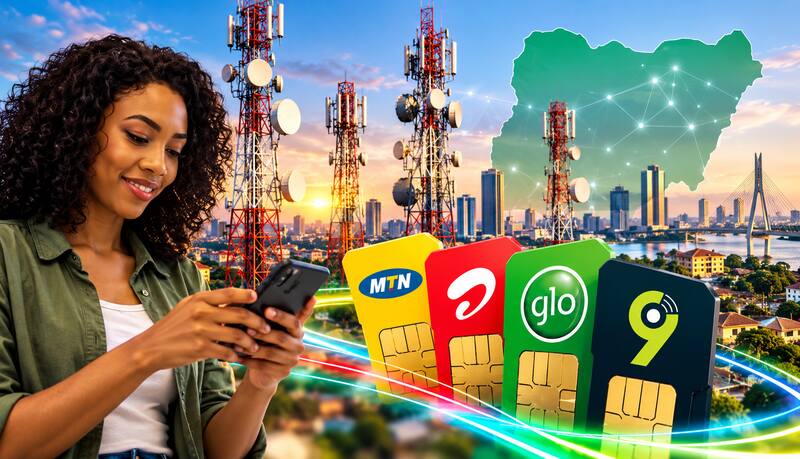
Nigeria’s telecommunications market is entering a new phase, with companies that once operated outside the public spotlight beginning to compete for mobile subscribers. For years, MTN, Airtel, Globacom and 9mobile, now known as T2, have dominated the conversation about mobile calls, internet access and data subscriptions. However, developments between 2023 and October 2026 show that other providers are working to establish themselves in the market.
Two developments stand out. VITEL Wireless began commercial operations in 2025, followed by Lebara Nigeria in September 2026. Meanwhile, Swift Telephone Network Limited, known as STN, announced on October 1, 2026, that it had secured a licence that could enable it to offer a wider range of telecommunications services.
These companies are not all entering the market in the same way. Some operate through existing mobile network infrastructure, while others are positioning themselves for broader telecommunications operations. Their business models, licences, launch dates and announced services reveal how competition could develop in the coming years.
Why Nigeria’s telecom market is attracting new operators
Nigeria’s mobile telecommunications industry has historically been dominated by a small number of major operators. Their networks support mobile calls, internet access, text messages, business communications and a growing range of digital services.
For subscribers, competition is often judged through familiar questions. Which provider has stronger coverage in their neighbourhood? Which offers more data for the money? Which network performs better during busy periods? How easily can customers reach customer support when something goes wrong?
New entrants have an opportunity to attract customers by addressing some of these concerns. However, obtaining a licence does not automatically translate into a successful telecommunications business. Operators must develop commercially viable services, establish distribution channels, comply with regulations and secure the network arrangements needed to connect customers.
The Nigerian Communications Commission, or NCC, introduced a framework for Mobile Virtual Network Operators in 2022. The framework created a route for businesses to provide mobile services without necessarily constructing a complete nationwide radio network of their own. The NCC published an updated version of its framework page on December 18, 2024.
This framework is important because it helps explain the emergence of VITEL Wireless and Lebara Nigeria. Both companies can offer mobile services by relying on arrangements with existing network infrastructure providers rather than having to reproduce the entire infrastructure operated by established telecommunications companies.
A new brand can introduce different packages, distribution methods or customer experiences without immediately building thousands of base stations across Nigeria.
VITEL Wireless: The newcomer that launched in 2025
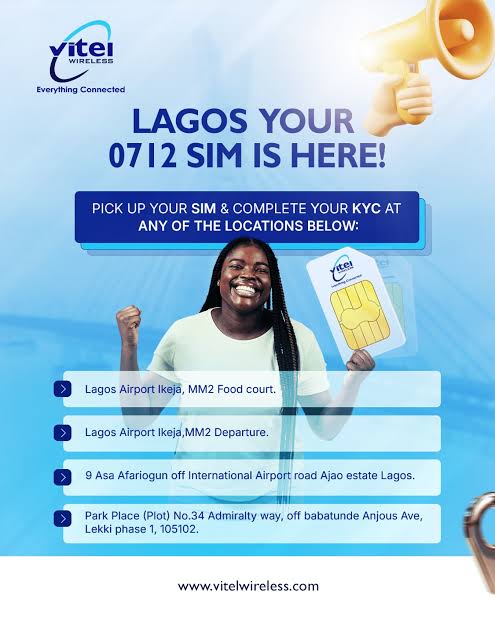
VITEL Wireless is one of the companies that have moved beyond the licensing stage to offer services to Nigerian customers.
The NCC’s published MVNO records list VITEL Wireless Limited as a licensed mobile virtual network operator, with its licence taking effect on October 1, 2023, and expiring on September 30, 2033. The licence established its regulatory position before the company began its public commercial rollout.
A major public milestone followed in October 2025.
On October 28, 2025, it was reported that VITEL Wireless was preparing to launch nationwide services on October 30. The report identified its 0712 number series and said the company planned to offer voice calls, text messages and data services. It also reported that VITEL had established interconnectivity arrangements with MTN, Airtel and Glo, alongside a roaming agreement with MTN for nationwide coverage.
Interconnectivity is a significant part of launching a mobile service. It enables subscribers on one network to communicate with subscribers on other networks. Without effective arrangements for connecting calls and messages across networks, a new provider would struggle to offer the ordinary mobile experience customers expect.
The October 2025 announcement also outlined VITEL’s intended approach to customer value. The company publicised a voice rate of 24 kobo per second and a text message charge of ₦6. It also promoted a plan under which customers could select 11 contacts for free calls and messages, subject to the company’s applicable service terms. These were company announced offers, rather than proof that every subscriber would necessarily spend less than they would on competing networks.
VITEL also presented itself as more than a conventional provider of calls and data. Its announced services included tools for personal safety, employment and productivity, artificial intelligence based CCTV monitoring, asset tracking and connected devices. These offerings indicate the company’s interest in business and technology applications alongside consumer telecommunications.
The company’s commercial strategy has continued to develop through distribution and payment partnerships. Its official website identifies OPay and Moniepoint as channels for airtime and data purchases. It also lists bank and payment partners, including Fidelity Bank, Zenith Bank, Paystack and CoralPay. The company says its services are available through SLOT stores and that it uses MTN infrastructure to extend connectivity across Nigeria.
These partnerships are important because customers need convenient ways to purchase airtime, buy data, obtain SIM cards and receive support. A new provider may have an attractive package, but its ability to turn that offer into regular usage depends partly on how easily customers can access its services.
VITEL’s non-expiring data offer
Another milestone came in March 2026, when VITEL promoted a data product designed around a familiar complaint among Nigerian subscribers: unused data can expire before customers finish using it.
On March 5, 2026, an offer under which customers could receive a free eSIM with 3.5GB of data for ₦1,500 was reported. The report brought attention to VITEL’s efforts to distinguish its offering from the familiar packages available through established operators.
Later that month, VITEL publicly promoted its non-expiring data offer under the name “Data Wey No Dey Expire”. TechCabal’s partner coverage reported that the product was launched at an event in Lagos on March 24, 2026. The central proposition was that purchased data would remain available until it was consumed, rather than expiring according to the usual time limit attached to many bundles.
The offer could appeal to customers whose internet usage varies from day to day. Someone who mainly uses mobile data for messaging, occasional browsing, or emergency internet access may not always consume a standard bundle before its expiry date.
However, the headline promise should not replace checking the actual terms. Subscribers should confirm the current price, eligible bundles, applicable restrictions, and whether the offer remains available before purchasing it.
VITEL’s entry into the market demonstrates one way a smaller provider can compete: rather than attempting to match every product offered by the biggest operators, it can focus on particular customer frustrations and build services around them.
Lebara Nigeria: Nationwide commercial operations begin in September 2026
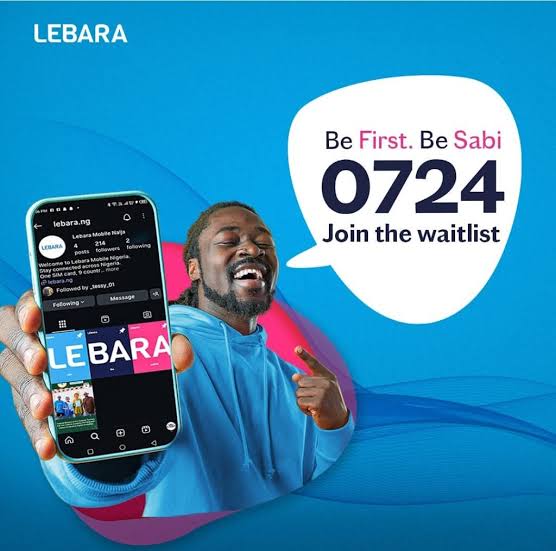
Lebara Nigeria is another major entrant in the expanding market. The company is associated with the international Lebara Group and operates locally through VAS2Nets Telecommunications Limited, which holds an NCC mobile virtual network operator licence.
The regulatory milestone came before the nationwide launch. According to reporting published by Legit.ng on September 16, 2026, the brand licensing agreement between Lebara and VAS2Nets was announced in May 2024. The report also identified March 2024 as the effective date of the local MVNO licence. The NCC’s published licence records list VAS2Nets Telecommunications Limited under the MVNO category, with the licence effective from March 1, 2024, to February 28, 2034.
The company subsequently began preparing the public for its arrival. During 2025, Lebara opened a number reservation portal that allowed prospective customers to select preferred numbers before full commercial operations.
The process gave the company an opportunity to build interest before customers could use the service nationwide. The number series associated with Lebara Nigeria is 0724.
A further public milestone came in February 2026, when Lebara held a soft launch in Lagos. BusinessDay reported on March 2, 2026, that the company had formally signalled its entry into Nigeria through a soft launch and logo unveiling. The event marked a step towards commercial operations, rather than the same thing as a full nationwide launch.
The decisive date was September 14, 2026.
Lebara announced that it had commenced nationwide commercial operations, making its services available to the public. A report published two days later said customers could obtain physical SIM cards through retail agents or activate an eSIM through digital channels. The company also offered remote identity verification through its My LebaraNG application.
Distribution was one of the notable parts of the launch. Lebara said it had more than 1,000 registered retail agents, including SLOT stores, available to support its rollout. This gave the company a physical route to customers alongside its app based activation process.
The launch was significant because it moved Lebara from preparations and number reservations into commercial service. Customers could now consider it as an actual provider, rather than a brand merely planning to enter the Nigerian market.
What Lebara offers Nigerian subscribers
Lebara’s entry brings another option for customers interested in physical SIM cards, eSIM activation and mobile connectivity. The company’s approach combines digital onboarding with retail distribution, potentially making it easier for different categories of customers to access the service.
However, it is important to understand the underlying business model. Lebara Nigeria operates as an MVNO, not as a fourth or fifth company that has automatically built an independent nationwide radio network. Reports on the company’s Nigerian operations identify Airtel Nigeria as its host network. This means the reach and quality of service are connected to the infrastructure arrangements supporting Lebara’s operations.
The arrangement could still allow Lebara to compete through its prices, customer service, distribution and additional digital products. The challenge will be whether those differences are compelling enough to convince Nigerians to obtain a new SIM or transfer part of their mobile spending to the service.
The company’s actual performance will depend on the packages it makes available, the reliability of its service, the ease of resolving customer complaints and how consistently subscribers can use its network in their regular locations.
Swift Telephone Network Limited: The October 1, 2026 licence milestone
While VITEL and Lebara have entered the market through the MVNO model, Swift Telephone Network Limited represents a different development.
STN announced on October 1, 2026, that it had obtained a Unified Access Service Licence, commonly called a UASL, from the NCC. Nairametrics reported on the same date that the licence could allow the company to provide a wider range of services, including voice, data, fixed and mobile telecommunications.
The NCC’s individual category licensees register lists Swift Telephone Network Limited as a UASL holder. Its licence took effect on October 1, 2026, and is scheduled to expire on September 30, 2036. That makes the date an independently verifiable regulatory milestone, not merely a statement about the company’s future ambitions.
STN’s chief executive, Oluwole Adetuyi, described the licence as a new phase in the company’s development. The company said it intended to use the authorisation to develop telecommunications infrastructure, expand connectivity and contribute to efforts to address Nigeria’s digital divide.
The licence is important because it gives STN a broader regulatory authorisation than the MVNO model used by VITEL and Lebara. However, receiving a UASL does not by itself prove that a new operator has already deployed a nationwide network, opened every planned service to the public or reached the scale of MTN and Airtel.
The next milestones to watch are actual service launches, infrastructure development, coverage announcements, number allocation and the availability of services to ordinary subscribers.
What STN’s licence means for competition
Nigeria’s telecommunications market requires substantial investment in network infrastructure, transmission capacity, power, maintenance, spectrum where applicable and customer support. A company with broad service authorisation still needs a practical commercial plan to turn that permission into a working operation.
STN’s licence could create room for it to develop a wider range of telecommunications services. Its future impact will depend on how it uses that authority, which services it launches first and whether it builds or secures the infrastructure and commercial partnerships needed to reach customers.
For consumers, the distinction between a licence announcement and an operational launch is essential. A licence confirms regulatory permission within its scope; it is not a guarantee that the company is already offering nationwide mobile services on the same scale as the established operators.
The established providers STN, VITEL and Lebara are challenging
The arrival of new entrants does not mean Nigeria’s established telecommunications companies have disappeared. MTN, Airtel, Globacom and T2 remain important parts of the market, with existing customers, infrastructure and distribution networks.
MTN Nigeria is a major mobile network operator offering calls, data and related digital services. Airtel Nigeria is another established operator, with a large subscriber base and a wide range of consumer and business offerings. Globacom, popularly known as Glo, is a Nigerian telecommunications brand offering voice and data services. T2, formerly 9mobile, remains a separate provider competing for mobile customers.
The new entrants face a difficult task because customers do not judge networks only by promotional prices. Subscribers also need dependable service at home, in school, at work and during travel. A provider that offers a cheaper data bundle may struggle to win regular customers if its service is unreliable in the places where they need it.
The business models also differ. VITEL and Lebara operate through the MVNO framework, allowing them to rely on existing infrastructure arrangements. STN’s UASL creates a broader regulatory route, but the licence alone does not establish how quickly it will build out or commercialise services.
This means the new providers should not be treated as identical competitors. Their launch dates, licences, network arrangements and product strategies are different.
How Nigeria’s MVNO framework created room for new brands
The NCC’s MVNO framework is central to understanding the changes taking place in the market. Published by the commission and updated on its website on December 18, 2024, the framework sets out different tiers for virtual operators and explains how their activities can fit into the telecommunications service value chain.
The framework allows different kinds of operators to participate in the market without each one necessarily duplicating all the infrastructure of a traditional mobile network operator. Depending on their licence tier and commercial arrangements, virtual operators can focus on customer management, marketing, service packaging, applications and other parts of the service chain while relying on existing network infrastructure for some functions.
That model can lower certain barriers to entry, but it does not remove every challenge. MVNOs still need to reach agreements with host networks, comply with SIM registration and other regulatory requirements, develop reliable billing systems and provide customer support.
The experience of Nigeria’s first commercial MVNO launches illustrates the difference between a licence and a functioning business. The existence of a regulatory framework can attract applicants, but only some licensees move through the commercial negotiations, technical integration and customer onboarding required to begin serving subscribers.
The launch of VITEL in October 2025 and Lebara in September 2026 provides concrete examples of operators that progressed to commercial service. Their experience will help show whether Nigeria’s MVNO framework can produce sustained competition rather than simply an expanding list of licensed businesses.
What Nigerians should check before switching networks
The growing number of providers gives customers more options, but choosing a SIM should involve more than following a launch announcement or an attractive advert.
Coverage should come first. Subscribers should confirm the network supporting the service and whether it performs well in the places they use their phones. A provider relying on another operator’s infrastructure may have access to a broad coverage footprint, but actual performance can still vary by location and service arrangement.
Data prices should be compared carefully. A low headline price does not necessarily mean a better deal if the data allowance is smaller, the offer has restrictions or the bundle expires before it is used. VITEL’s non expiring data proposition is one example of a different approach, but subscribers should verify the current terms before buying.
Call charges deserve attention. Customers who make frequent voice calls should compare the applicable rates and any special conditions attached to promotional offers. If a provider advertises free calls to selected contacts, subscribers should establish how those contacts are selected and whether the benefit has other restrictions.
SIM availability and activation matter. Lebara’s physical SIM distribution and eSIM activation provide different ways to get started, but eSIM customers need a compatible device. Subscribers should also confirm identity verification requirements before attempting activation.
Customer support is part of the service. Customers should check how to contact the provider, report failed transactions, resolve billing disputes and replace a lost or damaged SIM. These practical issues can matter as much as the advertised data price.
Finally, subscribers should not assume that moving to a new brand will automatically solve every problem experienced on an existing network. Network performance, service quality and customer experience must be assessed through actual use.
Will the new operators reduce telecom costs in Nigeria?
The arrival of VITEL and Lebara, alongside STN’s new licence, creates opportunities for competition, but lower prices are not guaranteed.
VITEL has promoted non expiring data and special calling offers. Lebara has entered the market with physical SIM cards, eSIM activation and retail distribution. STN has secured broader service authorisation and says it plans to develop infrastructure and expand connectivity. Each development points to a different potential route to competition.
The strongest evidence of change will come from what happens after the announcements. Customers will need to see whether new offers remain available, whether service quality is consistent, whether customer support works effectively and whether providers can attract enough subscribers to sustain their businesses.
The infrastructure question is particularly important. An MVNO can introduce a new brand and pricing model without constructing an entirely separate nationwide radio network. However, it generally depends on the host network for the underlying mobile coverage. That can help it enter the market more quickly, but it also means the new brand cannot independently resolve every coverage or congestion problem affecting the infrastructure on which it relies.
STN’s path may be different because its UASL gives it a broader authorisation. Yet the practical result will depend on the company’s investment decisions, partnerships and actual rollout.
The important dates in Nigeria’s new telecom competition
The timeline shows how the market has developed rather than suggesting that every new provider appeared at once.
On October 1, 2023, VITEL Wireless Limited’s MVNO licence took effect, according to the NCC’s published register.
On March 1, 2024, the MVNO licence held by VAS2Nets Telecommunications Limited, the company associated with Lebara Nigeria, took effect. The NCC register gives the licence an expiry date of February 28, 2034.
On May 2024, Lebara’s brand licensing agreement with VAS2Nets was announced, according to reporting published in September 2026.
On October 30, 2025, VITEL was scheduled to begin nationwide services after announcing its rollout and 0712 number series. Its reported plans included voice calls, SMS, data and interconnectivity arrangements with established operators.
On March 5, 2026, The Guardian reported VITEL’s offer of a free eSIM with 3.5GB of data for ₦1,500. Later in March, the company promoted its “Data Wey No Dey Expire” product at a Lagos event held on March 24.
On February 2026, Lebara held a soft launch in Lagos, followed by its nationwide commercial launch on September 14, 2026. The nationwide rollout made physical SIMs and eSIM activation available through its distribution channels.
On October 1, 2026, Swift Telephone Network Limited’s UASL licence took effect, with a stated expiry date of September 30, 2036. This is the key regulatory milestone for STN as it seeks to develop a broader telecommunications operation.
What the next stage of competition could look like
Nigeria’s telecom market now has more than the familiar four major brands to consider. VITEL Wireless has progressed to commercial service and has promoted products designed around customer needs. Lebara has completed its nationwide commercial launch after months of preparation. STN has obtained a broad licence that could support a different type of market entry.
Their progress should be judged by separate standards. VITEL’s next test is whether its offers and distribution can attract and retain subscribers. Lebara must show whether its digital activation, retail presence and service packages can translate into a meaningful customer base. STN must demonstrate how it intends to turn its licence into working services and infrastructure.
For Nigerians, the development offers a reason to pay attention, but not to assume that the market has already been transformed. The established operators retain significant advantages in infrastructure and customer reach. The newcomers will need to prove that they can offer services people want, at prices they understand, with dependable access and effective support.
The central question is no longer whether new telecom brands are entering Nigeria. It is whether they can turn licences, launch events and promotional offers into sustained competition that makes a practical difference to subscribers.