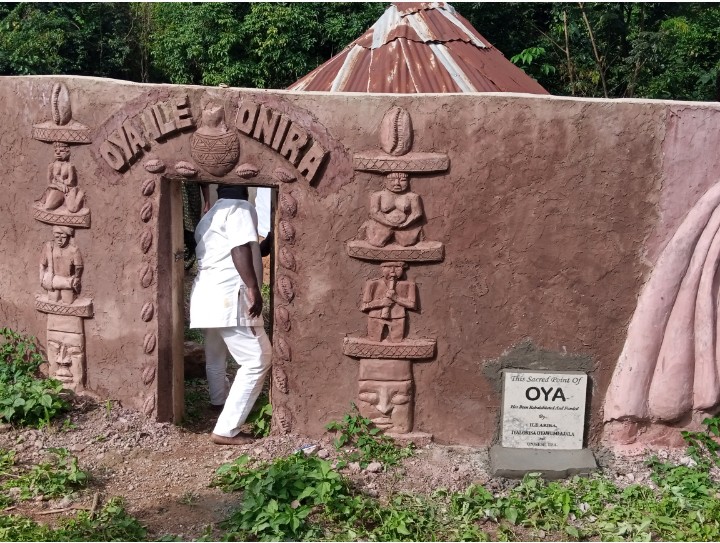
Deep within Ira, a Yoruba community in Kwara State, lies a sacred place whose story reaches beyond the boundaries of an ordinary historical landmark. Known as Igbo Ọya, the grove is associated with one of the most prominent female deities in Yoruba traditional religion, whose connection with the town has endured through generations of oral history, religious observances and cultural traditions. The story surrounding the site links a powerful deity, an ancient settlement and a mystery that continues to shape how the community remembers its past.
The tradition holds that Ọya, the legendary wife of Ṣàngó, returned to Ira following her husband’s disappearance and eventually entered the earth at a location that became sacred in her honour. The account has given the grove a special place in the cultural identity of Ira, drawing attention to the relationship between Yoruba mythology, traditional leadership and the preservation of indigenous heritage.
As of October 2026, interest in Igbo Ọya also extends to efforts to document its history, improve its recognition and explore its potential as a cultural tourism destination. Understanding the story requires looking beyond the deity’s disappearance to examine the history of Ira, the traditional institution of the Onira and the significance of preserving a site whose meaning has been passed down through generations.
The Location of Igbo Ọya in Kwara State
Igbo Ọya, meaning Ọya’s Grove, is located in Ira, within Oyun Local Government Area of Kwara State, southwestern Nigeria. The community is part of the Yoruba cultural landscape, and its traditional history is closely connected with the grove and the religious beliefs surrounding the deity. The Kwara State Government identifies the House of Ọya in Ira as a tourist attraction, placing the location among the state’s culturally significant destinations.
The grove’s importance comes from its association with the traditional account of Ọya’s disappearance. Rather than being regarded simply as a stretch of woodland, the location is understood through the religious history attached to it and the community’s continuing relationship with that history. Its significance rests on the belief that a major Yoruba deity became associated with the land, giving the location a spiritual identity that has survived through generations.
Ira’s position within Kwara State also demonstrates how Yoruba cultural heritage extends beyond the boundaries of present day Osun, Oyo, Ogun, Ondo, Ekiti and Lagos states. Communities in Kwara preserve their own traditions, historical accounts and sacred locations, making the state an important part of the wider Yoruba cultural landscape.
Who Is Ọya in Yoruba Traditional Religion?
Ọya is a prominent female òrìṣà in Yoruba traditional religion, widely associated with wind, storms, transformation and powerful natural forces. She is also connected with the River Niger, known in Yoruba as Odò Ọya, reflecting the deity’s significance in religious traditions that associate natural landscapes with divine presence. Her identity varies across traditions, but her strength, independence and association with dramatic natural forces remain important features of her mythology.
She is traditionally remembered as one of the wives of Ṣàngó, a major Yoruba deity associated with thunder and lightning. Ṣàngó is also linked to the historical traditions of the old Oyo Empire, where accounts of a powerful ruler became intertwined with religious narratives surrounding his transformation into a deity. The stories of both figures have developed through oral traditions, religious practices and historical writings, with details differing between communities.
Ọya’s influence is not confined to Nigeria. Yoruba religious traditions travelled across the Atlantic through the forced migration of enslaved Africans, contributing to the development of religious practices in parts of the Caribbean and South America. In Brazil, she is widely known as Iansã, while related traditions in Cuba recognise her as Oyá. These traditions preserve different expressions of her religious significance, demonstrating the reach of Yoruba spiritual heritage beyond its place of origin.
Her association with Ira gives the town a distinctive connection to this wider religious history. The grove provides a specific geographical setting for a tradition about a deity whose worship and mythology are recognised across different Yoruba communities and African diasporic religions.
The Traditional Account of Ọya’s Disappearance
The story most closely associated with Igbo Ọya concerns the deity’s disappearance into the earth. According to the tradition preserved in Ira, Ọya returned to her ancestral home after the disappearance of Ṣàngó and eventually entered the earth at a location that became sacred. The place was subsequently associated with her name, and the grove became a lasting part of the community’s religious and cultural identity.
A Yoruba saying captures the connection between the 2 locations associated with the deities: “Ọya wọlẹ̀ ní ilé Ìrá, Ṣàngó wọlẹ̀ ní Kòso.” The expression is commonly translated as “Ọya disappeared in Ira, while Ṣàngó disappeared at Koso.” It reflects a traditional understanding in which revered figures are associated with particular places through stories of their disappearance and transformation into deities.
The account should be understood within its religious and cultural context. The tradition explains why the grove is sacred to the community, but the claim that Ọya physically entered the earth is not an event established by modern archaeological or scientific evidence. Its historical importance lies in the story’s preservation and the role it continues to play in shaping the identity of Ira.
Historical literature on the Yoruba, including Samuel Johnson’s The History of the Yorubas, provides a broader context for understanding traditions concerning Yoruba rulers, deities and the relationship between oral history and religious belief. Such accounts help researchers examine how communities have preserved their understanding of the past, even where different versions of a story exist.
The Relationship Between Ọya, Ṣàngó, Ira and Koso
Ọya’s story in Ira is closely connected with traditions surrounding Ṣàngó, who occupies a central position in Yoruba religion. Traditional accounts identify Ṣàngó with the old Oyo political system and describe his transformation into a deity associated with thunder, lightning and powerful spiritual authority. His story has been transmitted through different oral traditions, religious practices and historical narratives.
Some versions of the tradition describe Ṣàngó leaving Oyo and travelling towards the region associated with Nupe, which is connected with accounts of his maternal origins. Ọya is said to have accompanied him for part of the journey before remaining in Ira. Following news of his disappearance, she is traditionally described as returning to the area and eventually becoming a deity herself.
Koso, a location associated with Ṣàngó’s disappearance, and Ira, associated with Ọya’s disappearance, therefore occupy related positions in the traditional religious landscape. The locations connect the 2 deities through geographical memory, with each place preserving a story that explains its sacred significance.
The precise sequence of events differs across traditional accounts, and the narratives are best understood as traditional histories rather than a single universally agreed historical record. Their continued importance, however, demonstrates how Yoruba communities use sacred places to preserve stories about deities, rulers and the origins of religious practices.
How the Grove Became Part of Ira’s History
Igbo Ọya is significant not only because of its association with a deity but also because it is connected with the traditional account of Ira’s development. According to the community’s history, a hunter named Laage travelled from Oyo and established a settlement with his people around an area known as Fere. The settlement became known as Ira Fere, and Laage is remembered as its founder and first Onira.
The traditional account states that the settlement eventually moved closer to the sacred grove associated with Ọya. The earlier settlement retained the name Ira Fere, while the newer settlement became known as Ira. This account links the community’s geographical development with the religious importance of the grove, making the site part of a broader story about how the town took shape.
The tradition does not provide an independently established archaeological date for the settlement’s founding or the movement between the 2 locations. It nevertheless remains an important part of the community’s historical memory because it explains the relationship between the town, its traditional ruler and the sacred landscape.
The connection also illustrates the role of oral history in preserving local heritage. Family accounts, community traditions and stories passed between generations can provide valuable information about how people understand their origins, although individual claims may require documentary or archaeological evidence before they can be established as independently verified historical facts.
Laage, the First Onira
Laage occupies a central position in the traditional history of Ira. Remembered as a hunter who migrated from Oyo, he is credited with establishing the settlement from which the community developed. His position as the first Onira connects the town’s founding narrative with the traditional institution that continues to represent Ira’s historical identity.
Another tradition states that Laage disappeared into the earth at a location within Obada’s compound in Ira. The account resembles the story associated with Ọya, although the 2 traditions concern different figures and separate locations. Both stories have become part of the community’s historical memory, linking particular places with the disappearance of revered figures.
The similarities between these narratives provide an insight into the way sacred geography operates within local tradition. Locations are remembered through the events and figures associated with them, and their significance can continue long after the original stories have been passed down through generations.
Laage’s story also helps explain why the grove cannot be separated entirely from the history of Ira’s traditional leadership. The founding account, the settlement’s movement and the religious significance of Ọya form connected parts of the community’s understanding of its past.
The Onira’s Role in Preserving the Heritage
The Onira is the traditional ruler of Ira, and the institution is closely associated with the community’s customs, history and cultural identity. Its traditional origins are linked to Laage, whose story forms part of the town’s founding narrative. The relationship between the royal institution and Igbo Ọya therefore extends beyond the grove itself to the wider history of the settlement.
Historical reporting published on October 7, 2026, identified Oba Abdul Wahab Oyewale Oyetoro as the Onira of Ira and discussed the grove’s connection with the town’s origins. The account placed the sacred site within the wider history of the community, highlighting its importance to Ira’s cultural identity.
Traditional rulers and community institutions can play an important role in documenting oral history, maintaining cultural practices and guiding discussions about the preservation of sacred locations. Their involvement can also help ensure that decisions about tourism or conservation take account of local customs and the religious meaning attached to particular places.
Formal heritage protection, however, is a separate matter. A site’s association with a traditional ruler or its recognition within community history does not automatically establish that it has been legally designated as a protected monument. Any claim about such status requires supporting documentation from the relevant authorities.
The Oya Festival in Ira
The Oya Festival is a cultural celebration associated with the deity and her place in Ira’s traditional history. The festival provides an opportunity to recognise local customs, preserve the community’s connection with Ọya and introduce the story of the sacred grove to a wider audience. It also creates a setting for discussions about cultural preservation and the possibility of developing the location as a tourist destination.
A report published in October 2013 announced that the festival was scheduled to take place in Ira from November 15 to November 26 that year. The report identified the Olokun Festival Foundation as the organising body and highlighted the need for support in promoting Yoruba cultural heritage. The announcement demonstrates that efforts to raise the festival’s profile were being discussed more than a decade ago.
The site’s development received renewed public attention during the 2023 Oya Festival, held at Ira Grammar School. In November 2023, Gani Adams, the Aare Onakakanfo of Yorubaland, called on the Kwara State Government to improve the grove and develop its tourism potential. His appeal included better road access and measures to make the location more attractive to visitors.
The Onira also expressed support for efforts to raise the festival’s profile. These public appeals show that the grove’s cultural importance has been accompanied by calls for practical improvements, although the announcements do not establish that every proposed project was subsequently completed.
As of October 28, 2026, the information available does not establish a confirmed date or programme for a 2026 edition of the festival. Any announcement about a new edition would require confirmation from the organisers or relevant community authorities.
Tourism Development at Igbo Ọya
The Kwara State Government’s identification of the House of Ọya in Ira as a tourist attraction gives the site a place within the state’s cultural tourism landscape. Its potential appeal includes visitors interested in Yoruba mythology, traditional religion, local history and the preservation of indigenous cultural practices. Researchers and students may also find the location relevant to the study of oral traditions and the relationship between communities and sacred landscapes.
Developing the site for tourism would require careful attention to its religious significance. Improvements to access roads, visitor information, conservation arrangements and local interpretation could make the history easier to understand for people unfamiliar with the traditions surrounding Ọya. Such work would need to respect the community’s customs and any restrictions associated with worship or access to sacred areas.
The calls made during the November 2023 festival indicate that road access and further development were already subjects of public discussion at that time. The available information reviewed for this article does not establish the full extent of construction, conservation work or visitor facilities completed by October 2026.
For prospective visitors, confirming access arrangements with local authorities or community representatives would be advisable. A location recognised for its cultural importance may not necessarily operate like a conventional public park, and visitors should respect the religious practices and local customs associated with the grove.
Efforts to Secure Wider Heritage Recognition
Interest in Igbo Ọya has also extended to the possibility of obtaining wider recognition for the site’s cultural importance. A report published in September 2026 discussed an initiative involving the Oya Heritage and Cultural Foundation and the traditional leadership of Ira to document the grove’s history and pursue greater international recognition.
Such efforts can involve recording oral accounts, collecting historical documents, establishing the site’s cultural significance and identifying measures needed for its long term preservation. Proper documentation would help preserve the traditions associated with Ọya while providing a clearer account of the grove’s relationship with Ira’s history.
International heritage recognition generally requires a formal process, supported by documentation and assessment under the relevant framework. Public statements about an intention to seek recognition are different from confirmation that an application has been accepted or a designation granted.
The September 2026 report describes efforts to pursue greater recognition, rather than confirming an existing World Heritage designation. Any claim about the current status of an application would need to be checked against official records.
What Igbo Ọya Reveals About Yoruba Sacred Groves
Igbo Ọya forms part of a wider Yoruba tradition in which particular landscapes are preserved because of their religious, historical or cultural significance. Sacred groves can serve as places of worship, sites of remembrance and locations associated with community origins. Their importance may come from the combination of the physical environment and the stories that generations have attached to it.
Academic research published in African Archaeological Review has examined the roles of sacred groves in Yoruba towns, including their relationship with settlement patterns, community life and responses to epidemics. This research provides a broader context for understanding why some wooded locations have retained special significance even as surrounding communities have changed.
Preserving a sacred grove can involve more than protecting trees or maintaining a shrine. It may require documenting oral traditions, recording the history of the community, identifying culturally important areas and consulting the people responsible for maintaining local customs. These steps can help ensure that development does not undermine the very traditions that make a site significant.
For Ira, the grove represents a connection between landscape, religious belief and collective memory. Its association with Ọya gives the location a particular identity, while the story of Laage and the origins of the town places it within a wider account of the community’s development.
The Historical Record Behind the Disappearance Story
Understanding Igbo Ọya requires a distinction between the existence of the site and the traditional explanation for its sacred status. The grove’s location in Ira, its association with Ọya and its importance within the community’s cultural history are documented through local traditions, historical accounts and government tourism information.
The account that Ọya disappeared into the earth belongs to Yoruba religious tradition. It explains the sacred meaning attached to the grove, but it is not a scientifically verified event. The same care is needed when discussing Laage’s disappearance and the traditional account of Ira’s founding, which form part of the community’s oral history.
The site’s recognition as a tourist attraction is also different from formal heritage designation. Government tourism information establishes that the location is recognised for its cultural appeal, but it does not automatically demonstrate that the grove has been legally protected or internationally inscribed as a heritage monument.
Oral history remains valuable for understanding how communities interpret their origins, preserve religious beliefs and maintain a relationship with places that have special meaning.
Why Igbo Ọya Remains Important in 2026
Igbo Ọya remains an important part of Ira’s cultural identity because it brings together the story of Ọya, the traditional history of Laage and the continuing institution of the Onira. The grove gives the community a physical location through which its religious traditions and accounts of the past can be remembered and shared.
The recent attention surrounding documentation and heritage recognition also raises practical questions about how the site can be preserved for future generations. Recording oral histories, improving access where appropriate and developing reliable visitor information could help people learn about Ira without compromising the grove’s religious significance.
The history of the site demonstrates that cultural heritage is not limited to buildings, monuments or objects held in museums. A landscape can carry meaning through stories, ceremonies and the traditions of the people who maintain it. Igbo Ọya’s importance comes from this relationship between place and memory, which has connected the grove with Ira across generations.
The enduring account remains that Ọya returned to Ira and disappeared into the earth, leaving behind a location that became sacred in her honour. The tradition continues to shape how the community understands the grove, while current efforts to document and promote the site may determine how its history is presented to wider audiences in the years ahead.