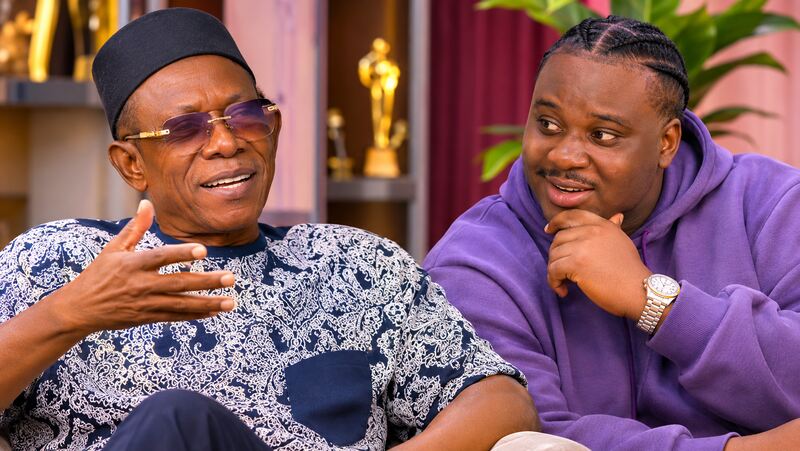
Veteran Nollywood actor Nkem Owoh, popularly known as Osuofia, brought his familiar humour and confidence to a conversation with comedian Isbae U, but the interview gradually revealed several interesting aspects of his career, personal outlook, and experiences in the Nigerian film industry. The exchange featured playful questions, unexpected remarks and discussions touching on some of the personalities and events that have remained part of his long journey in entertainment.
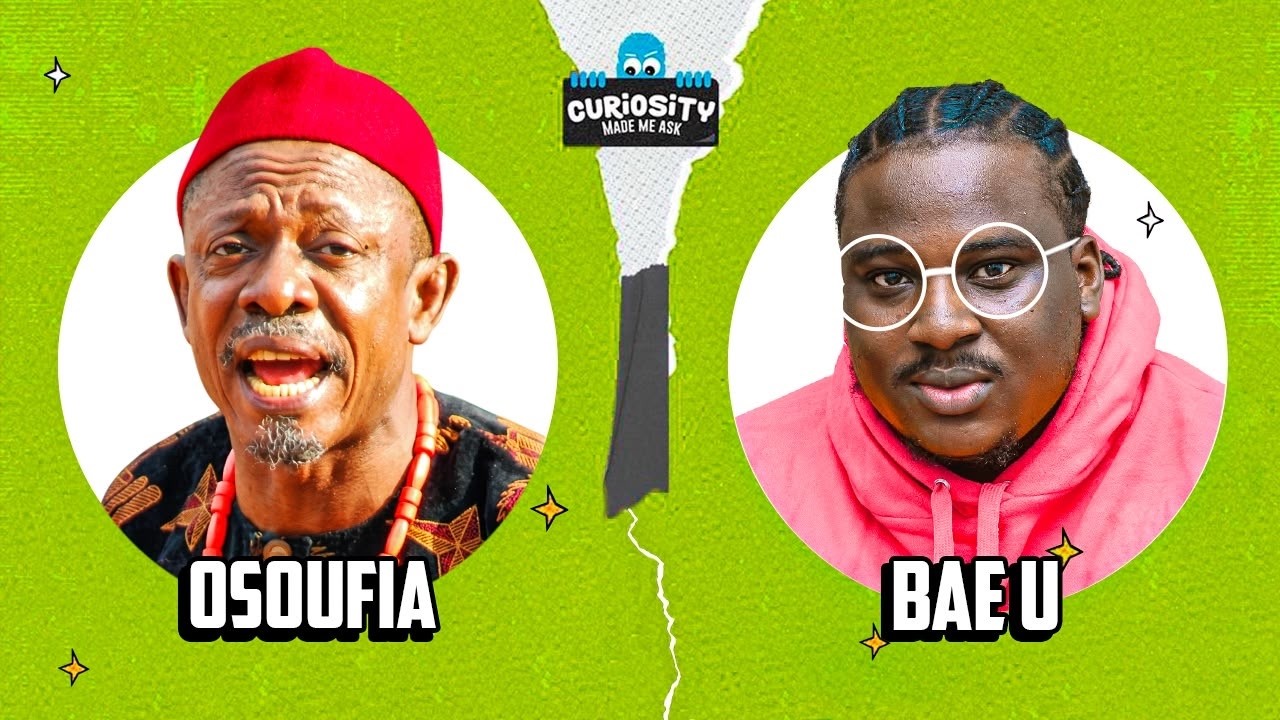
Published on November 7, 2026, the episode of Isbae U’s interview programme, Curiosity Made Me Ask, covered subjects ranging from the actor’s encounter with celebrated author Chimamanda Ngozi Adichie to his relationship with fellow Nollywood veteran Patience Ozokwor, popularly known as Mama G. There were also questions about his acting methods, his famous 419 song, his understanding of humility and the long running conversation about the origins of Nollywood.
Some moments were particularly amusing, especially when Isbae U attempted to challenge the veteran actor’s popularity and appearance. Others grew more serious as the conversation shifted to the history of Nigerian filmmaking, with Owoh taking time to explain the distinction between the early home video industry and the later adoption of the Nollywood name.
The discussion also revisited characters and performances that helped establish Owoh as one of Nigeria’s most recognisable comic actors. From his exchange about Chimamanda to the questions surrounding Mama G and the EFCC joke, the interview offered several memorable moments.
Chimamanda Adichie’s Reaction To Meeting Osuofia
One of the opening exchanges that attracted attention involved celebrated Nigerian author Chimamanda Ngozi Adichie and an encounter she reportedly had with Nkem Owoh at an event. Isbae U said she was curious about the author’s reaction when she met the actor, describing how excited she was to see him and comparing her response to meeting a major celebrity.
He asked Owoh, “Why was Madam Chimamanda so excited to see you at that event? She was so excited like she saw a big star.” The actor responded with a brief “Yes,” seemingly acknowledging the encounter without offering a lengthy explanation about what happened between them.
Isbae U then turned the discussion towards himself, joking that he felt disappointed because Chimamanda had not shown him the same level of excitement. He said, “I was really disappointed eh, she form my hand oh. If she’s shouting for Osuofia like that, if she now meets isBae U, she will be rolling on the floor.”
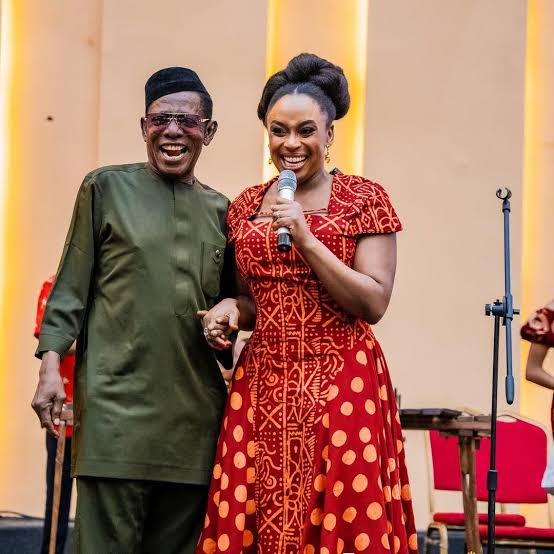
Owoh immediately challenged the comedian’s expectation, replying, “No, she might not take you as a star.” The response generated another amusing moment as Isbae U’s attempt to place himself alongside the veteran actor became the subject of their exchange. The discussion showed how Owoh’s decades of screen appearances have made his Osuofia identity recognisable beyond the regular Nollywood audience.
Isbae U Confronts Owoh Over Nollywood’s Origins
The conversation took a more substantial direction when Isbae U raised the long running debate about the origins of Nollywood and the contributions of Yoruba filmmakers to the Nigerian movie industry. He confronted Owoh with an alleged statement that Yoruba people started Nollywood rather than the Igbo, prompting the veteran actor to immediately challenge the way the accusation was presented.
Owoh responded, “No, I didn’t say that.” Isbae U attempted to continue his question, but the actor’s interruption led to another playful confrontation. The comedian warned him, saying, “I don’t like being cut off. This is your first and only warning. You say that again, I walk you out.”
Owoh appeared amused by the threat and simply asked, “Really?” Isbae U continued the joke by suggesting that he had enough influence to turn his audience against the veteran actor. He said, “I have the power to tell my fans to cancel you. Nobody will remember Osuofia again.” Owoh remained confident and replied, “I doubt if it’s going to be possible.”
After the playful exchange, the actor proceeded to explain what he meant when discussing the contributions of Yoruba filmmakers to the development of Nigerian home video productions. He argued that the Nollywood name came much later than the early filmmaking activities that eventually contributed to the industry’s growth.
Owoh explained, “First of all, you have given me this wrong accusation that I said, Yoruba started Nollywood. No. Yoruba started this film on… when did Nollywood come out? When we started the thing, there was no Nollywood as a name.”
He further explained that filmmakers eventually came together to discuss how the industry could develop and become more organised. According to him, “We sat together, and we’re banding, you know, ideas and all that, how the thing is going to come to fruition. And eventually, we chose Nollywood.”
Owoh Explains Yoruba Filmmakers’ Contribution To Home Video
Owoh’s explanation centred on the distinction between the early home video movement and the later emergence of Nollywood as an industry identity. He acknowledged the contribution of Yoruba filmmakers, particularly their role in making home video productions popular among Nigerian audiences. He said, “So, Yoruba started the thing. They made the thing very popular home video and all that. Yes, they did. And I’ve said it several.”
The actor also mentioned Hubert Ogunde and Adebayo Salami, popularly known as Adebayo Papa, as personalities whose productions he admired. He said, “Ogunde and Adebayo Papa. These are the people I love to watch their thing.”
When Isbae U jokingly suggested that Ogunde was Igbo, Owoh disagreed and maintained that the filmmaker was Yoruba. He responded, “Ogunde is not Igbo. I’m telling you that Yoruba started it. When Ogunde was out, I don’t think there was any Igbo man who was that popular in that.”
He eventually made his position particularly clear, saying, “The Yoruba did not start Nollywood. They started Home video.” His explanation was an attempt to separate the history of Yoruba filmmaking and home video productions from the later establishment of Nollywood as a recognised industry.
Yoruba travelling theatre, stage productions and early television filmmaking had already established a significant entertainment tradition. Hubert Ogunde was among the prominent figures in this earlier period, while Western Nigeria Television, established in Ibadan in 1959, also played a role in the development of Nigerian television entertainment.
The 1990s subsequently brought a major expansion of commercial home video productions, with Kenneth Nnebue’s Living in Bondage, released in 1992, widely recognised as a landmark in the development of modern Nigerian video filmmaking. The name Nollywood gained international recognition in 2002 following a report by journalist Norimitsu Onishi.
Owoh Opens Up About Pride And Humility
Following their exchange about the possibility of cancelling him, Isbae U turned the conversation towards Owoh’s personality and suggested that his confidence might be an indication of pride. The comedian asked, “Is that pride I’m seeing?” Rather than denying the suggestion, the veteran actor openly acknowledged that he considered himself a proud person.
Owoh responded, “I’m a very proud person oh. Are you not proud?” Isbae U immediately presented himself as someone who was very humble, saying, “No, I’m very humble.” The actor then offered a brief observation about how the 2 qualities could exist together without necessarily contradicting each other.
He explained, “Humility doesn’t mean you don’t have to be proud.” The statement was one of the more reflective moments in an interview largely driven by humour and teasing. Owoh’s response suggested that he did not regard humility as a requirement for someone to abandon personal confidence or pride in their achievements.
Isbae U Questions Owoh’s Acting Methods
Another subject that attracted attention was Owoh’s approach to acting and the claim that he sometimes departed from the original scripts provided for movie productions. Isbae U introduced the subject by saying he had heard comments from some directors and producers who claimed the veteran actor hardly followed scripts on set.
The comedian told him, “I’ve heard some directors and producers say, you hardly follow the script on set. And even though they say they like it, I really think it’s a bad behaviour.” He then explained his position by imagining a situation where he was producing a movie and expected an actor to follow the material prepared for the production.
Isbae U continued, “If I give you a script on my set, I’m about to shoot a movie, follow my script. Why must you add your own to it?” Owoh did not launch into a lengthy defence of his acting methods. Instead, he gave a brief response that left the possibility of working together open.
The actor replied, “Okay, when that time comes.” Isbae U immediately questioned why Owoh assumed he would ever invite him to appear in one of his productions, asking, “What makes you think I will call you to my movie set?”
The exchange highlighted the creative relationship between actors and filmmakers, particularly the place of improvisation during movie production. Owoh’s famous comic performances have often been associated with memorable expressions and spontaneous sounding dialogue, although Isbae U’s reference to complaints from unnamed directors and producers remains an allegation raised during the interview rather than a confirmed admission by the actor.
EFCC Comes Up Over ‘I Go Chop Your Dollar’
The discussion also moved towards one of Owoh’s most recognisable musical performances, I Go Chop Your Dollar, a song associated with his portrayal of a Nigerian fraudster in the film The Master. The performance became widely recognised because of its satirical treatment of advance fee fraud, popularly called 419 in Nigeria.
Isbae U brought up the song while joking about its association with internet fraud and the possibility of attracting the attention of law enforcement authorities. He asked, “What is the name of that your 419 song that you used to promote and motivate scam? EFCC, if you people are watching, it’s not too late to take this man.”
The reference to the Economic and Financial Crimes Commission was clearly presented as a joke within the interview. Owoh’s performance was a fictional entertainment portrayal, and the discussion did not establish any involvement by the actor in financial fraud.
The song remains one of the performances closely associated with his popular entertainment identity, particularly because its lyrics and exaggerated portrayal of fraudulent activities became familiar to many Nigerian music and movie audiences. Isbae U used that recognition to create another humorous moment during the conversation.
Owoh Refuses To Guess Isbae U’s Age
The comedian later asked Owoh to estimate his age, apparently expecting the veteran actor to make a guess that could become another opportunity for humour. He asked, “If you are to guess my age, what’s my age?” Owoh appeared reluctant to give an answer and replied, “Let me not say it oh.”
Isbae U insisted that the actor should make a guess and even pretended to cry while pressing him for an answer. Owoh eventually turned the situation into a joke about the comedian’s appearance, particularly his facial hair.
He remarked, “Crying? With all these beards, I’m disappointed.” The comment immediately changed the direction of the exchange, with Owoh using the comedian’s beard as the basis for his response rather than attempting to estimate his actual age.
Mama G’s Relationship With Osuofia
The conversation became particularly entertaining when Isbae U brought up Owoh’s long standing on screen relationship with Patience Ozokwor, popularly known as Mama G. The 2 actors have appeared together in several Nollywood productions, with their performances becoming familiar to audiences who followed Nigerian movies during the home video era.
Isbae U observed that many people enjoyed watching them together and suggested that some viewers wished their relationship could extend beyond acting. He told Owoh, “A lot of people love your on-screen relationship with Mama G. Some even wish you guys could be real life couples.”
The comedian then suggested that such a relationship might be possible, although he introduced another joke about Mama G’s preference for handsome men. He said, “And I think that’s possible, but the only problem is, the Mama G I know, she has good taste in men, she likes fine men.”
Owoh immediately turned the comment towards Isbae U, asking, “And you think you are handsome?” The comedian confidently replied, “I get that a lot.” The veteran actor then delivered one of the most memorable lines of the interview, telling him, “You are healthy, you are not handsome.”

The remark produced another playful exchange as the 2 men continued joking about the comedian’s appearance. It was one of the moments that showed Owoh’s ability to turn an ordinary question into a comic response, a quality that has remained central to his screen identity.
Why Owoh Never Kissed Mama G In Their Movies
Isbae U continued the discussion by asking about the absence of kissing scenes between Owoh and Mama G in their movie appearances. Considering the number of times the 2 actors have portrayed characters connected through romantic or marital storylines, the comedian wanted to know why their performances never included an on screen kiss.
He asked, “All the movies you did, you both never got to kiss on screen.” Owoh gave a straightforward explanation, saying, “The script never said kiss.” Isbae U then added another teasing remark, asking, “But you wish.”
The exchange remained humorous, with Owoh’s explanation pointing directly to the material provided for their performances. Their on screen relationship had become familiar to movie audiences, but the presence of romantic storylines did not necessarily mean that every scene required physical affection.
Francis Duru’s Name In The Nollywood Origins Debate
The discussion about the origins of Nollywood also connects with a wider conversation involving veteran actor Francis Duru and the contributions of different ethnic groups to the Nigerian film industry. The debate has frequently centred on the distinction between the early Yoruba film tradition and the commercial expansion of home video productions during the 1990s.
Yoruba filmmakers had established a strong entertainment tradition through travelling theatre, stage performances and television productions before the commercial video boom. At the same time, Igbo entrepreneurs, producers, marketers and filmmakers played significant roles in expanding the home video business and creating a distribution network that helped Nigerian movies reach wider audiences.
The 2 developments form part of the history of the industry, although they belong to different periods and involved different contributions. Owoh’s position during the interview was that the Yoruba contribution to early home video filmmaking should be acknowledged without confusing it with the later creation and naming of Nollywood.
His reference to Hubert Ogunde and Adebayo Salami also placed attention on the older generation of Yoruba entertainment personalities whose work helped shape Nigerian film and theatre culture. The conversation therefore went beyond a simple disagreement over ethnic ownership and returned to the different stages through which Nigerian filmmaking developed.
Nkem Owoh’s Personality Beyond The Osuofia Character
Throughout the interview, Owoh displayed the confidence and comic timing that made him a familiar presence in Nollywood. His responses to Isbae U’s questions were often brief, but they frequently redirected the conversation and gave the comedian another opportunity to react. The actor appeared comfortable discussing his career, his public image and the people he had worked with over the years.
His exchange about Chimamanda Adichie touched on his recognition outside the film industry, while the discussion about Mama G revisited the popularity of their screen partnership. The EFCC joke brought attention to one of his most famous musical performances, and the questions about scripts introduced an aspect of his working relationship with movie producers.
The Nollywood discussion was different because it gave him an opportunity to explain a position he believed had been misrepresented. He repeatedly distinguished between Yoruba filmmakers’ contributions to home video productions and the later emergence of Nollywood as a name for the wider Nigerian film industry.
The Full Conversation On Curiosity Made Me Ask
The episode featuring Nkem Owoh was published on November 7, 2026, on Isbae U’s Curiosity Made Me Ask programme. The interview ran for approximately 52 minutes and 49 seconds, bringing together discussions about the veteran actor’s career, his public image, Nollywood history and his relationships with fellow entertainers.
Some of the most memorable exchanges involved Chimamanda Adichie, the comedian’s cancellation threat, Owoh’s explanation of humility, the EFCC joke and the questions about Mama G. The conversation also offered a reminder of how performances from earlier generations of Nollywood continue to shape discussions about the industry’s history and its most recognisable personalities.
Owoh’s appearance ultimately brought together several aspects of his entertainment career, from the comic identity that made him famous to the historical questions surrounding the development of Nigerian filmmaking. His exchanges with Isbae U provided the humour, while his explanation about Yoruba home video productions and Nollywood supplied one of the interview’s most substantial discussions.