


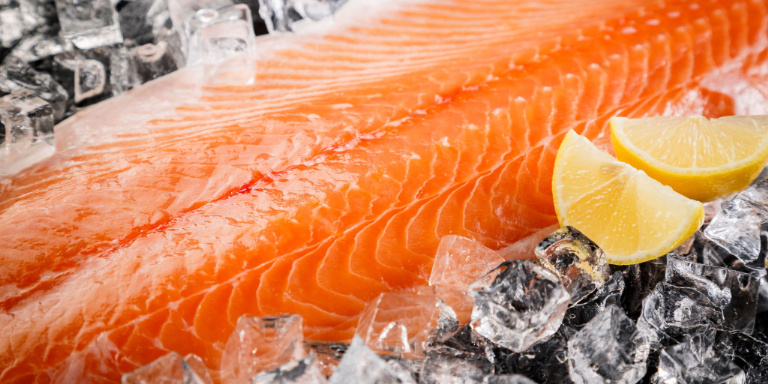
If you were thinking about ordering some salmon tonight, we’re going to ask you to hold the phone. According to a study published in the Centers for Disease Control and Prevention’s monthly journal Emerging Infectious Diseases, scientists have discovered Diphyllobothrium nihonkaiense — more affectionately known as the Japanese broad tapeworm — worms and larvae in Alaskan wild salmon and are now claiming that salmon caught anywhere off the Pacific coast could be contaminated.
Gross, but if you don’t live on the West Coast — or in the U.S. for that matter — you’re good, right? Unfortunately, the salmon-tapeworm problem is much more pervasive; wild Alaskan salmon, once caught, are typically transported on ice (not frozen, which kills tapeworms) to major corners of the world, including restaurants throughout the U.S. So, you could be in Boson and still be at risk.
Scientists know very little about Japanese broad tapeworms, but do know that they’re related to another species, Diphyllobothrium latum, which can grow up to 30 feet long (gulp). D. latum tapeworms were thought to be responsible for the 1986 outbreak that resulted in 2,000 tapeworm infections across Japan, South Korea and the Pacific coast of Russia. Turns out, those scientists were wrong — it’s been the Japanese broad tapeworm, all along.
While most infected people are asymptomatic, be on the lookout if you experience any abdominal discomfort, nausea, loose stool or inexplicable weight loss. In more severe cases, where the infection is larger, intestinal obstructions occur. If that’s happening to you, you’ll know.
The good news is that it’s fairly easy to tell if you have a tapeworm. “The reason you know you have tapeworms is you look in your stool and you find bits of tapeworm floating in the water,” Dr. William Schaffner, a professor of preventive medicine at Vanderbilt University School of Medicinem, told CNN. Nope, it’s not pleasant, but a quick glance down is all it takes. No weird floating worm segments in your number two? No problem.
If you do? Take a sample and go straight to your doctor. Treatment is usually swift and effective.
Tapeworm infection has been clinically rare in the U.S., but this new study suggests that we might be at greater risk than previously anticipated. To avoid an infection entirely, the CDC recommends consuming only adequately frozen or cooked fish — cooking or baking fresh fish on 145 degrees Fahrenheit for four or five minutes denatures the worm, and its larvae, entirely, claims Dr. Patrick Okolo, chief of gastroenterology at Lenox Hill Hospital in New York.
How are we only discovering this now, you ask? “Because we do things that we haven’t done before,” explained Schaffner, like transport fresh fish over great distances, where they’re consumed raw.
Diagnostic measures have also advanced significantly over the last few decades. “The tapeworm itself is probably not new — it’s just that more skilled parasitologists started looking for it,” Jayde Ferguson, a co-author of the study and scientist at the Alaska Department of Fish and Game, told CNN. “Identifying these parasites is challenging.”