
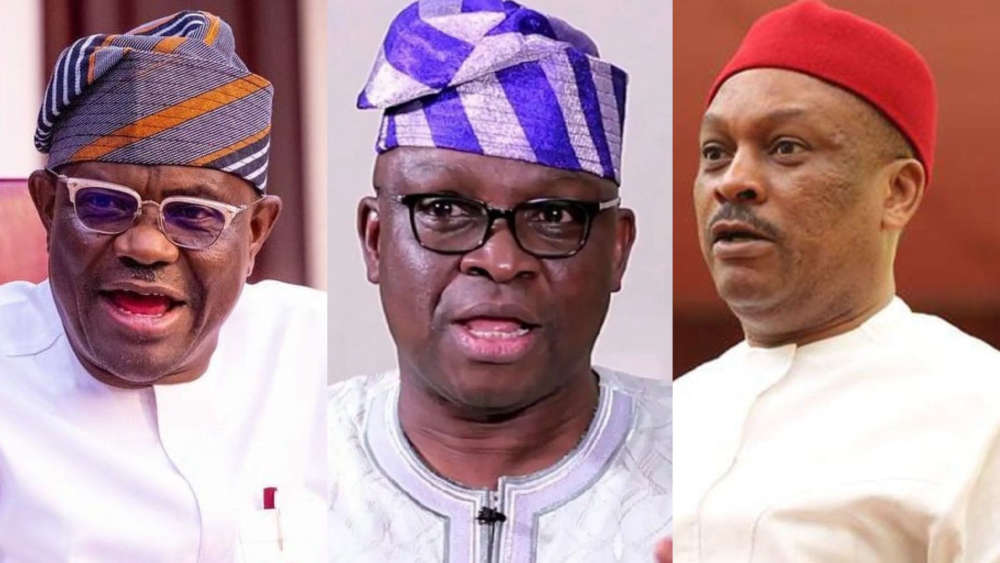
A quiet tension clung to Abuja like a heavy veil, the kind that follows decisions made behind doors thick enough to swallow every whisper. Political operatives moved through the city with guarded eyes, their expressions betraying the unease of a party that had just triggered a seismic shift. Somewhere between the murmurs of strategy and the silence of shock, the People’s Democratic Party delivered its most consequential blow in years: the expulsion of Nyesom Wike, Ayo Fayose, Samuel Anyanwu, and others whose names once shaped the party’s architecture.
The announcement rippled through the political landscape with the force of a fault-line rupture. Conversations changed their tone overnight. Old alliances became brittle. Political rooms that once echoed with certainty now carried a hush thick enough to plant doubt in every corner. The expulsion was not merely a disciplinary action; it was a message—one so calculated and loaded that its full meaning refused to sit still.
Observers who had followed PDP’s internal battles for years sensed something deeper than administrative punishment. Questions began to swirl in corridors of power, on television panels, across social media, and within party structures that had become accustomed to turbulence but not to a purge of this magnitude. Every angle felt incomplete. Every explanation raised another question. Nothing about the moment suggested closure.
Within hours of the announcement, Nigeria’s political compass felt newly scrambled. A familiar party was forced into unfamiliar terrain, walking a tightrope between asserting authority and risking fragmentation. The stakes grew higher with every passing minute. Something larger than discipline was at play, and the unanswered questions grew louder than the official statement that triggered them.
A Party at War With Itself: The Cracks Beneath the Surface
Political watchers often describe the PDP as a house large enough to hold disagreements, but the cracks beneath the façade had been widening long before the expulsions. Internal conflicts simmered quietly, occasionally erupting during primaries, convention battles, and intense national campaigns. Those flare-ups were often treated as typical party politics—until the fractures deepened beyond cosmetic repair.
The seeds of recent unrest were planted in the aftermath of the 2023 elections, where competing factions began carving out separate territories within a party already struggling to reclaim national dominance. Power blocs hardened into impenetrable walls. Governors guarded influence zones with a defensive zeal. National executives struggled to maintain cohesion amid competing demands, each rooted in old grievances and renewed ambitions. The party’s spine was bending under pressure long before anyone admitted it.
Senior members whispered about unresolved betrayals that stretched across election cycles. They referenced compromises that had delayed necessary reforms, strategic miscalculations that weakened the party’s national voice, and a chronic inability to manage dissent without escalating tensions. These murmurs never fully reached the public, yet they shaped the decisions leading to the dramatic expulsion that caught the country off guard.
By the time the disciplinary hammer fell, the PDP was no longer simply confronting internal dissent; it was confronting the consequences of years of unresolved conflict. The expulsions became a turning point not because they were unexpected, but because they forced every faction to confront the question the party had avoided for nearly a decade: how long can a political house survive when its pillars are constantly at war with one another?
The Wike Question: Power, Loyalty, and the Politics of Defiance
Few names carry as much weight within PDP’s modern history as Nyesom Wike’s. His rise from local administration to national relevance reshaped the party’s internal dynamics, carving out a lane of influence unmatched by most contemporaries. Wike cultivated a reputation built on boldness, strategic generosity, and relentless political maneuvering. Supporters hailed him as a stabilizer; critics saw a disruptor who played by rules of his own making. Both descriptions contained pieces of the truth.
Tension around Wike did not appear spontaneously. His role in the 2022–2023 presidential power struggle left scars that had barely begun to heal. The famous G-5 rebellion, his public confrontations with party leadership, and his unexpected collaboration with the ruling All Progressives Congress all contributed to a political persona that was both admired and feared. Many within the PDP believed his defiance transcended internal disagreement—it challenged the party’s very definition of loyalty.
Even so, expelling a political heavyweight of his stature was never going to settle the matter. Instead, it raised more questions about timing, motive, and the future of the party’s soul. Was this a necessary correction or a risky gamble? Did the party act to protect itself, or had it surrendered to inevitable fragmentation? These questions grew louder as analysts dissected every layer of political calculus behind the decision.
Wike’s reaction, measured yet unmistakably defiant, signaled a political storm still gathering. His supporters framed the expulsion as a targeted strike motivated by fear, while opponents cited it as overdue accountability. Somewhere between both interpretations lay the more complex reality: Wike’s influence had always been bigger than the office he held, and removing him from the PDP register did nothing to erase his reach.
Fayose’s Fallout and the Battle Over PDP’s Moral Compass
Ayo Fayose has always walked the political space with a peculiar combination of humor and unpredictability, the kind that kept allies guessing and opponents on edge. His political trajectory carried enough drama to fill several memoirs, yet beneath the theatrics lay a deeper struggle for relevance, influence, and survival within a party that once celebrated him as one of its boldest governors. The decision to expel him raised a different kind of debate—one that questioned the meaning of discipline, loyalty, and internal justice.
Many within the PDP saw Fayose as a figure who crossed too many red lines without facing proportionate consequences. His outspoken criticism of party leadership, his visible flirtations with rival power structures, and his occasional divergences from the PDP’s collective messaging often made him a lightning rod for controversy. Yet, his charisma and grassroots popularity shielded him from disciplinary action for years. The suddenness of his expulsion left even longtime critics searching for clues about what changed behind the curtain.
Analysts began speculating that his removal signaled a new standard the party wanted to enforce—a line drawn in the sand after years of internal permissiveness. Others suggested that the move was less about principle and more about political convenience, a calculated attempt to streamline the party’s internal map ahead of future elections. Regardless of interpretation, the fallout forced the PDP to confront a deeper question: what does the party now consider unacceptable behavior, and why did the threshold shift only at this moment?
Fayose’s allies framed the expulsion as a personal attack cloaked in institutional language. They argued that the party ignored context, dismissed political realities, and allowed sentiment to shape discipline. Supporters highlighted his role in defending the PDP during moments of national turmoil, insisting that disagreements should never be mistaken for betrayal. These arguments stirred a philosophical debate within the party ranks—one that stretched far beyond Fayose himself, touching on how a political party defines morality in times of internal conflict.
The Anyanwu Dimension: Imo Politics and the Quiet Eruption
Samuel Anyanwu’s expulsion carried its own distinct shockwave, one that rippled through Imo State more quietly but no less profoundly. His political journey, shaped by years within the PDP’s framework, represented a regional loyalty that had endured storms, elections, and shifting alliances. Removing him from the party register raised the kind of questions that refused to fade, especially in a state where political identity is often intertwined with survival.
Regional observers pointed out that Anyanwu’s influence went far beyond his official positions. He carried the weight of local credibility, the trust of party members who believed he understood the pulse of Imo’s political climate more intimately than national executives in Abuja ever could. Severing ties with such a figure signaled more than corrective action—it hinted at a widening gap between the party’s central leadership and the realities unfolding across the grassroots.
Speculation brewed over whether the expulsion was rooted in personal grievances, unresolved primary disputes, or deeper ideological fractures. Some argued that the party had grown weary of internal controversies tied to his factional battles. Others believed the move targeted a growing power base that threatened certain interests ahead of future strategic negotiations. Whatever the driving force, the decision ignited a quiet eruption among local stakeholders who worried about the long-term consequences for the party’s relevance in the state.
Conversations in Imo political circles shifted rapidly. Loyalists wondered whether the PDP had underestimated the symbolic cost of removing someone who embodied decades of institutional continuity. Opponents wondered whether the party had handled the situation with enough fairness or strategic foresight. A lingering unease settled across the region—a sense that something had broken in the relationship between the party and one of its most recognizable state figures.
Power Blocs, Governors, and the Fear of Internal Revolution
Every major Nigerian political party is shaped by clusters of influence, and the PDP is no exception. Governors wield enormous power within its structure, often acting as kingmakers who determine national direction through consensus or confrontation. Their role in the crisis surrounding the expulsions cannot be overstated; they sat at the center of discussions, calculations, and silent negotiations that paved the way for the final decision.
Fear of internal revolution had been building for years. Certain factions worried that unchecked defiance from figures like Wike and Fayose threatened to inspire similar behavior among others. The party’s fabric, already weakened by recurring internal battles, could not withstand another cycle of rebellion. Governors who once tolerated dissent began to consider the long-term danger of allowing parallel centers of influence to grow too powerful.
The calculus behind the expulsions became clearer when observed through this lens. Political survival often requires choosing between discomfort and collapse. Many governors believed the party needed a drastic reset—one that would reassert central authority and discourage future insubordination. They viewed the expulsions as a painful but necessary surgery, a procedure intended to stop internal decay before the party hemorrhaged more members or credibility.
Yet the strategy carried risks. Consolidating power without addressing underlying grievances can produce temporary calm but long-term instability. Some governors feared that the expulsions might trigger a counter-movement among grassroots members and regional stakeholders who felt sidelined by decisions made without adequate consultation. The thin line between discipline and provocation became even thinner as reactions from different states began to shape the national mood.
2027 CALCULATIONS: THE INVISIBLE CHESS GAME BEHIND THE EXPULSIONS
The 2027 election now casts its shadow across every conversation held within PDP’s inner circles, and the expulsions have become a silent opening move on a board few people can fully see. The leadership appears convinced that order must precede ambition, that internal stability is a prerequisite for external victory. Yet beneath that belief lies a complex political arithmetic—one where the removal of Wike, Fayose, and Anyanwu reshapes alliances, recalibrates blocs, and subtly repositions the party for a battle it cannot afford to lose. Every major political season carries an undercurrent of survival instincts, and this episode is no exception.
Strategists argue that the party needed to regain narrative control before 2027 begins in earnest. Their reasoning revolves around the idea that unresolved internal conflicts weaken national credibility. The expulsions, therefore, are cast as a preventive measure, a way to ensure that voices capable of derailing the party’s messaging or fracturing voter confidence are neutralized early. Yet this strategy carries a dual edge. Political firebrands can disrupt unity, but they can also energize voters who crave authenticity over caution. Losing such figures may streamline the hierarchy but could also drain passion from the party’s base.
Regional blocs now read these expulsions through the lens of future negotiations. Any shift in internal power dynamics inevitably influences zoning debates, ticket combinations, and campaign financing networks. The party must now navigate these reconfigurations without appearing desperate or disorganized. Each region interprets the expulsions as a signal of where national influence may shift next. Whether this interpretation leads to fresh loyalty or quiet withdrawal will become clearer as political horse-trading intensifies behind closed doors.
The chessboard feels especially delicate because the ruling party understands the magnitude of PDP’s crisis and will attempt to deepen any cracks. Opposition unity is an essential currency heading into 2027, and a fractured PDP translates to diminished resistance against incumbency power. The leadership’s gamble rests on the belief that a cleaner, more disciplined internal structure enhances their competitive strength. Yet politics rarely rewards neatness; it rewards influence, resilience, and the ability to retain strong personalities even when they are inconvenient. The next two years will reveal whether the expulsions were a masterstroke or a miscalculation disguised as courage.
PUBLIC PERCEPTION AND THE RISK OF A FRACTURED OPPOSITION
Across the country, public reactions to the expulsions mirror the broader distrust Nigerians already feel toward political institutions. Many interpret the move as another chapter in the endless drama of elite infighting, a spectacle that distracts from real governance issues. Others believe the party acted too aggressively, mistaking disagreement for sabotage. The leadership’s attempt to frame the expulsions as an act of discipline has struggled to gain unanimous acceptance, which highlights the delicate terrain the party now walks on.
Several Nigerians see Wike, Fayose, and Anyanwu as figures who—despite their controversies—represent transparency in a political space where masking intentions is common. Their departures evoke mixed emotions: relief among those who blame them for destabilizing the party, frustration among supporters who feel their voices have been dismissed, and confusion among undecided voters who wonder what direction PDP truly intends to follow. Public perception ultimately shapes electoral viability, and right now, that perception is clouded by speculation.
The danger extends beyond reputation. A fractured opposition landscape benefits no one except the ruling establishment. When a major party bleeds internally, smaller opposition parties either cannibalize its members or fragment themselves by absorbing incompatible factions. Such fragmentation dilutes the collective bargaining power required to mount a credible challenge against incumbency. PDP risks appearing like a house that seals its windows while leaving its doors open, vulnerable to external winds and internal abandonment.
Supporters seeking stability now look for reassurance that the party will not spiral into further purges or petty rivalries. They expect clarity, consistency, and a narrative that explains the expulsions without sounding vindictive. If the party fails to establish such clarity, it risks becoming a symbol of endless self-conflict. The broader electorate already carries fatigue toward political drama, and excessive internal turbulence could push more citizens toward apathy—an outcome that ultimately weakens democratic participation and strengthens entrenched power.
WHAT REMAINS OF PDP’S IDENTITY AFTER THE PURGE?
The essence of PDP has always rested on its ability to balance competing interests under a broad national umbrella. That umbrella once symbolized inclusion, negotiation, and adaptability. The expulsions challenge this legacy, raising the question of what remains of the party’s foundational identity. The PDP that now emerges appears more assertive, more centralized, and less tolerant of voices that challenge internal orthodoxy. Some see this evolution as long overdue; others view it as ideological shrinkage.
One of the party’s long-standing strengths has been its willingness to accommodate strong personalities without allowing them to dominate the entire structure. That tolerance created a mosaic of influencers whose collective weight made PDP formidable. Eliminating key figures disrupts that mosaic, forcing the party to redefine its cohesion. The identity that once celebrated diversity of thought now appears to lean toward streamlined obedience, and this shift could either strengthen internal order or suffocate organic political debate.
A revised identity may also require the party to articulate its moral and political philosophy with greater clarity. Nigerians crave ideological direction, not just electoral ambition. PDP must demonstrate whether it stands for reform, institutional discipline, economic renewal, or democratic expansion. A purge without ideological articulation feels like a house repainting its walls without repairing its foundation. The next phase of the party’s identity will depend on whether its leaders can translate internal discipline into external vision.
Members still loyal to the party hope that the purge is not an erasure but a reset. They want a PDP capable of reinvention, one that sheds its old baggage without losing its national scope. Whether this hope becomes reality depends on transparency in decision-making, fairness in future disciplinary actions, and the ability to maintain unity without slipping into authoritarian tendencies. The party’s identity is now a work in progress—a sculpture partially carved, waiting for shape and coherence.
LEAVING WITH THIS: A PARTY SEARCHING FOR ITSELF IN THE RUBBLE
The expulsion of Wike, Fayose, Anyanwu, and others marks a turning point that will echo through the party’s future long after the dust settles. PDP stands at a crossroads where every choice carries weight, every silence creates interpretation, and every internal decision shapes its national relevance.
The party has attempted to reconstruct itself, yet reconstruction rarely occurs without debris. What lies before PDP now is a terrain filled with questions—questions about loyalty, ideology, survival, and the unpredictable future of Nigerian politics.
Ultimately, this is not just the story of a party expelling its members. It is the story of a political organization wrestling with its identity, haunted by its past, hardened by its internal wars, and uncertain about its future. Whether PDP rises from the rubble or sinks deeper into it depends on how it interprets this moment—not as an ending, but as a reckoning that demands clarity, courage, and a renewed commitment to the ideals it once claimed to embody.