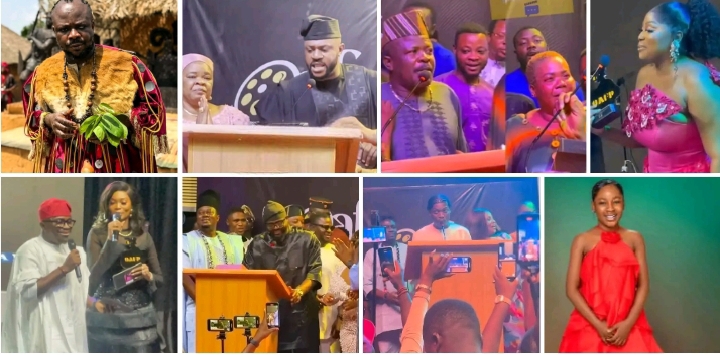
There are nights in the Nigerian entertainment space that arrive quietly, then somehow they grow into something larger than the room they happen in. The 2025 edition of the Odunlade Adekola Film Production Awards is one of those nights. Abeokuta was the place, the kind of December night breeze that makes people talk without thinking too much about their own noise. The date was December 8 and the place was packed in that typical Yoruba film culture way where everybody feels like they know everybody, even when they truly do not.
Odunlade Adekola stood at the centre of everything even when he was not on stage. His presence moves like that. He does not have to be talking before you feel him. This year felt like a return to something steady. Something that reminds everyone that Yoruba film culture is still its own powerhouse with its own kings, queens, rookies and artisans behind the camera who make it all come alive.
Kiekie and Masoyinbo rolled the energy of the room like two people who knew they were not just working. They were also living the moment, swinging between jokes, warm chaos and those sweet bridges that keep an award night from falling apart. Their vibe was the right one.
Before we go anywhere else, the winners in clean bullets are right here.
How the night started for real
People were still settling when the first wave of cheers started flying around. Not because someone walked in, but because the music that filled the hall had that Abeokuta seriousness mixed with festival energy. Yoruba entertainment gatherings run like family parties. You do not wait for a strict program to start enjoying yourself. You enjoy because people around you are enjoying and the circle keeps pulling more people in.
There was no rush to get the show rolling. The hosts were warming up, and the audience was already engaging in their own playful arguments about who would win what. Someone at the back argued loud enough for the whole row to hear that if Mide Martins did not collect something that night, the world was upside down. Another person said Ibrahim Yekini was already the owner of one award even before he walked into the hall.
It is always that sweet noise. You cannot buy that kind of energy.
Kiekie and Masoyinbo doing their thing
This year the stage belonged to Kiekie and Masoyinbo. The two of them did not come to behave like they were scared of the room. They danced their way into the night, cracked the type of jokes that do not sound scripted, interacted with people who were not even ready to interact. They held the hall like friends holding a block party.
Kiekie had that sharp smart presence that makes her stand out anywhere. Masoyinbo balanced the stage with a calmer delivery, sometimes serious, sometimes playful but always in the right rhythm. They made the whole night feel fluid, like a gathering where everyone is free.
Their style helped the award night feel more human. Less stiff. More like an inside story unfolding in real time.
The moment the awards started to hit different
Once the first set of winners were announced, the whole air changed. It was like a quiet understanding that tonight was special. People clapped the way Yoruba people clap when they recognise real work. They do not just clap. They clap with a kind of power that says, this one deserves it.
One of the earliest emotional moments happened before the big awards even rolled heavy. When Saliu Gbolagade was announced for the Legendary Award and Outstanding Performance for Koleoso, the hall shifted. This man had decades in the game. He had stories in his bones. You could see the respect moving around the room like a physical thing.
Then came the moment money started landing. People walked up on stage to bless him. Real life love. No camera tricks. It felt like gratitude from an industry that understands how many elders built the structure younger actors are standing on.
That scene alone will be remembered for a long time.
Mide Martins grabbing the Best Actress spotlight
Mide Funmi Martins walking up to collect Best Actress of the Year for Lajelaje felt like a moment that had been building for months. Her performance had circulated across social media. Clips from the film had people arguing in comment sections about the depth she brought into the character.
So when her name came up, it felt right. Not because she is popular. But because her work this year carried weight. She blended emotional tension with presence in a way that felt seasoned. She is one of those actresses who does not chase the camera. The camera follows her.
The applause took a while before it calmed down, and honestly nobody was in a hurry for it to stop.
Ibrahim Yekini owning his night
When Ibrahim Yekini also known as Itele was announced for Best Actor for Akuda, the hall responded with that heavy reaction you give someone who has delivered again and again. Then the Award of Excellence landed on him too. That double hit made it clear he was one of the pillars of the night.
Ibrahim has built a certain consistency around his name. He works with the energy of someone who does not joke with craft. Akuda was one of those films where he pushed past the usual boundaries. That award did not feel like a surprise. It felt like confirmation.
His face carried gratitude and a little bit of shock too. Those are the moments that make award nights worth it.
The creators behind ‘Konge’
Konge came into the night carrying weight. Not just because it was nominated for Best Movie, but because everyone in the room knew it was a production where multiple hands had pushed past limits. Paul Adeshina collected Best Director, but it was more than one person behind the camera. Michelle Onamade, the kid actor whose scenes carried raw energy, delivered moments that made adults pause. The way she moved, the way she reacted to every scene, showed that she was not just following instructions. She was interpreting, adding herself to the story.
The producers, editors, cinematographers, everyone, had their fingerprints on this movie. Desmond Tutu as Director of Photography on Koleoso may not have been on Konge, but the whole night reminded everyone that in Yoruba cinema the visuals, the cuts, the sound, they carry their own kind of narrative. Bolaji Ajala editing Aje Ni A Mi, Tajudeen Opebiyi recording sound for Lajelaje, even Abdulrasak Alagbada designing sets for Ile, they all showed how crew work is as much performance as acting. Each name that went up on that stage meant someone spent months, sometimes years, working for that single frame to look right, feel right, sound right.
Crew categories that matter
It is easy to overlook what happens behind the camera. But in Abeokuta that night, the crowd made it clear they were noticing. Best Set Designer, Best Gaffer, Best Sound Recordist, Best Editor, Best Traditional Costumier, Best Director of Photography, even Best Kid Actor, all of them had their moment. Each award, each applause, reminded everyone that Yoruba filmmaking is a collaborative grind. It is sweat, compromise, improvisation, coffee spills, late nights, arguments about lighting angles, costume threads, camera movement. And then the applause comes, and it makes all the small battles worth it.
Yoruba film culture context
Yoruba film culture is its own beast. It runs differently from Nollywood at large. It is intimate, it is musical, it is performative in a way that makes audiences feel like they are part of the story before the story even starts. Awards nights like OAFP are less about spectacle and more about recognition, respect, and continuity. You can feel the history in the hall, the way people lean toward the stage when elders are honoured, how laughter flows when comedians get their moments, and how newcomers get attention without being drowned by celebrity.
It is also deeply social. You watch and notice who came with who, who talked to who, who smiled but avoided eye contact. It is about connections, networks, legacies. It is not just art, it is life on display and life behind the curtain at the same time.
Behind the scenes stories
Not every moment gets caught on camera. Some of the night’s tension happened backstage. Michelle Onamade was nervous before her scene presentation, pacing in a corner, chewing on the back of her sleeve. Paul Adeshina whispered to her, coached her through a take, and then the camera rolled and everyone forgot she was nervous. Ibrahim Yekini joked with Ayefele about old film mistakes, making everyone laugh. Saliu Gbolagade moved quietly, shaking hands, nodding at every familiar face, letting younger actors feel like they were being hugged by experience. These behind the scenes moments do not show up in clips or Instagram posts, but they set the mood, the energy, the authenticity of the night.
Odunlade Adekola holding it all together
Odunlade Adekola, the anchor of the event, is more than the host or the award namesake. He is the glue that keeps the night grounded in both culture and craft. Watching him on the sidelines, seeing him whisper encouragement to actors, checking in with crew, laughing with old colleagues, shows that he understands the ecosystem. He is not just celebrating others. He is protecting the ecosystem that supports the films, the actors, the stories, the camera angles, the costumes, the lights. Without that, awards nights can feel hollow, but this one felt like it had roots, history, and vision all at once.
Winners at a glance
- Best Actor of the Year 2025
Ibrahim Yekini for Akuda - Best Actress of the Year 2025
Mide Funmi Martins for Lajelaje - Best Content Creator of the Year 2025
Ayo Ajewole also known as Woli Agba - Director of Photography of the Year 2025
Desmond Tutu for Koleoso - Best Editor of the Year 2025
Bolaji Ajala for Aje Ni A Mi - Best Female Comedy Actor of the Year 2025
Kemi Apesin for Tani Perfect Maid - Best Traditional Costumier of the Year 2025
Biola Adegunju for Ile - Best Male Comedy Actor of the Year 2025
Sanusi Izzihaq for Tade Idan - Best Female Supporting Actor of the Year 2025
Anike Ami for Last Weekend - Producer of the Year 2025
Ayefele - Best Indigenous Movie of the Year 2025
Ile - Best Sound Recordist of the Year 2025
Tajudeen Opebiyi for Lajelaje - Best Gaffer of the Year 2025
Ibrahim Arilewo for Visitation - Best Male Supporting Actor of the Year 2025
Babatunde Aderinoye for Orun Kanna - Best Set Designer of the Year 2025
Abdulrasak Alagbada for Ile - Best Kid Actor of the Year 2025
Michelle Onamade for Konge - Best Movie of the Year 2025
Konge - Best Director of the Year 2025
Paul Adeshina for Konge - Award of Excellence
Ibrahim Yekini - Legendary Award and Outstanding Performance
Saliu Gbolagade for Koleoso
Closing narrative that wraps the full story
As the night wound down, the crowd spilled out into the cool Abeokuta air. Conversations were loud, lingering, stories being retold immediately. People talked about Saliu Gbolagade’s decades in the industry, Michelle Onamade’s breakout energy, Paul Adeshina’s direction, and how Mide Martins carried Lajelaje in a way that would be remembered. Ibrahim Yekini’s double recognition made everyone feel like they had witnessed a masterclass in consistency.
The 2025 OAFP Awards reminded everyone why Yoruba cinema survives, thrives, and still matters. It is about craft, community, respect, and above all, passion. Awards are just a way to make the invisible work visible. Behind the laughter, applause, and stage lights, it is the long nights, the tiny mistakes corrected, the quiet encouragements, and the relentless pursuit of telling a story well that make nights like December 8 unforgettable.
By the time the last lights dimmed, everyone knew they had witnessed not just an awards night, but a small testament to the pulse of Yoruba cinema. Odunlade Adekola stood quietly in the crowd, letting others shine, proving that sometimes the anchor does not need the spotlight to be the center of gravity.