
On the Lagos–Ibadan Expressway, the usual hum of engines and exhaust fumes was interrupted by the sudden violence of metal and fate. December 29, 2025, began like any other, but for Anthony Joshua, the former heavyweight champion whose name carries the weight of two nations, it became a day of collision and reckoning. Across Nigeria, feeds lit up, WhatsApp chains rattled with disbelief, and the echo of screeching tires found its way into living rooms far removed from the crash site. The numbers were simple yet devastating. Two lives lost. One national hero wounded. In the quiet of private reflection, a country held its breath, straddling shock and empathy.
The power of a public figure’s vulnerability became evident in real time. Anthony Joshua, a man celebrated for controlled aggression in the ring, was reduced to human fragility in the face of road chaos. The event transcended sports news, becoming a mirror of societal anxieties—of mortality, infrastructure, and the tension between celebrity and citizen. Nigerians did not merely read the headlines; they absorbed them, processed them, and projected their own fears and hopes onto a moment that belonged to one man yet resonated nationwide.
As news rippled through media platforms, there was a tension between rumor and reality, between sympathy and critique. Early reports suggested delays in emergency response, eyewitness interventions, and the immediate transportation of the injured. Social media became both a lens and a mirror, reflecting the collective unease and amplifying it through comments, hashtags, and viral threads. In this dynamic, the narrative of the crash became a narrative of the nation itself, highlighting both resilience and the fragility of systems meant to protect life.
In a country where public figures embody more than their profession, the crash demanded multiple forms of response. Some voices expressed raw empathy, some wielded humor that bordered on insensitivity, and others leveraged the incident to critique structural weaknesses. Within hours, the Lagos–Ibadan Expressway, a symbol of mobility and commerce, had transformed in the public imagination into a stage for reflection, analysis, and national dialogue.
A Nation Paused: Official Condolences and Presidential Response
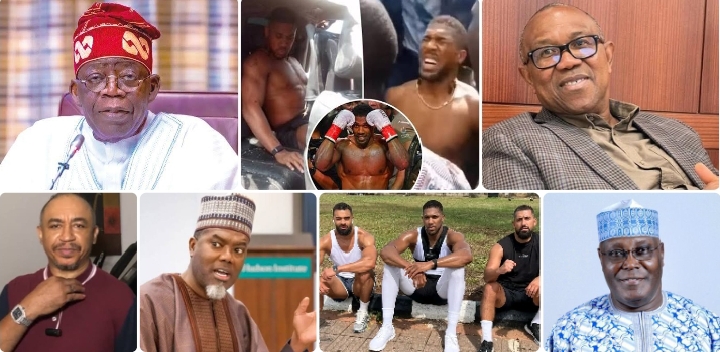
President Bola Ahmed Tinubu’s reaction was measured yet laden with symbolism. From his official X account, he extended heartfelt condolences to Anthony Joshua and the families of the two victims, framing the event as a tragic loss to the nation. Tinubu praised Joshua’s discipline and commitment, noting that his achievements in the global sports arena had inspired millions of Nigerians. By highlighting both human vulnerability and national pride, the president transformed a news report into a statement of collective identity.
The presidential statement went further, communicating personal concern. Tinubu reportedly spoke with Joshua and his mother, offering reassurance, prayers, and assurances regarding medical care. This personal touch underscored the duality of public life in Nigeria—where leaders engage not only through formal channels but also through gestures that humanize political authority. The symbolism of the president calling directly resonated with citizens who watched the unfolding story with both apprehension and hope.
The president’s response also aimed to set a tone for public conduct. By urging unity, compassion, and national solidarity, he implicitly asked citizens to temper immediate judgment and focus on empathy. The crash, while tragic, became a prism through which the interplay of governance, celebrity, and civic morality could be observed. Tinubu’s words carried the weight of authority, yet they also acknowledged the fragility inherent in everyday life on Nigerian roads.
In framing the event as both a personal tragedy and a national moment, the presidential response highlighted the relationship between fame, vulnerability, and leadership. It reminded the public that even figures elevated by global achievement remain susceptible to the same dangers as ordinary citizens. In a subtle narrative, Tinubu positioned Joshua’s survival as symbolic of resilience, while mourning the lost lives reinforced the reality of systemic fragility and the enduring need for infrastructure improvements.
Voices of Experience: Atiku Abubakar and Reflections on Resilience
Former Vice President Atiku Abubakar reacted to the crash with expressions of profound sadness, blending personal empathy with national reflection. Recognizing Joshua as a symbol of resilience and strength, Atiku highlighted the human dimension behind headlines and social media frenzy. In his statement, prayers for recovery intertwined with condolences for the deceased, creating a narrative that acknowledged both triumph and tragedy. His commentary, while concise, reinforced the shared sense of vulnerability that transcends fame.
Atiku’s response was also reflective, situating Joshua’s accident within broader themes of human fragility and the unpredictability of life. By drawing attention to the inherent risks faced by all citizens, he offered a lens through which Nigerians could view the event beyond celebrity fascination. The former vice president emphasized empathy as a necessary response, framing mourning as both private reflection and public solidarity.
His words resonated widely because they acknowledged the multiple layers of human experience at play. Joshua’s injuries were not isolated events but symbolic of the daily negotiation between achievement, risk, and survival. The loss of two lives amplified this reflection, prompting public consideration of safety standards, road conditions, and emergency readiness. Atiku’s framing encouraged citizens to perceive tragedy with depth rather than simplification.
Beyond empathy, Atiku’s reaction carried subtle moral weight. By foregrounding resilience, he implicitly celebrated the human capacity to endure, recover, and inspire even after traumatic incidents. This narrative positioned Joshua not only as a boxer or celebrity but as a lens through which Nigerians could explore themes of courage, mortality, and national identity in a moment that combined shock, hope, and reflection.
The Razor Edge of Humor and Sensitivity: Daddy Freeze and Social Media Reactions
When Daddy Freeze reacted to the accident with a darkly humorous reference to Joshua’s recent bout with Jake Paul, the online backlash was swift and telling. His comment, intended as a play on words connecting the boxer’s ring experience with the crash, collided with the emotional weight of loss, igniting debates on timing, decorum, and sensitivity in public commentary. Social media users condemned the remark for appearing insensitive toward the victims while also highlighting the broader tensions between celebrity humor and human tragedy.
This incident exemplified the precarious balance between levity and grief. In a moment dominated by anxiety and mourning, a single quip could polarize public opinion and redirect conversation from empathy to controversy. The response demonstrated that Nigerian audiences, while often accustomed to witty commentary, were unwilling to accept humor that seemed to trivialize human suffering. The virality of the backlash underscored the rapidity with which public sentiment forms in the digital age, particularly when celebrity, tragedy, and social commentary intersect.
At the same time, this controversy revealed deeper truths about societal engagement. Humor, even when ill-timed, functions as a lens through which citizens process fear, uncertainty, and media narratives. Daddy Freeze’s comment, while criticized, catalyzed discussions on appropriate responses, ethics in online commentary, and the responsibilities of influential figures in shaping discourse during crises. It was a reminder that even jokes carry weight when the stakes are life and death.
The reaction to humor in the wake of tragedy illuminated the multiplicity of public responses. Nigerians collectively navigated empathy, critique, and reflection, negotiating a shared moral and emotional landscape. In this environment, social media served both as amplifier and arbiter, converting individual commentary into nationwide conversation, reinforcing the interconnectedness of celebrity, citizen, and consequence.
Framing the Story: Reno Omokri and the Narrative of Nigeria
Reno Omokri’s response to the crash was neither a simple condolence nor a light-hearted commentary. He focused on the power of narrative, cautioning Nigerians against rushing to paint the country negatively based on early online posts about the accident. For Omokri, the speed of social media amplification carried its own danger—unverified claims, misleading eyewitness accounts, and premature criticism threatened to overshadow facts and shape international perception unfairly. His framing reminded citizens that in moments of tragedy, storytelling becomes as consequential as the event itself.
Omokri emphasized patience and verification. He highlighted reports suggesting delays by first responders, noting that eyewitnesses reportedly assisted Joshua at the scene before professional services arrived. By drawing attention to immediate human interventions, he sought to correct misconceptions without diminishing the gravity of the accident. The underlying message was clear: empathy must coexist with accuracy, and public reaction should not inadvertently “de‑market” Nigeria to global audiences.
His commentary also underscored the interplay between celebrity incidents and national image. In the age of virality, Joshua’s crash became not only a story about road safety or personal vulnerability but also a mirror through which Nigeria was being judged. Omokri’s focus on narrative control exposed the tension between private tragedy and public spectacle, reminding citizens and media professionals alike that context matters as much as coverage.
Through Omokri’s intervention, the discourse expanded beyond shock and sympathy. Nigerians were prompted to consider responsibility in reporting, to examine the influence of social media, and to question how collective narratives are formed in moments of high emotion. The commentary itself became a lesson in digital civics, showing how a celebrity accident can ripple outward to shape perceptions of governance, infrastructure, and national character.
Infrastructure and Governance Under Scrutiny: Peter Obi’s Reflection
Peter Obi’s reaction pivoted from personal sympathy to systemic critique. While expressing sorrow over Joshua’s injuries and the deaths of two victims, Obi highlighted deficiencies in emergency response and road infrastructure. He drew attention to reports that victims were transported in police vehicles instead of ambulances, linking the tragedy to deeper governance challenges. The accident thus became a lens for Obi to reflect on public safety, resource allocation, and the readiness of institutions tasked with preserving life.
Obi’s framing resonated with a public familiar with Nigeria’s infrastructure struggles. By connecting the incident to broader issues of road safety, healthcare access, and timely response, he emphasized that even high-profile individuals are vulnerable in systems designed with gaps. His commentary invited citizens to see beyond celebrity to structural realities, transforming the conversation from shock to critical reflection on national preparedness.
In his online statements, Obi did not diminish Joshua’s prominence or survival. Instead, he used the tragedy as a springboard to question policy implementation, resource distribution, and accountability in emergency services. The subtle tension between condolence and critique encouraged a dual lens of empathy and inquiry, prompting the public to consider both human and systemic consequences of accidents that might otherwise be seen as isolated events.
Obi’s approach exemplified how leaders leverage incidents to illuminate systemic challenges without overshadowing human suffering. The emphasis on governance, preparedness, and infrastructure created a framework through which Nigerians could interpret the accident as part of larger societal patterns. In doing so, Obi transformed a moment of national grief into a conversation about civic responsibility and institutional capacity.
National Empathy and Digital Pulse: Social Media Reactions
Across Nigeria, digital platforms became arenas of collective emotion. Fans, observers, and influencers flooded feeds with prayers for Joshua, condolences for the deceased, and expressions of relief that the champion had survived. Emojis, hashtags, and personal narratives created a tapestry of empathy, blending celebrity fascination with genuine concern. Social media, in this context, was not just a communication tool but a digital agora where grief, support, and anxiety converged in real time.
Amid the outpouring, criticism emerged alongside compassion. Many Nigerians lamented perceived inadequacies in emergency response, citing delays in ambulances, lack of paramedics, and unsafe road conditions. These voices amplified calls for systemic reform, transforming individual shock into a collective demand for better infrastructure and governance. The conversation thus oscillated between sympathy for Joshua and frustration with the environment that enabled such tragedy.
The viral nature of social media magnified nuances, including dark humor, speculation, and critique of public figures’ responses. Moments such as Daddy Freeze’s controversial remark illustrated the tension between levity and sensitivity, revealing how digital audiences negotiate appropriateness and morality in the face of high-profile misfortune. These dynamics created a layered discourse in which empathy, critique, and moral judgment intersected.
Social media captured the nation’s heartbeat, providing a lens into the multiplicity of responses a single event could generate. Nigerians collectively processed fear, hope, anger, and solidarity, demonstrating that a celebrity accident could act as a mirror for national consciousness. The digital pulse became both thermometer and megaphone, measuring and amplifying the emotional and civic state of a country.
International Dimensions: Jake Paul and the Global Boxing Community
The crash reverberated beyond Nigeria, attracting attention from international athletes and commentators. Jake Paul, Anthony Joshua’s recent opponent, posted messages emphasizing the primacy of life over sport, offering prayers for Joshua and condolences for those affected. His intervention underscored how celebrity rivalries, once confined to the ring, can intersect with human vulnerability to generate global empathy. In Nigeria, Paul’s posts were widely shared, amplifying the narrative of Joshua’s survival and the tragedy of lives lost.
International reactions highlighted the dual nature of fame. Joshua’s global profile ensured that his accident was not only a national story but an international event. Observers, fans, and journalists abroad engaged with updates, dissected reports, and debated emergency response, showing how local incidents involving global figures can spotlight national systems and infrastructure on a worldwide stage. The crash thus became a point of reflection beyond Nigeria’s borders.
Global commentary also interacted with local discourse, creating a complex feedback loop. Tweets, reposts, and commentaries from international figures were refracted through Nigerian lenses, generating additional scrutiny, validation, or criticism. Citizens compared foreign empathy to domestic response, using the event to evaluate not only their heroes but the broader effectiveness of public institutions and emergency services.
In effect, Joshua’s crash revealed the porous boundaries between national and international narrative. Life, loss, and vulnerability transcend borders, while responses—whether personal, political, or digital—become measures of societal character. The global gaze intensified the stakes of local critique, emphasizing that celebrity accidents carry symbolic as well as human significance.
Closing Thoughts
Anthony Joshua’s accident was more than a headline; it became a mirror reflecting vulnerability, resilience, and national consciousness. Nigerians responded with empathy, critique, and debate, showing how closely public sentiment intertwines with celebrity, governance, and social infrastructure.
The reactions of leaders, media personalities, and citizens revealed the balance between compassion and accountability, humor and sensitivity. Each voice contributed to a larger narrative about life, mortality, and the systems meant to protect it.
At its core, the incident reminded the nation that even heroes are human, and that tragedy can illuminate both strength and fragility. The conversation it sparked offers insight into societal priorities, civic awareness, and the shared pulse of a country attentive to its people and institutions.
In observing how empathy, critique, and reflection converged, Nigerians were invited to see beyond shock and headlines, to consider resilience, responsibility, and the quiet work of solidarity in the face of loss.