
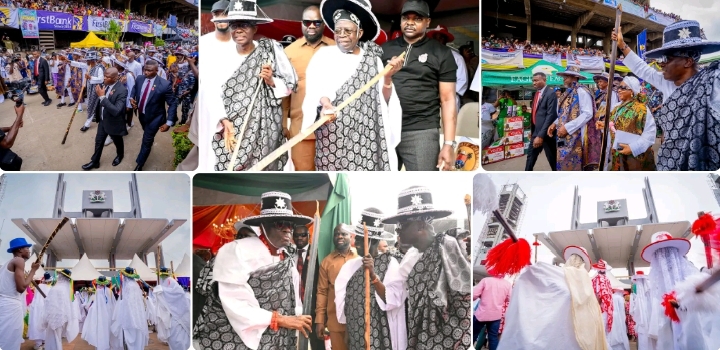
Lagos Island was alive with anticipation as December 27 approached. The city’s streets carried a quiet energy that hinted at something more than the ordinary weekend. Residents, visitors, and onlookers sensed that the day would be different, a gathering of tradition, memory, and cultural display. But who would be there, and what exactly would unfold?
Even before the festival began, key figures and dignitaries were reported to be in attendance, adding layers of significance to the event. Who would appear, and in what capacity? The presence of leaders, families of notable Lagosians, and traditional authorities hinted at a ceremony that was both celebratory and ceremonial, blending public spectacle with recognition of legacy.
From distant corners of the city, the first signs of preparation could be seen. White fabric shimmered subtly against the early sunlight, and the hum of organization suggested that Lagos’s iconic festival was returning in full splendour. What would the procession look like, and how would the city respond to its revival?
As crowds began to gather, the anticipation deepened. The festival promised to reveal not only cultural spectacle but also the figures whose presence would define its significance. Every arrival, every ceremonial gesture, and every quiet observation was part of a larger story, one that connected Lagos’s citizens to its history and to each other. The full picture was still emerging, but the day carried the unmistakable weight of tradition reaffirmed and celebrated.
The Return of the Eyo: Lagos Breathes Its Heritage Again
The air over Lagos Island carried a weight that was unseen yet undeniable. It was not just another Saturday. The streets, usually humming with commerce and chatter, were cloaked in anticipation. A city that never truly sleeps had paused. Every corner whispered the same question: who would appear, what would unfold, and how would the past reach into the present in the spectacle known simply as Eyo. White and black were no longer mere colours; they were a statement of identity, unity, and history distilled into the ceremonial robes of the masquerades. The rhythm of drums and the subtle sway of onlookers created a tension that felt almost sacred as the city prepared to witness one of its most iconic traditions after eight long years of absence.
Tafawa Balewa Square had become a theatre for memory and aspiration. The square stretched beyond mere concrete and asphalt; it was a canvas awaiting the brush of tradition. As the first glimpses of the white-clad figures appeared, a collective breath rose from the crowd. This festival was never just about spectacle. It was a narrative stitched into the very bones of Lagos, an unfolding story where each masquerade, each dignitary, each observer was both actor and witness. The city seemed to hold its pulse as if the very essence of Lagos waited to exhale in rhythm with the steps of the Eyo.
The 2025 edition carried with it a purpose heavier than the ceremonial staffs the masquerades carried. It was to honour four figures whose legacies shaped Lagos into the metropolis it had become. Brigadier-General Mobolaji Olufunsho Johnson, the first Military Governor, had built the foundations on which Lagos grew into its modernity. Alhaji Lateef Jakande, the first civilian Governor, had cast the ideals of governance into tangible projects. Sir Michael Otedola, a businessman and former Governor, had bridged commerce with civic responsibility. And Alhaja Abibatu Mogaji, mother of President Bola Tinubu, had guided Lagos markets and communities with a matriarchal hand that blended influence with care. These four names were the silent drumbeats beneath the festival’s overt display.
Even before the procession began, the city felt different. Lagosians arrived in waves, some in quiet observation, others in exuberant anticipation. Families of the honourees, dignitaries from far and near, political leaders and traditional authorities, each carried a presence that was both symbolic and literal. The festival had become more than ritual. It was a convergence where history, identity, and spectacle collided in the vivid white and black robes of the Eyo. Every step taken, every chant sung, every glance exchanged carried layers of meaning beyond the obvious.
Honouring Legacy: The Dignitaries Who Shaped Lagos
At the heart of the festival was the presence of those who held power and memory in equal measure. President Bola Ahmed Tinubu appeared not merely as a figurehead but as a participant in a dialogue between past and present. His participation in the grand finale was as much about ceremonial importance as it was about reinforcing Lagos’s image on the national and international stage. It was a reminder that heritage and governance were intertwined and that the preservation of culture carried weight equal to the exercise of power.
Governor Babajide Sanwo-Olu, the chief host, moved through the crowd with a careful balance of ceremony and engagement. He was more than a figure behind the podium; he was a custodian of Lagos’s cultural pulse, ensuring that each movement of the procession, each ceremonial homage, echoed the city’s identity. The festival allowed him to frame Lagos not only as a commercial hub but also as a city where history and culture converged with everyday life. It was a message of continuity, of pride, and of economic and cultural resilience.
Deputy Governor Obafemi Hamzat’s presence, alongside Speaker Mudashiru Obasa, underscored the unity of Lagos State leadership. Their attendance was a public testament to the significance of Eyo not as a mere festival but as a reaffirmation of governance intertwined with cultural preservation. Political presence was not ceremonial alone; it was a statement that Lagosian heritage demanded recognition at the highest levels and that the city’s narrative was inseparable from the people entrusted to steward it.
Other political figures such as Hope Uzodinma, the Governor of Imo State, extended the festival’s significance beyond Lagos. Their participation illustrated the reach and recognition of the festival as a national cultural event. This was a gathering where politics, tradition, and community were interlaced seamlessly, and where attendance was both a privilege and an obligation to history. Each dignitary’s presence contributed a layer of legitimacy, a marker that Lagosian tradition commanded respect and acknowledgment across Nigeria.
The Ceremonial Heart – Oba Rilwan Akiolu and Traditional Authority
Central to the festival’s revival was Oba Rilwan Akiolu, the Oba of Lagos, whose ceremonial role anchored the event. The Oba’s presence was not merely symbolic; it was a reminder that cultural rituals were stewarded by living history, that the guardians of tradition were not relics but active participants in the city’s ongoing narrative. His movements through the procession were precise, deliberate, as if each gesture communicated a dialogue with the past and an affirmation of Lagos’s enduring identity.
Traditional authorities, including royal chiefs and custodians like Chief Adebola Dosunmu, played critical roles in the procession and homage ceremonies. Their presence bridged centuries of Lagosian heritage, threading lineage and ceremonial precision into the modern spectacle. The festival’s rituals, from the “Ijade Opa Eyo” to the orchestrated processions, were layered with historical resonance, and the careful orchestration by these figures ensured that the display was authentic and deeply rooted in the city’s cultural memory.
The white and black attire of the Eyo masquerades symbolized unity, peace, and communal identity, but it also served as a metaphorical bridge between tradition and contemporary Lagos. The Oba’s guidance ensured that this symbolism was observed, that each step and movement of the masquerades resonated with historical integrity, and that spectators were participants in an enactment of identity, rather than mere observers of spectacle. The festival became a canvas upon which Lagos’s past, present, and aspirations for the future were painted with disciplined precision.
Families and representatives of the honourees were integrated into these ceremonial acts, performing homage and ensuring that memory was observed both publicly and intimately. Their presence reinforced the narrative that Eyo was not only a civic performance but also a deeply human ritual of remembrance, respect, and legacy. The festival achieved a rare alignment between governance, culture, and familial heritage, positioning Lagos as a city where public spectacle and private memory coexisted harmoniously.
The Masquerade Procession: Movement, Colour, and Symbolism
The first glimpse of the Eyo masquerades moving across Tafawa Balewa Square drew gasps that rippled through the crowd. It was more than a parade; it was the heartbeat of Lagos made visible. Each figure, cloaked entirely in white with the iconic black hats towering above, moved with purpose and precision. The masquerades were living metaphors, bridging centuries of history with the immediacy of the present, their flowing robes like waves of memory cascading through the city. Their staffs struck the ground with measured cadence, echoing the rhythm of a past that demanded acknowledgement.
The procession was meticulously organized, yet it retained the organic energy of spontaneous celebration. Spectators lined the streets, craning their necks to capture every movement, every flourish of the masquerades. The white garments contrasted sharply against the deep hues of the crowd, a visual declaration of purity, unity, and cultural continuity. In every step, the masquerades enacted Lagosian values, embodying community cohesion, respect for authority, and the reverence for those who had shaped the city’s history.
Their movements told stories older than any written record, stories that could only be understood in motion, in presence, in shared experience.
Behind the spectacle were intricate layers of meaning. The Eyo festival’s white robes and black accessories symbolized duality—life and death, the past and the present, humility and authority. The towering hats signified status and connection to the spiritual, reminding onlookers that Lagosian tradition blends the corporeal with the metaphysical. Observers were drawn into the narrative without even knowing the full script, their eyes tracing patterns that had been honed over decades, patterns that demanded attention, reflection, and participation.
Every twirl of the staff, every measured step, spoke to Lagos’s collective memory. Families of the honourees and dignitaries watched intently, aware that this was more than a performance. The procession was a bridge to history, a living homage to leaders like Brigadier-General Johnson and Abibatu Mogaji, whose contributions had shaped the modern Lagosian landscape.
As the masquerades weaved through the square, the crowd experienced the festival as both spectacle and education, absorbing cultural norms, ancestral respect, and civic pride simultaneously. By the time the last Eyo passed, it was clear that the city had not merely observed its past; it had lived it in full vibrancy.
Symbolism of the Robes: White, Black, and Lagos Identity
The white robes of the Eyo masquerades are never just fabric; they are a canvas upon which Lagos projects its history, unity, and aspirations. In the sunlit streets of Tafawa Balewa Square, the robes shimmered with an almost spiritual brightness, drawing the eyes of spectators and reinforcing the visual hierarchy of tradition. White, in the Eyo lexicon, represents purity, peace, and the communal spirit that binds Lagosians together. Each figure, covered head to toe, became a walking emblem of these ideals, a moving testament that identity is both inherited and performed.
Black accessories, particularly the distinctive hats, punctuated the visual narrative. They symbolized authority, reverence, and a connection to the spiritual world. The contrasting tones of black and white created a visual tension that mirrored Lagos itself: a city of contrasts, balancing history with modernity, authority with the people, tradition with innovation. The interplay of these colours during the procession acted as a silent storyteller, reminding observers that cultural pride is both visible and embodied.
The robes also served a practical and communal function. In their uniformity, they erased social distinctions among the masquerades, creating a collective identity that emphasised unity over individuality. Yet within this uniformity, subtle variations—differences in staff designs, movements, and timing—allowed each participant to honour personal skill and ritual significance. In this way, the robes reflected Lagos’s layered society: diversity within cohesion, individuality within community, and ritual within civic life.
Spectators, both residents and tourists, absorbed these layers instinctively. Many could not articulate the symbolic meanings in full, yet the visual resonance was undeniable. Children pointed at the bright robes, elders nodded knowingly, and photographers captured patterns that would circulate far beyond the city. The festival, through its costumes, communicated a language older than words, a language of belonging, pride, and Lagosian identity that resonated in every footstep and every wave of flowing fabric. The white and black robes were more than attire; they were a statement of self and city, culture and continuity.
Tributes to Lagos Icons: Honouring Leaders and Legacy
The festival’s heart rested in its tribute to four towering figures whose legacies informed Lagos’s governance and identity. Brigadier-General Mobolaji Olufunsho Johnson, the first Military Governor, was remembered for laying structural and administrative foundations that continued to influence Lagos’s growth. His memory was evoked not only through ceremonial mentions but through processional symbolism, where the strict order and discipline of the masquerades reflected his governance style, blending authority with public service.
Alhaji Lateef Jakande’s era of the first civilian administration was equally celebrated. His record of infrastructural development, from schools to housing estates, was subtly referenced in the procession’s deliberate pacing and spatial organization. The festival transformed history into choreography, each movement an allegory for projects that shaped the city physically and socially. Spectators were reminded not through lectures but through visual storytelling that connected governance with lived experience.
Sir Michael Otedola’s contributions bridged commerce and civic responsibility. As a businessman and former governor, his legacy was evoked in the festival’s capacity to bring diverse stakeholders together—politicians, traditional authorities, families, and citizens. The festival itself mirrored his ethos, combining spectacle, community, and practical engagement. Every detail, from the positioning of Eyo groups to the participation of dignitaries, reflected a blending of influence and cultural stewardship that Otedola exemplified.
Alhaja Abibatu Mogaji’s presence was felt in subtler, yet profoundly powerful ways. As Iyaloja-General of Nigeria and mother of the president, her guidance over market networks and local communities was symbolized in the festival’s attention to organization and public participation. Families and representatives of the honourees partook in homage ceremonies, ensuring that memory was anchored in both ritual and relational presence.
This integration of familial, civic, and ceremonial tribute reinforced the festival’s overarching narrative: Lagos’s past, present, and future are inseparable, and memory is most potent when enacted collectively.
Economic and Cultural Implications of Eyo Festival 2025
The 2025 Eyo Festival was more than ceremonial display; it was an engine of cultural economy. Vendors lined the streets offering local crafts, foods, and souvenirs, turning the festival into a marketplace of both material and intangible wealth. Hotels reported full bookings, and tour operators highlighted the festival as a key driver of Lagos’s tourism calendar. Beyond mere revenue, the festival positioned Lagos as a hub where tradition intersects with opportunity, showcasing how cultural heritage can translate into tangible economic benefits.
Cultural capital, however, was the more enduring currency. The festival reinforced Lagos’s identity on national and international stages, drawing dignitaries, politicians, and tourists alike. By emphasising heritage, the city strengthened its claim as a leader in cultural preservation and civic pride. The visibility of the event, amplified through media coverage and social platforms, projected an image of Lagos that balanced modernity with authenticity, appealing to investors, policymakers, and cultural enthusiasts simultaneously.
The festival also encouraged local engagement and entrepreneurship. Artisans and designers involved in creating masquerade costumes, stalls, and decorative displays benefited directly from the event, while young Lagosians were inspired to value cultural heritage as both vocation and identity. The economic ripple extended to transport operators, caterers, and performers, demonstrating the interconnectedness of culture and livelihood. Eyo Festival 2025 became a case study in how intangible heritage sustains tangible economies.
Moreover, the event’s planning and execution reinforced governance strategies that align culture with civic development. Lagos State’s investment in infrastructure, crowd management, and festival coordination highlighted a model where heritage supports both social cohesion and economic activity. The festival offered lessons for policymakers: cultural events can strengthen communal identity, attract revenue, and enhance the city’s global reputation when executed with precision and respect for tradition. Eyo Festival 2025 was not only a spectacle; it was a demonstration of Lagos’s capacity to leverage history for contemporary relevance and growth.
Closing Reflection: Lagos and Its Living Tradition
As the 2025 Eyo Festival came to a close, Lagos returned to its usual rhythm while carrying the quiet echo of celebration. The event reminded the city that cultural heritage is not static; it lives in the streets, in the people, and in the gestures that link past and present. The festival left a subtle impression that tradition and community remain central to the city’s identity.
Beyond the pageantry, it highlighted the value of participation and observation. Each spectator, whether a resident or visitor, became part of the city’s story, witnessing a ritual that continues to shape Lagosian pride and collective memory. The presence of leaders, families, and citizens reinforced the idea that culture is a shared responsibility as much as it is a celebration.
Eyo Festival 2025 also showed that Lagos can honour its past while moving forward. The careful balance of ceremony and public engagement suggested that the city’s heritage is resilient, adaptable, and enduring. Its significance is measured not only in spectacle but in how it inspires reflection and connection among those who experience it.
When the square emptied and the crowd dispersed, the city retained the sense that history and identity are continuous. The festival was a moment of alignment between Lagos’s past, present, and future, leaving a quiet, lasting imprint on the consciousness of the city and its people.