Ogun State, Nigeria.
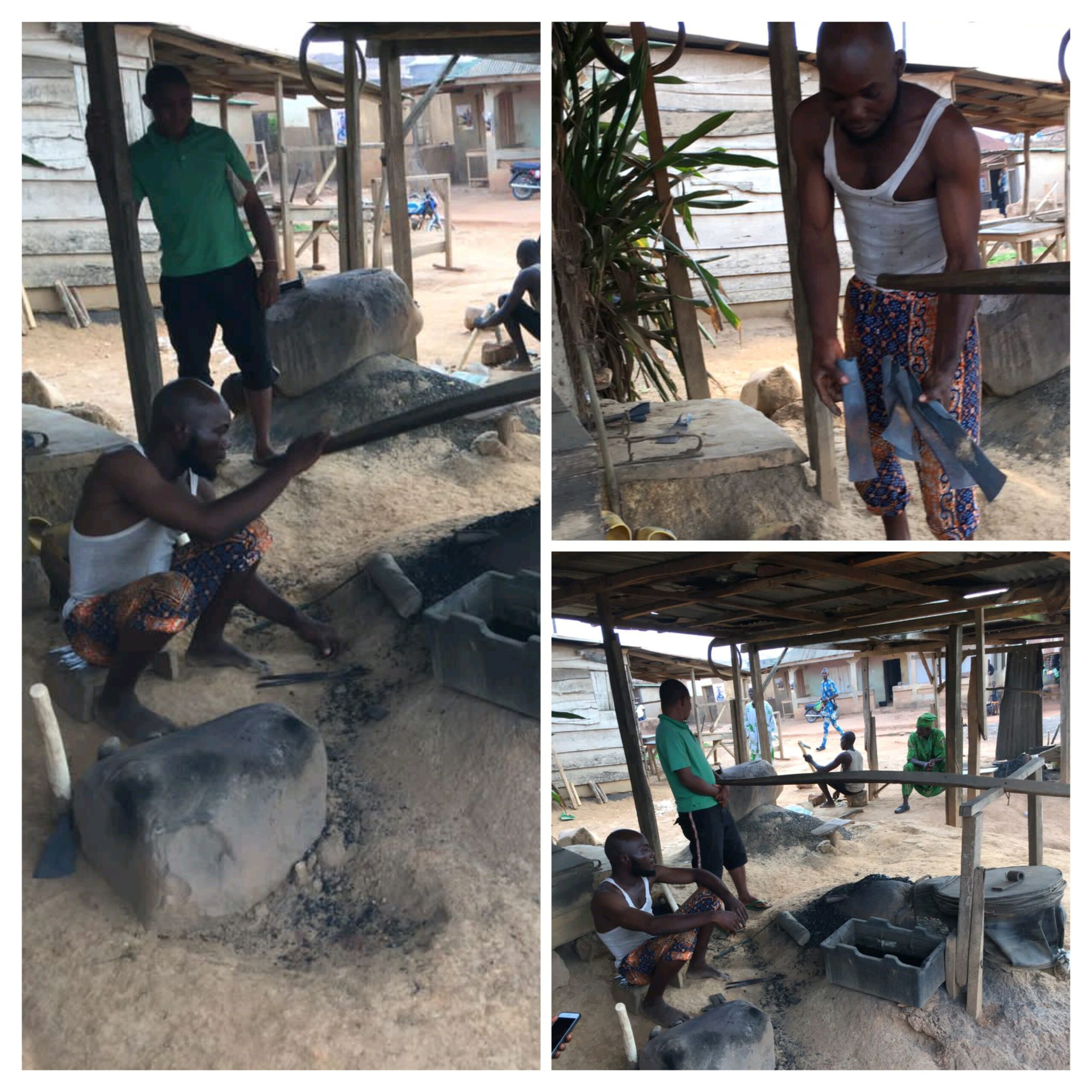
Salisu Toheeb, 45, was sitting on a wooden bench in his blacksmithing shop at Ijebu-Igbo, having toiled through the whole day, he decided to take a break from the day’s job after crafting some farming tools to meet his client’s demands. Businesses may not be as usual but he strives to make enough profits to feed his family and live a contented life.
He could not hide his displeasure towards the setbacks thwarting the blacksmith business as the toll of people withdrawing from the occupation kept rising daily. “You know that the Blacksmithing occupation was once done by most people beforehand but nowadays, people are not getting involved again. When I was young, I knew how this place was. Only two people exist here now. If this job is one that people get their children involved in or people learn, we will see that our current youth will be doing the job,” Salisu told this reporter.

PC: Caleb Ijioma/WITHIN NIGERIA
As far as this Ogun-based Blacksmith is concerned, without the blacksmithing occupation, there will be no tools farmers can use for their farm production. Apart from the indifference towards the job, most youths nowadays have dived into learning other occupations like aluminum production instead of the so-called ‘dirty blacksmithing business’. Salisu maintained that the blacksmith work is powerful and stressful, reasons why people avoid learning it and the money gained from the business, is far below the services it provides.
This craft has not received focus from the government and it’s gradually going into extinction. Blacksmithing as a local craft has been abandoned, with no support and funding.
Nevertheless, people like Salisu, born a blacksmith, were motivated into the iron dissecting business because of its benefits to society. He further narrated the hazards of the job while beckoning the government to contribute to the growth of this age-long vocation before it finally goes into extinction.
One of the hazards in the business is the high tendency of getting an injury, Salisu told this reporter. He said that “We don’t allow anyone to play with the tools. If it cuts someone, it takes time to heal. At times we work to the point that if this thing blows the fire and it becomes wide, the iron may cut us whenever we are working. It can meet us anywhere and injure us. Every time, we keep praying to God.”
Meanwhile, he called on the Government to promote the blacksmithing business because of its contribution to the economic and agricultural growth of the society. He echoed that farmers are dependent on the blacksmiths for the materials they need such as a hoe, cutlass, and shunku among others, to produce foods or crops for people to sell or consume and some other benefits these iron materials provide people.
“There are engines for this business if the government asks how they can develop this occupation. This place is also a factory. It is just a local one. Had it been our government decided to make a great input in the job to develop it. At least, we do watch American movies. They use metal like this, but they have their way of carving it, but because our government did not assist us. We pray that God will make them remember us. This is not only happening here. It is just the same at other places like Ijebu-Ode, Ibadan, and Lagos. If you visit Owode-Onirin in Lagos, you’ll see it there,” Salisu noted.
Roles of Blacksmithing as a Local Craft
Blacksmithing— a trans-generational occupation in Nigeria and Africa at large, has served numerous purposes, ranging from provisions of skills and ideas on how humans can explore their environment. Caught between the anvil and the hammer, tools such as hoes, cutlasses, diggers, guns, metal doors or gates and among others, are used for the benefit of human society.
Trained by his father, Adeniyi Akinola started this job when he was just a young boy. After school hours, he would trace his steps to his father’s workshop, where he’d spend the rest of the day learning the art of dissecting metals. According to him, he has been in this job since 1993, and there is no town where a Blacksmith resides which does not develop.
According to him, the neglect in the profession can be traced to many reasons, one of which is world evolution, how technology is evolving, driving to extinction the preceding tools and techniques. He added that youth avoid learning the blacksmithing occupation as a result of the challenges in the course of doing the job.
He narrated the challenges in the business, stating that, “If iron is put inside a fire to smoothen or sharpen it, while we are beating it, it can split. At times, it splits into the eyes. That’s small. Irrespective of the hours you used to work, either 6 or 24 hours, your body will be heated with fire. There will be heating whether you build the workshop with a pan or ceiling. No way it won’t hurt the person except for one who doesn’t do a powerful job like someone that turns iron into cutlass, hoe, jigger, gomugomu, trap, arike, and so on.
“If anyone sees how they manufacture it, they will see how the tool used in hitting them is very powerful. They will say it’s a powerful job without knowing that it is a job that requires brain and experience. It is how you lay your thing that you will follow suit. As the Blacksmith is working, he must take care of himself. But I believe no job doesn’t have its challenges. Even a teacher faces challenges,” he remarked.
Salisu and Adeniyi are both looking up to the government to breathe life into the dying blacksmith vocation irrespective of the technological advancements but invest and promote the business with proper awareness among youth to sustain occupation for the upcoming generation.
Blacksmiths Are Backed By The gods
Unveiling how creativity meets mystery, this reporter spotted a shrine close to the blacksmith shops, which triggered the question of what does a blacksmith put in the shrine to worship? Is it ESU (Devil) or OGUN (the god of iron)?
Mr. Adeniyi reacted that a blacksmith does not worship the devil but the god of iron (OGUN). “If Ogun Jasi is here, the devil will be over there. If it is Ogun Laaro that they are worshipping and someone is asked to worship the devil; if they initiate kola nut and capture the devil, the devil in the village is what they will worship. They work in line with each other.”
He further explained the importance of the Devil to the blacksmiths saying that it serves as a source of protection. For him, blacksmiths are doing the job of the god of iron, and iron is also their tool.
This iron forger differentiated the categories of blacksmiths and the roles they perform in society, stating their relationship with the god of iron. He reiterated that they (blacksmiths) follow the paths that the god of iron has revealed, which exposes them to so many gains in the occupation.
“There are different Blacksmiths. Ajirorin (one who builds iron) is different from Ajilurin (one who hits iron). Ajilurin is a child of the god of iron. (The interviewee prays to Ogun). There is no way, at times, Ajilurin can go outside by 4:00 am or 5:00 am at midnight, considering the way his neighbours accommodate him to work. The more he hits the iron, the more he takes away evil from the vicinity. A smoke will first emanate. It sends away bad trees from the vicinity.
“There is no god worshiper that doesn’t recognize and give honour to the god of iron. It is the way that the god of iron reveals that is what we are currently following. They will kill five different items, which include; a pig, dog, (awoko), snai. It is not a small charm. The most popular herbalist in the village also worships it. One can’t be doing this our job and act anyhow or steal,” Adeniyi revealed.
Blacksmiths Should Be Empowered
As Blacksmithing faces extinction, Olabode Kehinde Ejiogbe, a Cultural Custodian, has called on the government to empower blacksmiths and other local crafts in the country.
According to him, blacksmith was important in the community in the olden days as it was used to produce farming equipments, and different weapons to protect the community (Dane guns, bow and arrow), but now blacksmiths workshops have become very few in some villages and towns due “the refusal of children to follow their forefathers steps again because of civilization.”
He berated the government for introducing farming machines to local farmers, which are expensive and sometimes inaccessible because of lack of finance, instead of empowering the blacksmithing craft capable of manufacturing materials that would be cheaper.
“ Nowadays, instead of giving empowerment to this craft industry for more processing of farming tools to be cheaper for farmers to produce more food for the nation, they just introduced agriculture machines to local farmers which they can never get money to afford or even get a loan from the government to hire them,” he said.
He posited that for the blacksmith craft to come alive, the government must take intentional actions to promote and support the craft.
“The government can introduce the promotion of art and craft and some empowerment for Artists and craftsmen like blacksmiths, wood and stone carvers, tinsmiths, potters, etc, by giving them some loan to produce what they learned in the workshop through the little remaining survived Craftsmen’s, the craft will become existing again, will be appreciated worldwide” Ejiogbe noted.