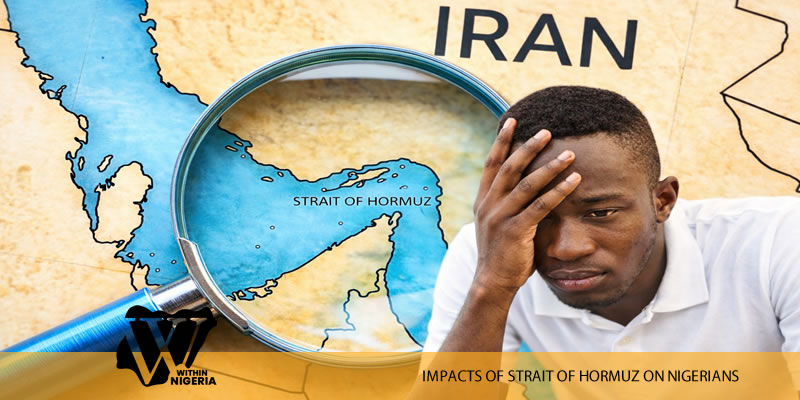
The escalating situation in the Strait of Hormuz continues to pose substantial concerns to global energy security and economic stability. Over the last few weeks, both the United States and Iran have demonstrated significant strength in seizing control of the canal, which is a critical conduit for world oil supplies, but Iran has demonstrated a stronger edge over the Strait of Hormuz.
WITHIN NIGERIA learned that three supertankers had departed the strait of Hormuz under a US-Iran ceasefire seen as tenuous by many observers, but tensions remained high, with Iran threatening a “severe” response if the US blocked its ports.
Recall that the US announced a blockade on Iranian ports beginning April 13, 2026, which may prevent approximately 2 million barrels of Iranian oil from entering the world market everyday.
According to sources, this action drove oil prices surging, with Brent crude rising more than 8% to $103 per barrel, jeopardizing global energy security and the economic stability of countries, particularly Asia’s energy-intensive economy.
As security worries mount, despite alternative methods being offered, several critical commodities, including crude oil, have been badly impacted, making life more difficult for everyone, particularly the ‘ordinary’ people.
Here is a list of essential commodities that we strongly feel the Straits of Hormuz situation has impacted.
Crude Oil
The Strait of Hormuz is a critical chokepoint for global oil supply, with around 20% of the world’s oil passing through it. The Strait of Hormuz crisis is causing a significant surge in crude oil prices, with Brent crude topping $103 a barrel and West Texas Intermediate rising to $104.65 per barrel. The US blockade of Iranian ports is restricting Iranian oil exports, causing concerns about potential supply disruptions.
Petrol (Refined Fuel)
According to reports, refined petroleum products such as gasoline are also delivered via the route in large quantities. If not resolved, the current interruptions may have a direct impact on global petroleum availability and pump costs. The Strait of Hormuz issue is generating a substantial increase in petrol prices, potentially reaching ₦1,800 per litre in Nigeria.
In Nigeria, the impact is significant, with petrol prices rising by 39.5% between February 23 and mid-March 2026. Despite its local refining capability, Nigeria remains vulnerable to global oil market instability, according to the Lagos Chamber of Commerce and Industry.
Fertilizers (Urea and Ammonia)
The region around the Strait of Hormuz is critical to worldwide production and exports. The crisis has a substantial impact on fertilizers, particularly urea and ammonia.
WITHIN NIGERIA, it was discovered that the crisis in the Strait of Hormuz has resulted in a spike in urea prices, supply problems, an increase in ammonia prices, and production halts.
The Strait of Hormuz accounts for roughly one-third of worldwide fertilizer traffic, with major producers such as Qatar, Saudi Arabia, and Iran impacted, while fertilizer facilities in India, Bangladesh, and Pakistan have shut down or decreased production owing to energy supply interruptions.
Sulfur
According to reports, approximately half of the global seaborne sulfur traffic goes via the Strait of Hormuz.
The crisis in the Strait of Hormuz has a substantial influence on sulfur, a crucial energy ingredient and byproduct of oil and gas refining, creating supply disruptions and price increases.
Sulfur is a vital feedstock for sulfuric acid, which is used in a variety of sectors such as fertilizers, polymers, and medicines, according to sources in Nigeria.
Methanol
Reports revealed that a third of global seaborne methanol trade passes through the strait of Hormuz, significantly impacting methanol, a key chemical feedstock for resins, coatings, and plastics.
WITHIN NIGERIA learned that ongoing disruption at the strait of Hormuz has tightened supply and raised costs for producers of plastics, paints, and synthetic fibers.
According to Mitsubishi Gas Chemical of Japan, methanol deliveries from Ar Razi Saudi Methanol Company, one of the world’s largest methanol producers, have been temporarily suspended.
Graphite Feedstocks
The crisis rocking the strait of Hormuz has disrupted the supply of petroleum coke, a byproduct of oil refining, which is the primary feedstock for synthetic graphite production.
Graphite Feedstocks, a key commodity, particularly in the production of synthetic graphite used in electric vehicle (EV) battery anodes.
WITHIN NIGERIA learned that the Middle East is a significant supplier of graphite feedstocks, and the crisis is exposing vulnerabilities in global supply chains.
Aluminium
Reports disclosed that the region where the Strait of Hormuz is located accounts for at least 9% of global aluminum production.
WITHIN NIGERIA learned that the crisis rocking the Strait of Hormuz has significantly impacted aluminum prices, pushing them above $4000 per tonne and disruptions to shipping routes have caused issues in the supply chain.
Helium
Qatar is a major producer of helium, a critical commodity and accounts for nearly one-third of global helium supply.
WITHIN NIGERIA learned that three plants where helium is produced in Qatar have shut down due to damage which has affected global supply chains.
The crisis rocking the strait of Hormuz has affected helium shipments, leading to concerns over price volatility, allocation, and among others.
Glycol (MEG)
Monoethylene Glycol (MEG), a key commodity used in producing polyester fibers, packaging, and textiles.
Reports disclosed that the Middle East accounts for around 6.5 million tonnes of MEG shipments annually.
WITHIN NIGERIA learned that the crisis rocking the Strait of Hormuz has significantly impacted the Glycol (MEG), primarily causing prices volatility, allocation, among others.
Iron Ore and Steel Pellets
The Middle East is a major supplier of high-grade iron ore pellets and direct-reduced iron, both of which are essential for steel production.
According to reports, Iran and Bahrain, which account for 18% of worldwide seaborne pellet exports, are currently in trouble, potentially leading to a tightening of supply and higher pricing.
WITHIN NIGERIA learned that vessel availability to convey fresh procurement appears to be limited as shipowners avoid the strait as a result of the turmoil.
Iron ore prices are rising due to increased transportation costs caused by a change in shipping routes.