Football formations shape how teams play, defend, and attack. Understanding them transforms watching matches from confusing chaos into readable tactical chess. The numbers, 4-4-2, 4-3-3, 3-5-2, describe how players arrange themselves from defense to attack, creating structures that determine spacing, pressing patterns, and attacking options. But formations aren’t rigid blueprints. They’re flexible frameworks that shift constantly based on possession, game state, and opponent tactics.
The best football formations balance defensive solidity with attacking threat while suiting available players. Manchester City’s narrow 4-2-3-1 under Pep Guardiola dominates through central overloads and technical superiority. Liverpool’s fluid 4-3-3 under Arne Slot combines high pressing with explosive transitions. Atlético Madrid’s compact 4-4-2 under Diego Simeone strangles opponents before launching devastating counter-attacks. None of these systems is inherently superior, their effectiveness depends on execution, personnel, and context.
This guide explains the most common formations through how elite teams currently deploy them in 2025/26, providing practical understanding for beginners without drowning in tactical jargon. By understanding formations, you’ll appreciate why managers make substitutions, how teams exploit space, and what tactical adjustments mean when commentators mention them mid-match.
The Best Football Formations
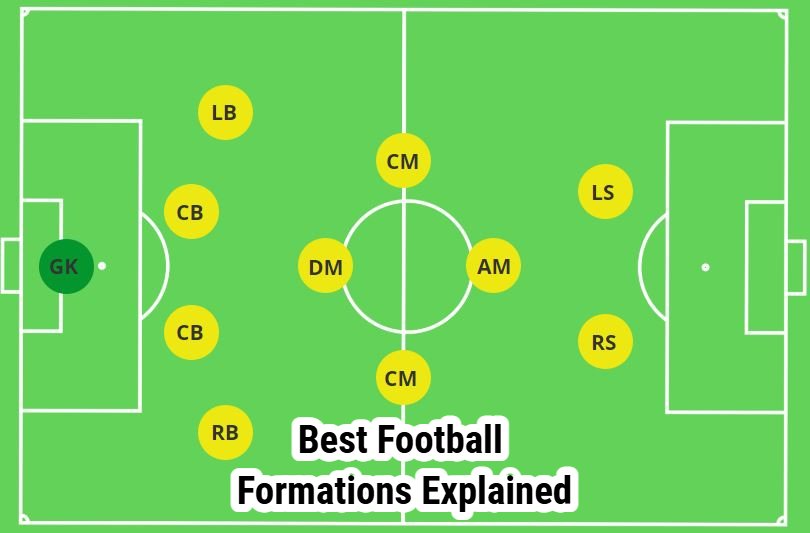
Formation numbers always start from the defensive line and work forward, excluding the goalkeeper. A 4-3-3 means four defenders, three midfielders, three forwards. A 3-5-2 deploys three center-backs, five midfielders (typically including wing-backs), and two strikers. The numbering provides a snapshot of team shape, though reality proves more complex.
Formations matter because they determine spatial relationships between players. Good formations create triangles and passing angles that allow smooth ball progression. They establish defensive coverage across the pitch, preventing opponents from exploiting gaps. They dictate pressing schemes, where players apply pressure and how teammates provide support. Formation choice reflects tactical philosophy: possession-based teams favor structures that facilitate passing combinations, while counter-attacking sides prioritize defensive compactness and transition speed.
The critical misconception beginners hold is that formations remain static throughout matches. In reality, most teams use different shapes when attacking versus defending. Liverpool’s 4-3-3 becomes a 4-2-4 in possession as midfielders push forward, then transforms into a compact 4-5-1 defensive block when opponents counter-attack. Manchester City’s 4-3-3 on the team sheet often looks like a 3-2-5 in build-up as fullbacks invert into midfield. Understanding this fluidity matters more than memorizing rigid formations.
Player roles within formations vary enormously. Two teams playing 4-2-3-1 might look completely different if one uses the double pivot defensively while the other pushes both midfielders forward. The attacking midfielder might drop deep to create, stay high to press, or drift wide to overload flanks. Formations provide structure, but roles, instructions, and player qualities determine how they actually function.
The relationship between formation and playing style isn’t straightforward. You can play possession football, direct football, or counter-attacking football within the same formation depending on player instructions and mentality. The 4-3-3 works for both Barcelona’s intricate passing and Liverpool’s vertical transitions. Formation choice should follow playing style preferences, not dictate them.
4-4-2: The Classic Foundation
The 4-4-2 dominated football for decades as the default formation because it offers intuitive simplicity. Four defenders provide stable coverage, four midfielders control central areas and flanks, two strikers create attacking presence. Everyone has clear responsibilities, defend your zone, support teammates, transition between phases. This straightforward structure made the 4-4-2 ideal for teams at all levels.
Structurally, the back four consists of two center-backs and two fullbacks. The midfield four traditionally features two central players and two wingers, though modern variations often use a diamond shape with one defensive midfielder, two central midfielders, and an attacking midfielder. The front two can play level or with one striker dropping deeper to link play. These variations allow significant tactical flexibility within the basic framework.
The formation’s strengths include excellent defensive balance. Two banks of four players create compact defensive blocks difficult to penetrate through the middle. When defending, the team naturally compresses space, forcing opponents wide or into long-range shooting. Transitions happen quickly, when winning possession, two strikers are immediately available for forward passes. Player roles remain clear even for less technically gifted players, reducing confusion and organizational breakdowns.
Weaknesses emerge against three-man midfields. Two central midfielders face three opponents in the middle, creating numerical disadvantages that allow possession-dominant teams to circulate the ball comfortably. The wide midfielders must cover enormous ground, defending their flank while supporting attacks, often leaving gaps. Against teams playing with inverted fullbacks or attacking fullbacks, the winger’s defensive duties can overwhelm them.
Diego Simeone’s Atlético Madrid exemplifies modern 4-4-2 excellence. Their structure emphasizes defensive compactness and discipline, with midfielders working in tight banks to deny space. When they win possession, direct forward passes to strikers create immediate counter-attacking threats. The system suits players who excel in defined roles rather than requiring technical wizardry, making it sustainable even without superstar talent.
Manchester United under Sir Alex Ferguson used 4-4-2 for decades, though with significant variations. Wide players like Ryan Giggs and Cristiano Ronaldo provided width and creativity while central midfielders controlled tempo. The striker partnerships, Yorke and Cole, Rooney and Ronaldo, combined different qualities to create multifaceted attacking threats. Ferguson’s success demonstrated that simple formations executed brilliantly beat complex systems executed poorly.
Beginners should consider 4-4-2 when their players understand traditional positions and roles clearly. It works well for defensive organization and transition speed, particularly against technically superior opponents. The formation suits teams with two effective strikers and wide players comfortable tracking back. However, against possession-heavy teams with extra midfielders, expect to spend long periods defending unless you can disrupt their rhythm through aggressive pressing.
4-3-3: The Modern Standard
The 4-3-3 became football’s dominant formation because it balances defensive stability with attacking flexibility. Four defenders provide familiar structure while three midfielders offer numerical advantage in the engine room. Three forwards create width and goal-scoring threat from multiple positions. Elite teams across Europe have adopted variations of this system, making it the template for contemporary football.
The back four operates identically to 4-4-2, though fullbacks often push higher to create width since wingers play more centrally. Midfield structure varies significantly between implementations. Some teams use one defensive midfielder with two box-to-box players, creating defensive security while allowing midfield penetration. Others deploy a double pivot with one advanced midfielder, offering greater defensive solidity but potentially less creativity. Liverpool under Arne Slot uses this latter approach, with Ryan Gravenberch and Alexis Mac Allister sitting deeper behind Dominik Szoboszlai.
The front three’s interpretation determines how teams attack. Traditional 4-3-3 featured wingers staying wide to stretch defenses and deliver crosses for a central striker. Modern variations favor inverted wingers, left-footed players on the right wing, right-footed on the left, who cut inside onto their strong foot to shoot or combine centrally. Liverpool’s Mohamed Salah exemplifies this, operating from the right but constantly drifting inside to create goal-scoring positions.
Width in modern 4-3-3 comes primarily from fullbacks overlapping forward. This creates overloads, two attackers against one defender, on the flanks. When wingers invert, fullbacks provide the touchline width teams need to stretch opponents and create space centrally. The system demands athleticism and tactical intelligence from fullbacks, who must judge when to push forward and when defensive duties require staying deep.
Strengths of 4-3-3 include midfield control through numerical superiority. Three midfielders face two in most opposing 4-4-2 or 4-2-3-1 setups, allowing easier ball circulation and progression. The formation creates excellent pressing structures, three forwards can press the opposition backline while three midfielders seal off escape routes. Attacking threat comes from multiple directions: wide players cutting inside, fullbacks overlapping, and midfielders arriving late into the box.
Defensive vulnerabilities arise when fullbacks push high. If possession is lost, wide areas become exposed with midfielders often too central to cover effectively. Opponents can exploit this through quick switches of play or direct balls into channels. The single defensive midfielder (in a 1-2 setup) bears enormous responsibility for screening the defense; if they’re beaten, center-backs face direct pressure with little protection.
Liverpool’s 4-3-3 under Slot emphasizes vertical transitions and aggressive pressing. The midfield three provides both defensive security and progressive passing. Salah and Luis Díaz (when available) attack from wide positions but constantly cut inside, with fullbacks providing width. The system creates relentless attacking pressure while maintaining defensive organization through Gravenberch’s positional discipline.
Manchester City’s version differs significantly despite similar shape. Their 4-3-3 often becomes a 3-2-5 in possession as one fullback (typically Rico Lewis) inverts into midfield while the other pushes forward. This creates central overloads that suffocate opponents and facilitate intricate passing combinations. The fluidity demonstrates how the same base formation allows vastly different implementations.
Beginners should embrace 4-3-3 when their players have good technical ability and tactical understanding. The formation requires intelligent movement, comfortable possession skills, and fitness to cover large spaces. It excels against teams that don’t match the midfield numbers but demands discipline to prevent defensive exposure. Start with clear roles, who inverts, who provides width, who screens defensively, before adding complexity.
4-2-3-1: Control and Creativity
The 4-2-3-1 evolved as teams sought defensive stability while maintaining attacking creativity. The double pivot, two defensive midfielders sitting in front of the defense, provides secure protection. Three attacking midfielders behind a lone striker create numerical superiority in the final third. This structure became hugely popular because it addresses both defensive and offensive priorities within one system.
Structurally, the back four functions standardly though fullbacks’ roles vary by implementation. The double pivot represents the formation’s defining characteristic. These two midfielders shield the defense, rarely both advancing simultaneously. Their positioning allows one to press the ball while the other covers, preventing easy penetration through the middle. Manchester City currently uses this structure frequently, with Rodri and one of Bernardo Silva or Mateo Kovačić forming the pivot.
The attacking midfield trio offers tactical flexibility. Wide players can stay wide as traditional wingers, providing crossing options. More commonly, they play as inside forwards cutting onto their strong foot to shoot or combine centrally. The central attacking midfielder (number 10) connects midfield and attacks through through-balls, dribbling, or late runs into the box. This player’s role varies from deep-lying playmaker to advanced goal-scorer depending on team needs.
The lone striker faces isolation as the formation’s main weakness. Without a strike partner, they often struggle to hold up play against multiple defenders or create chances independently. Successful 4-2-3-1 teams use strikers who can operate alone through physical dominance (holding defenders off), exceptional movement (constantly finding space), or technical brilliance (turning defenders or linking play). Erling Haaland at Manchester City exemplifies the first type, using strength and positioning to thrive despite minimal support.
Defensive strength comes from the double pivot’s protection. Two midfielders sitting deep make central penetration extremely difficult. If opponents try playing through the middle, they face four defenders plus two midfielders, a nearly impenetrable barrier. This allows fullbacks to push higher with reduced risk since the pivot covers defensively. The system also transitions smoothly into a 4-5-1 defensive block when protecting leads, with attacking midfielders dropping into midfield lines.
Counter-attacking potential emerges naturally from the structure. When winning possession deep, four attacking players (three attacking midfielders plus striker) are positioned to exploit space opponents left when pushing forward. Quick vertical passes bypass midfield congestion and create dangerous situations before defenses can reorganize. Many teams use 4-2-3-1 specifically for this counter-attacking capability combined with defensive solidity.
The formation’s popularity in modern football reflects its versatility. Brazil’s national team uses 4-2-3-1 frequently, as do many elite club sides when facing opponents they expect to dominate possession. The structure adapts to different game states, compact and defensive when protecting leads, expansive and creative when chasing goals. This adaptability explains why it’s become one of the most used formations in the Premier League during 2025/26.
Beginners should consider 4-2-3-1 when they want defensive security without sacrificing attacking options. The system works well for teams with one exceptional striker and creative midfield players. It requires less tactical complexity than 4-3-3 since roles are more clearly defined. However, success depends on the double pivot’s quality, weak defensive midfielders make the whole structure vulnerable. Start conservatively with defensive responsibilities emphasized before adding attacking freedom.
3-5-2 and 3-4-3: Three at the Back Systems
Three-center-back formations resurged dramatically in modern football after years of obscurity. The fundamental shift from four defenders to three changes how teams cover width, control midfield, and attack. Rather than relying on fullbacks for both defensive width and attacking contribution, three-at-the-back systems use wing-backs, hybrid players who function as defenders, midfielders, and wingers depending on game phase.
The distinction between 3-5-2 and 3-4-3 often depends on interpretation rather than actual positioning. Teams listed as 3-5-2 might have wing-backs pushing so high they’re effectively wingers (creating 3-4-3). Similarly, 3-4-3 setups with defensive wing-backs resemble 5-3-2 when not in possession. The fluidity between these designations reflects how formations change based on game state.
Three center-backs provide coverage across the defensive width that four players normally occupy. This requires specific player types. The central center-back must organize the defense and often play as a libero, stepping into midfield with the ball or sweeping behind the other defenders. The wide center-backs need recovery pace to cover when wing-backs push forward, plus comfort defending in open space away from the protection of fullbacks.
Wing-backs represent the system’s most critical positions. They must defend wide areas when opponents attack, then bomb forward to provide width when their team has possession. This demands exceptional fitness and tactical intelligence, poor positioning leaves the team exposed. Jeremie Frimpong at Liverpool exemplifies the modern wing-back: comfortable defending one-on-one, athletic enough to cover massive distances, and creative when joining attacks.
Midfield setups vary significantly. The 3-5-2 typically uses three central midfielders, creating numerical superiority in the middle of the pitch. This allows domination of possession and control of the game’s tempo. The 3-4-3 uses two central midfielders with wide forwards providing attacking width, trading midfield control for additional goal-scoring threat. The choice depends on whether numerical superiority in midfield or attacking options matters more.
Antonio Conte pioneered the modern three-at-the-back resurgence at Chelsea and later Inter Milan. His 3-5-2/3-4-3 hybrid dominated through defensive solidity, three center-backs plus two central midfielders created a five-man defensive block when protecting leads. Wing-backs provided width in attack without compromising defensive security. The system delivered Premier League and Serie A titles through tactical discipline rather than individual brilliance.
Thomas Tuchel’s Chelsea used variations of 3-4-3 effectively, demonstrating the formation’s flexibility. Against weaker opponents, the system became almost 3-2-5 in possession with wing-backs pushing extremely high. Against stronger sides, it transformed into a compact 5-4-1 defensive block. This adaptability allowed Chelsea to control games against different opposition without changing the basic structure.
Beginners should understand that three-at-the-back systems require specific personnel. Without quality wing-backs, the formation collapses, you lack width in attack and defensive coverage on the flanks. Center-backs must be comfortable in more space than usual. Midfielders need technical quality to compensate for reduced numbers in that zone (in 3-4-3). The formation suits teams with excellent wing-backs but suspect fullbacks, or when facing opponents playing with two strikers that have numerical parity in defense counters effectively.
4-1-4-1 and 4-5-1: Defensive Solidity
These formations represent defensive-first approaches prioritizing organization and compactness over attacking ambition. The 4-1-4-1 features four defenders, a single defensive midfielder, four across midfield, and one striker. The 4-5-1 describes the same setup from a different angle, five midfielders protecting four defenders with one striker isolated upfront. Teams deploy these structures when protecting leads, facing superior opponents, or emphasizing defensive solidity.
The distinction from 4-3-3 or 4-2-3-1 lies primarily in mentality and compactness rather than actual positioning. A 4-3-3 becomes 4-5-1 when the front three drop deep to help defend rather than pressing high. The key identifier is space between the lines, defensive systems compress that space, making it difficult for opponents to play through or around them. The midfield five creates a wall that channels opponents wide or forces long-range attempts.
The lone defensive midfielder carries enormous responsibility. They must screen the defense constantly, rarely venturing forward. When possession is won, they become the primary passing option for defenders to begin attacks. This position demands tactical intelligence to read danger, positional discipline to maintain defensive structure, and technical ability to receive under pressure. Without an exceptional defensive midfielder, the system struggles.
José Mourinho built a career on defensive structures resembling 4-5-1. His teams at Chelsea, Inter Milan, and Real Madrid used variations of this system to strangle opponents and hit on the counter. The lone striker, often a technical, hard-working player rather than a pure goal-scorer, drops deep to link play or holds the ball to allow teammates to advance. Diego Milito at Inter and Didier Drogba at Chelsea exemplified this role, combining physical presence with link-up play.
Strengths include extraordinary defensive stability. Five midfielders plus four defenders create near-impenetrable central areas. Teams struggle to create clear chances against properly organized 4-5-1 systems, often resorting to crossing from wide positions or long-range shooting. Counter-attacking potential exists if the lone striker can hold possession and wide midfielders make supporting runs. Many successful underdog performances use this system to frustrate favorites before snatching late goals.
Weaknesses center on lack of attacking threat. The isolated striker faces overwhelming odds, often starved of service and support. Creating goals requires exceptional individual quality or perfect execution of counter-attacks. Teams using this formation extensively risk inviting sustained pressure that eventually breaks through. The system also demands incredible discipline, one midfielder pushing forward at the wrong time exposes the defense.
Transitioning from defensive to attacking shape presents challenges. When possession is won, the lone striker is too isolated and the midfielders too deep to create immediate danger. The team must commit players forward quickly, which requires coordination and risks counter-pressing. Many 4-5-1 teams struggle to actually score when they win the ball back because attacking transitions happen too slowly.
Beginners should view 4-5-1 as a tactical response to specific circumstances rather than a preferred base formation. Use it when facing technically superior opponents who dominate possession, when protecting narrow leads late in matches, or when your striker excels at isolated play but overall quality lags behind. Ensure your defensive midfielder understands their protective responsibilities and that wide midfielders have the fitness to cover enormous defensive ground while still supporting attacks.
Flexible and Hybrid Formations
The most sophisticated tactical understanding recognizes that formations change constantly during matches. Liverpool’s 4-3-3 becomes 2-3-5 when building possession, 4-2-4 when attacking the final third, and 4-1-4-1 when defending deep. These transformations happen organically based on ball position and game phase, reflecting tactical fluidity that transcends rigid formation categories.
In-possession versus out-of-possession shapes differ dramatically. Manchester City’s 4-3-3 on paper transforms into 3-2-5 when attacking, one fullback inverts into midfield, the other pushes wide, creating a back three in build-up with five attackers in the final third. When opponents counter-attack, the shape immediately becomes 4-4-2 or 4-5-1 as attackers drop into defensive positions. Understanding these transformations reveals why commentators discuss formations differently than team sheets indicate.
The 4-3-3/4-2-3-1 hybrid that many teams employ demonstrates positional fluidity. On the team sheet, it’s 4-3-3. In possession, one midfielder drops creating 4-2-3-1. When defending, it can be either depending on whether midfielders press high or drop deep. Pep Guardiola’s Manchester City exemplifies this, with formations shifting constantly based on opponent structure and game situation.
The 3-4-3/3-5-2 spectrum works similarly. Wing-backs pushing extremely high creates 3-4-3 with width from both wingers and wing-backs. When defending, the same players drop into midfield forming 5-3-2. Conte’s teams moved fluidly along this spectrum, attacking with width and numbers, defending with compactness and numbers in midfield.
Guardiola’s Manchester City represents the pinnacle of formation fluidity. Their narrow build-up sees central overloads with many players in condensed spaces, facilitating quick combinations. Against specific opponents, they’ll use asymmetric shapes, one fullback inverting while the other provides width. The constant movement and positional rotation means describing their formation with static numbers becomes almost meaningless.
Beginners can incorporate basic fluidity without overwhelming players. Start with simple transformations like having attacking midfielders drop into midfield when defending, creating a 4-2-3-1 to 4-5-1 shift. Or have fullbacks push higher when attacking, transforming 4-4-2 to 2-4-4. These basic adjustments teach players that formations adapt to game state without requiring complex positional rotations.
The key lesson is that formations provide structure but shouldn’t limit thinking. The best teams use formations as starting points, then adapt based on what’s happening. Players don’t rigidly occupy positions; they solve problems, create numerical advantages, cover dangerous spaces, exploit gaps. Teaching this mindset matters more than drilling static formations.
Choosing the Right Formation for Your Team
Matching formation to available players represents the most critical tactical decision. Forcing players into roles that don’t suit their qualities inevitably fails. If your fullbacks lack pace and stamina, don’t use 3-5-2 with attacking wing-backs. If your strikers can’t hold up play alone, avoid 4-2-3-1 or 4-5-1. Start by honestly assessing player strengths, technical ability, physical attributes, tactical intelligence, then select formations that complement them.
Consider opponent structure when making formation decisions. Against teams using two strikers, playing three center-backs provides numerical equality defensively. Against lone strikers, four defenders might create unnecessary congestion. If opponents dominate midfield with three central players, match those numbers or accept you’ll struggle controlling possession. Tactical success often comes from creating favorable numerical matchups across the pitch.
Player strengths should determine formation more than abstract preferences. Teams with exceptional attacking fullbacks should use systems that allow them to push forward. Teams with dominant defensive midfielders might build around 4-2-3-1 or 4-3-3 with one deep player. Outstanding wingers suggest 4-3-3, while exceptional strike partnerships favor 4-4-2. Work backward from player quality rather than forward from idealized formations.
Common mistakes beginners make include selecting formations based on reputation rather than suitability. Just because Guardiola uses 4-3-3 doesn’t mean your team should. His players possess technical qualities yours might lack. Another error is changing formations constantly in response to single poor performances. Formations need time for players to learn positioning and develop chemistry. Frequent changes prevent the automaticity that makes systems work.
Physical ability matters enormously. High-pressing 4-3-3 requires exceptional fitness, players sprint repeatedly to close down opponents. Three-at-the-back systems need fast center-backs to cover wide areas. 4-4-2 demands that wide midfielders cover huge ground defensively and offensively. Assess honestly whether your players have the physical capacity the formation demands.
Tactical intelligence affects which formations suit your team. Some systems require more decision-making and situational awareness. Fluid formations with constant positional rotations demand smart players who read the game well. Rigid formations with clearly defined roles work better for players still developing tactical understanding. Start simpler, add complexity as players demonstrate capacity for it.
Practice and implementation require patience. Introduce formations in training with small-sided games that emphasize key principles, how to press in your formation, how to transition from defense to attack, where to position when you don’t have the ball. Build complexity gradually. Master defensive shape before adding complex attacking movements. Give players time to internalize positions and develop understanding with teammates.
Starting simple versus starting complex depends on player level. Amateur players and beginners benefit from straightforward 4-4-2 or basic 4-3-3 with clear positional responsibilities. Advanced players can handle fluid systems with positional rotations. Don’t overwhelm players with tactical complexity they can’t execute, simple formations performed well beat complex systems performed poorly.
Formations in Different Contexts
Professional football formations differ significantly from amateur and youth implementations. Professional players possess technical quality, tactical understanding, and physical capacity that allow complex systems. At amateur levels, simplicity often wins. Players might not grasp intricate positional rotations or have the fitness to execute pressing schemes. Formations should match not just ability but the amount of tactical coaching players receive.
Youth football introduces additional considerations. Formations like 7v7 and 9v9 use different player numbers, requiring adapted structures. Many youth systems emphasize player development over results, meaning formations should facilitate learning rather than optimize winning. Playing children out of position to develop different skills makes sense developmentally even if it reduces short-term effectiveness.
7v7 formations typically use 2-3-1 or 3-2-1 structures. The reduced player numbers emphasize individual quality while teaching basic positional concepts. Width remains important but with fewer players covering the pitch. Defensive organization simplifies, fewer players mean each defender covers more space individually. These formats develop technical skills and decision-making in more touches on the ball than 11v11.
9v9 systems might use 3-2-3 or 2-3-3 formations. These bridge between 7v7’s small numbers and full 11v11, introducing more tactical concepts while maintaining developmental focus. Players begin understanding how formations create passing angles and defensive coverage without the complexity of full-sided games.
FIFA and Football Manager represent formations through video game mechanics that simplify reality. In these games, formations combine with player instructions to create tactics. FIFA’s tactical presets include options like “Fast Build-up” or “Possession” that modify how your formation behaves. Football Manager offers incredible depth, allowing specific player roles, individual instructions, and situational adjustments that reflect real tactical complexity.
Video games teach formation basics effectively. Seeing how different structures create space, how pressing works, or how numerical advantages develop provides visual education that words struggle to convey. Many modern football fans learned tactical concepts through FIFA or Football Manager before applying that knowledge to watching real matches.
5-a-side and futsal use vastly different formations despite superficial similarities to 11v11. Futsal’s 1-2-1 or 1-3 formations emphasize constant movement and rotation. The smaller court and reduced player numbers mean positional fluidity matters more than rigid structure. Pressing happens immediately with fewer players to cover the space, creating intense tactical battles despite the format’s simplicity.
Watching and analyzing formations during live matches requires practice. Look for player positioning when the ball is in different zones. Notice how fullbacks behave, do they push forward or stay deep? Count central midfielders on each team. Watch how formations change between possession and non-possession. With practice, you’ll recognize formations instinctively and understand the tactical battles occurring beyond the ball.
Common Formation Myths and Misconceptions
The myth that formations determine playing style needs debunking. The same 4-3-3 can produce possession-dominant football (Manchester City), vertical transition football (Liverpool), or counter-attacking football depending on player instructions and mentality. Formation provides structure, but style comes from how players interpret that structure. You can play defensively or offensively within any formation depending on whether players push forward or sit deep.
“More attackers equals more goals” represents faulty logic. Playing five forwards doesn’t automatically create goal-scoring chances. Without midfield control, those attackers receive poor service. Without defensive protection, you concede goals faster than you score them. Football’s complex ecosystem means individual player numbers in positions matter less than how they interact systematically.
The search for the “best formation” misunderstands football’s context-dependency. The best formation against Liverpool differs from the best against Burnley. The best formation for Manchester City’s squad differs from the best for Brighton’s. Context, opponent style, player qualities, game situation, determines optimal formations, not universal hierarchies. Anyone claiming one formation objectively beats others doesn’t understand tactical nuance.
Static versus dynamic formation understanding matters enormously. Beginners imagine players staying in fixed positions throughout matches. Reality involves constant movement, positional rotations, and structural changes based on game phase. The 4-3-3 on the team sheet might appear as ten different shapes during the match depending on ball location and transition moments.
Numbers don’t tell the complete story because player roles and instructions matter more than positioning. A 4-3-3 with three attacking midfielders playing high creates vastly different dynamics than a 4-3-3 with one defensive midfielder and two box-to-box players. The formation numbers are identical, but tactical realities differ completely. This explains why tactical analysis goes far beyond naming formations.
Formation discussion often ignores that most professional teams use multiple systems within matches. They don’t play one formation, they use a defensive formation, an attacking formation, a pressing formation, and possibly more based on specific situations. The ability to switch formations tactically without substitutions represents advanced coaching, but even beginners can grasp that structure adapts to circumstances.
Conclusion
Football formations provide organizational frameworks that facilitate how teams control space, transition between attack and defense, and execute tactical plans. The best football formations aren’t objectively superior systems but structures that match player qualities to opponent challenges within specific game contexts. Manchester City’s narrow overloads suit their technical superiority. Liverpool’s vertical 4-3-3 exploits their transitional speed. Atlético Madrid’s compact 4-4-2 leverages their defensive discipline.
Understanding formations transforms watching football from passive consumption to active analysis. You recognize why managers substitute players, how teams exploit numerical advantages, what tactical adjustments mean when commentators mention them. You appreciate the chess match occurring beyond the ball, the spacing, the structural manipulations, the cat-and-mouse tactical battles that determine outcomes.
The formations covered, 4-4-2, 4-3-3, 4-2-3-1, three-at-the-back systems, and defensive blocks, represent the foundation of modern tactical football. Mastering these basics provides the framework for understanding more complex concepts like pressing triggers, positional rotations, and hybrid structures. But remember that formations are starting points, not destinations. The best teams use formations as scaffolding for creativity rather than cages limiting expression.
For beginners implementing formations, start simple and build complexity gradually. Ensure players understand their defensive responsibilities before adding attacking freedom. Focus on shape and spacing, are you too compact, too spread out, creating useful passing angles? Match formations to your players’ abilities rather than forcing them into systems that don’t suit their qualities. And above all, recognize that formations executed with discipline and understanding beat more sophisticated systems performed poorly.
The tactical landscape constantly evolves. The 2025/26 season has shown increased fluidity with teams like Manchester City using asymmetric structures and Liverpool blending Slot’s possession principles with Klopp’s transition threat. But the fundamental concepts remain constant, structure, spacing, numerical advantages, and adapting to game states. Master these basics through whichever formation you choose, and you’ll develop the tactical literacy that elevates your football understanding from casual to sophisticated.