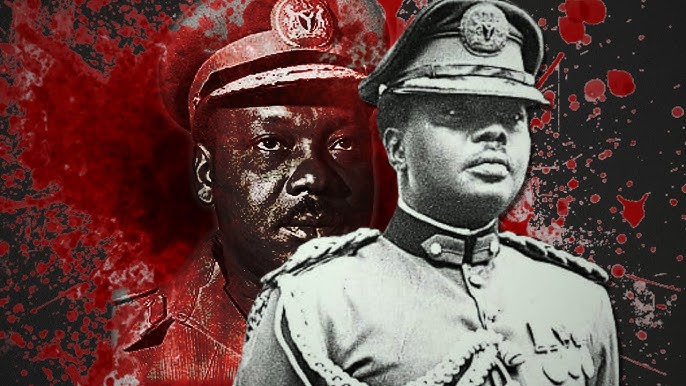
A coup is a sudden, illegal, forceful seizure of government by the military or powerful civilians. Nigeria endured military rule for 29 years, recording eight coup attempts: six successful and two failed.
Of those eight, five were notably bloody. Each left a heavy death toll and permanently altered Nigeria’s political trajectory.
January 15, 1966 Coup
Young officers launched coordinated attacks in Kaduna, Lagos, and Ibadan to topple the First Republic. They eliminated key political and military leaders, then installed Maj. Gen. J.T.U. Aguiyi-Ironsi as Head of the National Military Government.
The plotters, including UK-trained officers Maj. Kaduna Nzeogwu and Maj. Emmanuel Ifeajuna, justified the coup as a bid to rescue Nigeria from corruption, flamboyance, and looming anarchy.
Key coup leaders*: Maj. Emmanuel Ifeajuna, Maj. Chukwuemeka Kaduna Nzeogwu, Maj. Chris Anuforo, Maj. Tim Onwuatuegwu, Maj. Adewale Ademoyega, Maj. Don Okafor.
Political figures killed: Prime Minister Abubakar Tafawa Balewa, Premier Ahmadu Bello (Sardauna of Sokoto), Premier Samuel Ladoke Akintola, Finance Minister Festus Okotie-Eboh, Latifat Ademulegun, Ahmed Ben Musa, Zarumi Sardauna, Ahmed Pategi.
Security officers killed: Brig. Samuel Ademulegun, Brig. Zakariya Maimalari, Col. Ralph Shodeinde, Col. Kur Mohammed, Lt. Col. Abogo Largema, Lt. Col. James Pam, Lt. Col. Arthur Unegbe, Sgt. Daramola Oyegoke, PC Yohana Garkawa, Lance-Cpl. Musa Nimzo, PC Akpan Anduka, PC Hagai Lai, Philip Lewande.
July 29, 1966 Coup
Northern officers struck back for the January coup. Led by Lt. Col. Murtala Mohammed, Maj. T.Y. Danjuma, and Maj. Martin Adamu, they surrounded Government House, Ibadan, where Head of State Gen. Johnson Aguiyi-Ironsi was visiting Lt. Col. Adekunle Fajuyi, Military Governor of the Western Region.
Danjuma’s group arrested both men. Although Fajuyi was told he could step aside, he refused to abandon his guest. Both were driven to a bush along Iwo Road/Lalupon, beaten, and executed. Their bullet-ridden bodies were buried in shallow graves, later exhumed by Special Branch and reburied at the military cemetery in Ibadan.
The purge was ethnically targeted. According to Professor Ruth First in _The Barrel of a Gun_, nearly every Igbo soldier outside the East was killed, imprisoned, or forced to flee. The bloodbath claimed 42 officers and over 130 other ranks, overwhelmingly Igbo.
This coup directly triggered the secession of Biafra under Col. Ojukwu and the Nigerian Civil War.
February 13, 1976 Coup
Lt. Col. Buka Suka Dimka and co-conspirators ambushed Gen. Murtala Muhammed’s convoy in Lagos traffic near the Federal Secretariat, Ikoyi, around 8 a.m. They opened fire on his black Mercedes-Benz, killing Murtala, his ADC Lt. Akintunde Akinsehinwa, his driver, and his orderly instantly.
Dimka then seized Radio Nigeria, announced the overthrow, cited corruption, and declared himself Head of State.
However, the coup quickly collapsed for lack of broad military support. Lt. Gen. Olusegun Obasanjo, Murtala’s deputy, evaded assassination and rallied loyal forces. The Army and Navy refused to back Dimka.
Death toll: Gen. Murtala Muhammed, Lt. Akintunde Akinsehinwa, Col. Ibrahim Taiwo (Military Governor of Kwara), plus 12 others were killed by coupists.
Dimka fled but was captured on March 6, 1976. He and 38 others, including Gen. I.D. Bisalla, were tried and executed by firing squad at Kirikiri Prison on May 15, 1976. Obasanjo assumed power as Head of State.
April 22, 1990 Coup Attempt
Major Gideon Gwaza Orkar led middle-ranking officers in a dawn attack against Military President Gen. Ibrahim Badamasi Babangida.
The plotters seized key targets across Lagos: the Federal Radio Corporation of Nigeria, where Orkar broadcast at 7 a.m., Dodan Barracks in Ikoyi — the military HQ and presidential residence — and several military posts.
Babangida narrowly escaped the assault on Dodan Barracks via a back route. His ADC, Lt-Col U.K. Bello, was killed attempting to deploy a sabotaged tank against the rebels.
Chief of Army Staff Gen. Sani Abacha mobilized loyal troops and crushed the rebellion by day’s end. The coup failed because plotters never secured Babangida, Abacha, or support beyond Lagos.
Casualties: Dozens killed in shootouts, including during the Dodan Barracks attack.
Aftermath: Orkar and 41 co-conspirators were convicted of treason and executed by firing squad on July 27, 1990. Following complaints of ethnic bias, 27 of 31 acquitted soldiers were retried and executed on Sept 13, 1990. In total, 300 military personnel and 30+ civilians were arrested.
Key figures: Lt. Col. Anthony Nyiam, Orkar, Maj. Saliba Mukoro, Maj. Cyril Obahor, and Great Ovedje Ogboru played central roles.
March 1986 Coup Attempt
In March 1986, the regime of Military President Gen. Ibrahim Babangida uncovered a plot to overthrow the government. The conspiracy was allegedly led by Maj. Gen. Mamman Jiya Vatsa, then Minister of the Federal Capital Territory and a childhood friend of Babangida.
Though the coup never reached the execution stage, the government framed it as a serious threat. Vatsa and several senior officers were arrested for plotting to bomb Eko Bridge and Dodan Barracks, and to hijack the Independence Day celebrations.
Aftermath: After a military tribunal, Maj. Gen. Vatsa and 9 other officers were convicted of treason. All 10 were executed by firing squad on March 5, 1986. Human rights groups and several prominent Nigerians questioned the evidence, arguing the trial was politically motivated.
Key figures: Maj. Gen. Mamman Vatsa, Lt. Col. Musa Bitiyong, Maj. Christian A. Obu, Maj. Daniel Bamidele, and 6 others.