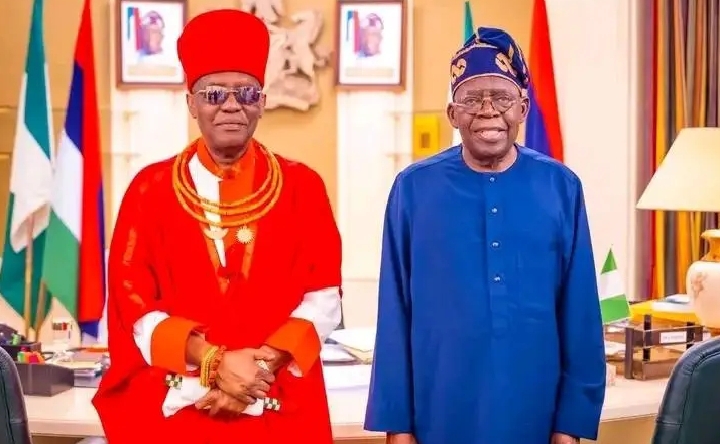
There are moments in politics that do not announce themselves with noise, yet they settle quietly into the national consciousness with questions that refuse to fade. The meeting held on April 30, 2026 at the Presidential Villa Abuja between President Bola Ahmed Tinubu and the Oba of Benin Oba Ewuare II belongs to that category of encounters that appear simple on the surface but carry deeper currents underneath. It was presented as a courtesy visit, yet the setting, the personalities involved, the timing, and the silence that followed have all contributed to a growing sense of curiosity across political and traditional spaces in Nigeria.
What happens when one of the most influential traditional rulers in the country sits behind closed doors with the President at a time when regional politics in Edo State is shifting, when development conversations are intensifying, and when cultural institutions are increasingly finding themselves at the center of national governance discussions.
The answers are not immediately visible, but the questions are beginning to take shape in public discourse, political analysis, and community conversations across the South South region.
This story is not about speculation. It is about reading the weight of timing, the symbolism of presence, and the implications of relationships between traditional authority and modern governance. The questions emerging from this meeting are not isolated. They are connected to governance, identity, development, and the evolving structure of influence in Nigeria.
Meeting Sequence At Presidential Villa Abuja
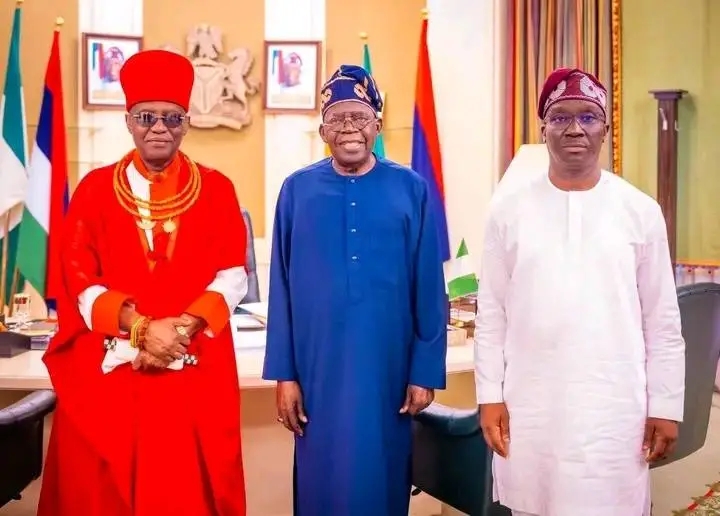
The engagement took place on April 30 2026 at the Presidential Villa in Abuja, the seat of Nigeria’s executive power. President Bola Ahmed Tinubu received Oba Ewuare II in a closed door session that lasted several hours according to official accounts. The Oba arrived with a delegation of Benin palace chiefs, reinforcing the traditional weight of the visit. Governor Monday Okpebholo of Edo State was also present, representing the state government in what was clearly a multi layered dialogue.
The atmosphere was described as calm and respectful, yet the significance lay not in the tone but in the composition of participants. The convergence of federal authority, state leadership, and one of Nigeria’s most historically influential monarchies created a setting that naturally drew attention. The Benin Kingdom carries centuries of cultural authority, and its voice remains deeply respected across Nigeria and beyond.
Although the meeting was officially framed as a courtesy visit, the duration and structure suggest that it extended into substantive discussions. Several hours inside the Presidential Villa is not a brief greeting. It is a window of time that allows for exchange of perspectives on matters of governance, development, and national stability.
What was particularly notable was the absence of immediate public disclosure. No detailed statement was issued immediately after the meeting, leaving room for interpretation and reflection. In political environments, silence often becomes part of the message, shaping how events are understood in the days that follow.
Key Figures Present At Engagement
The presence of President Bola Ahmed Tinubu placed the meeting at the highest level of executive authority in Nigeria. As head of state, his engagements with traditional rulers often carry symbolic and strategic weight, reflecting the continuing relevance of cultural institutions within the governance framework.
Oba Ewuare II, as the Oba of Benin, represents one of the most historically significant thrones in Africa. The Benin Kingdom is known for its deep cultural heritage, artistic legacy, and longstanding influence in regional identity. His presence at the Presidential Villa is therefore not a routine occurrence but a moment of national attention.
Governor Monday Okpebholo of Edo State added a critical layer of state representation. His participation signals that the discussions were not limited to ceremonial interaction but may have included governance related matters affecting Edo State directly. The presence of palace chiefs from the Benin Kingdom further reinforced the collective nature of the delegation, suggesting that the visit carried institutional weight beyond individual representation.
Each figure present brought a different form of authority. Federal power, traditional legitimacy, and state governance converged in a single room, creating a rare intersection of influence. Such intersections often generate outcomes that are not immediately visible but gradually shape policy direction and political relationships.
Discussions On Governance Development Stability
Although official details remain limited, reports indicate that discussions touched on cooperation between federal government structures, Edo State leadership, and the Benin traditional institution. This tripartite relationship is central to understanding the broader context of the meeting.
Development in Edo State has remained a recurring theme in national conversations, particularly around infrastructure, economic expansion, and social services. The meeting provided a platform where these issues could be raised directly at the highest level of federal authority.
Security considerations also formed part of the discussion focus according to available summaries. The South South region has continued to face evolving security dynamics, and traditional rulers often play advisory roles in community stability due to their influence at grassroots level. The inclusion of such topics reflects the interconnected nature of governance and local authority.
Cultural heritage preservation was another key area of interest. The Benin Kingdom holds internationally recognized cultural assets, and conversations around protecting and promoting these assets often require federal collaboration. The meeting likely provided an opportunity to reinforce commitments in this direction.
The development of infrastructure within Edo State was also part of the broader thematic engagement. Roads, economic projects, and social infrastructure remain central to regional progress, and discussions at this level often explore alignment between state priorities and federal support.
Political Interpretation Behind Engagement
Beyond the official framing, political observers have begun to interpret the meeting through multiple lenses. One interpretation centers on strategic alignment between the federal government and influential traditional institutions in the South South region. The Benin Kingdom holds significant moral and cultural influence, and engagement at this level often carries political meaning.
Another interpretation focuses on recognition of traditional authority within modern governance systems. Nigeria continues to balance constitutional democracy with deeply rooted traditional structures, and meetings such as this highlight the continuing relevance of monarchies in national dialogue.
Edo State itself occupies a strategic position in national politics. Its electoral significance and cultural importance make it a key region for political engagement. The presence of the governor during the meeting reinforces the idea that state level coordination remains central to broader federal planning.
There is also the dimension of continuity. Traditional institutions often serve as stabilizing forces during periods of political transition, and engagement with them can signal a desire for sustained cooperation and stability across regions.
Cultural Authority Within National Framework
The Oba of Benin occupies a unique position in Nigeria’s cultural hierarchy. The Benin throne is not only symbolic but historically influential, with roots that extend far into pre colonial governance systems. This cultural authority continues to command respect in contemporary Nigeria.
Engagement with such institutions often reflects an acknowledgment of the role they play in shaping public sentiment, community cohesion, and cultural identity. The meeting at the Presidential Villa therefore represents more than a political encounter. It reflects an ongoing negotiation between modern governance and traditional legitimacy.
Cultural preservation was reportedly part of the discussion themes, particularly in relation to heritage protection and promotion. The Benin Kingdom’s historical artifacts and cultural expressions remain globally recognized, making their preservation a matter of both national pride and international responsibility.
Edo State Political Context: Rising Attention
Edo State remains a focal point in national political calculations. The presence of Governor Monday Okpebholo at the meeting underscores the importance of aligning state priorities with federal engagement and traditional leadership.
Development concerns within the state continue to drive political conversations, particularly around infrastructure expansion and economic growth. These issues often require coordinated effort between multiple layers of authority, which was symbolically represented in the meeting composition.
The timing of the meeting also contributes to its political interpretation. Occurring on April 30 2026, it comes at a period when governance structures across states are increasingly seeking stronger federal partnerships to address local challenges.
The involvement of the Benin traditional council further emphasizes the importance of cultural institutions in mediating development conversations at the state level. Their participation signals that development is not viewed solely through administrative lenses but also through cultural and community frameworks.
Security Stability Regional Concerns
Security remains a recurring concern across many regions in Nigeria, including the South South. The inclusion of security discussions in the reported themes of the meeting reflects the ongoing need for collaborative approaches between federal authorities and local institutions.
Traditional rulers often play key roles in community intelligence, conflict resolution, and grassroots stability. Their influence makes them essential partners in addressing localized security challenges. The Benin Kingdom’s participation in such discussions reflects this continuing relevance.
While details of specific security measures were not disclosed, the acknowledgment of security as a discussion point highlights its importance within broader governance conversations.
Emerging Questions From Engagement
Several questions have begun to emerge following the meeting. What specific development commitments were discussed at the federal level? How will traditional authority be integrated into ongoing governance strategies? What role will Edo State play in shaping the outcomes of these discussions?.
There is also curiosity about whether this meeting signals deeper political alignment ahead of future regional developments. The convergence of key figures suggests that conversations may extend beyond immediate ceremonial purposes.
Another question revolves around cultural preservation commitments. How will federal collaboration support the protection and global promotion of Benin heritage? What frameworks will be established to ensure continuity in cultural engagement?.
These questions remain open, shaped by the absence of detailed public disclosure and the symbolic weight of the meeting itself.
Conclusion: Reflective Outlook
The meeting between President Bola Ahmed Tinubu and Oba Ewuare II on April 30 2026 remains one of those engagements that quietly shape national conversation without immediate declaration of outcomes. It brought together federal authority, state leadership, and traditional legitimacy in a single setting that naturally invites interpretation.
What emerges most strongly is not a single conclusion but a series of questions that reflect Nigeria’s evolving governance structure. The relationship between modern political authority and traditional institutions continues to define how leadership is understood, exercised, and sustained.
As the silence around specific details continues, attention shifts toward what follows. Future engagements, policy directions, and regional developments may gradually reveal the significance of this meeting. Until then, it stands as a moment of convergence, where history, governance, and cultural authority met behind closed doors in Abuja, leaving behind questions that continue to shape public curiosity.